
To understand quadrilaterals like squares, rectangles, rhombi, and more, focus on key properties such as side lengths, angles, and symmetry. Squares have equal sides and four right angles, while rectangles have right angles but unequal adjacent sides. Rhombi have equal sides with non-right angles, and parallelograms feature opposite sides parallel and equal. Recognizing these features helps you identify shapes quickly—exploring further reveals even more about their unique characteristics.
Key Takeaways
- Differentiating quadrilaterals involves examining side lengths, angles, and symmetry features such as right angles and parallel sides.
- Squares have four equal sides and right angles; rectangles have right angles with unequal adjacent sides.
- Rhombi feature four equal sides but non-right angles, often with diagonal symmetry.
- Parallelograms have opposite sides parallel and equal, with angles that may be acute or obtuse.
- Recognizing shape properties like symmetry, side lengths, and angle measures helps classify various quadrilaterals accurately.
Exploring the Characteristics of Quadrilaterals
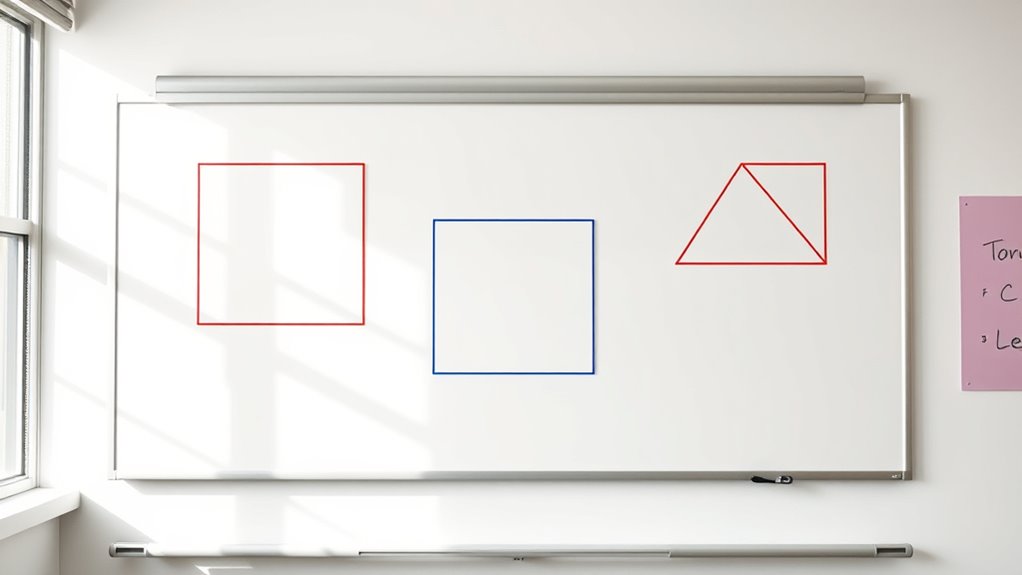
A quadrilateral is a four-sided polygon with straight sides. When exploring quadrilaterals, you notice that properties of parallelograms include opposite sides being parallel and equal in length. Additionally, their opposite angles are equal, and consecutive angles are supplementary. These properties help you identify and distinguish parallelograms from other quadrilaterals. Meanwhile, angles in trapezoids reveal that only one pair of sides is parallel, and the angles adjacent to these sides can vary. The non-parallel sides often form different angles, making trapezoids unique. Recognizing these characteristics allows you to classify quadrilaterals quickly and understand their geometric behavior. By understanding properties like these, you gain a clearer picture of how various four-sided shapes are defined and differentiated. Understanding geometric properties is essential in visualizing and analyzing the different types of quadrilaterals.
How to Differentiate Between Common Four-Sided Shapes

How can you quickly tell different four-sided shapes apart? Focus on their angle properties and symmetry features. For example, squares have four right angles and rotational symmetry. Rectangles also have four right angles but lack the same symmetry as squares. Rhombi feature four equal sides with two lines of symmetry, yet their angles aren’t right angles. Parallelograms have opposite sides equal and parallel, with angles that are not necessarily right angles. Use this table for quick comparison:
| Shape | Key Features |
|---|---|
| Square | 4 right angles, lines of symmetry, equal sides |
| Rectangle | 4 right angles, symmetry, unequal adjacent sides |
| Rhombus | Equal sides, diagonal symmetry, angles ≠ 90° |
| Parallelogram | Opposite sides equal/parallel, no right angles |
This helps you differentiate shapes by their angle properties and symmetry features easily. Additionally, understanding the properties of quadrilaterals can further improve your ability to distinguish these shapes.
Real-Life Examples of Various Quadrilaterals

Have you ever noticed quadrilaterals in everyday objects around you? They’re everywhere! Here are some real-life examples:
- Architectural design features rectangles in windows and doors, providing stability and aesthetic appeal.
- Sports equipment like rectangular gym mats or the sides of basketball courts showcase various quadrilaterals.
- Picture frames often take the form of squares or rectangles, emphasizing symmetry and simplicity.
- Floor tiles are usually square or rectangular, making installation easier and creating uniform patterns.
Recognizing these shapes helps you appreciate their role in design and function. From the structure of buildings to sports gear, quadrilaterals shape your environment in practical and visually pleasing ways.
Tips for Recognizing and Classifying Quadrilaterals
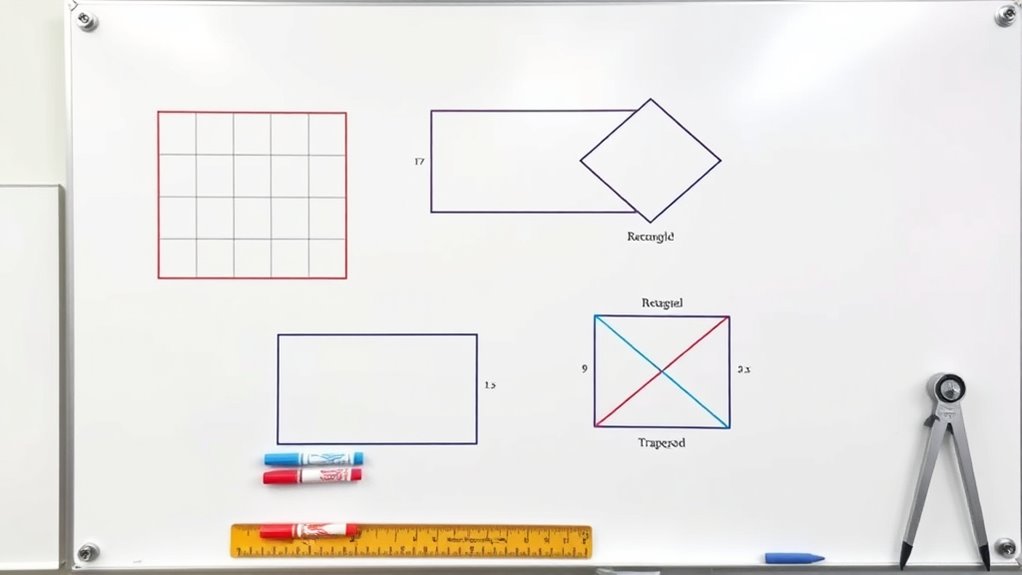
Wondering how to quickly identify and classify quadrilaterals? Focus on their angle properties and side length comparisons. For example, rectangles have four right angles, so check the angles first. Squares also have four right angles, but all sides are equal, so compare side lengths. Rhombi have four equal sides but usually don’t have right angles, so examine the angles closely. Parallelograms feature opposite sides that are equal and parallel, with opposite angles equal too. Trapezoids have only one pair of parallel sides. By observing these features, you can classify quadrilaterals efficiently. Always measure or compare side lengths and angles, and look for specific properties like symmetry or parallel sides to determine the type quickly. This approach simplifies recognizing and categorizing quadrilaterals accurately. Additionally, understanding geometric properties can help distinguish complex shapes more easily.
Frequently Asked Questions
How Do Symmetry Properties Vary Among Different Quadrilaterals?
You notice that symmetry varies among quadrilaterals. Some, like squares, have both rotational and reflective symmetry, meaning they look the same after rotation or reflection across axes. Rectangles have reflective symmetry but less rotational symmetry, while rhombi often have both types. Other quadrilaterals might lack symmetry altogether. Recognizing these differences helps you understand their unique geometric properties and how they relate to symmetry concepts like rotational and reflective symmetry.
Can a Quadrilateral Change Shape While Maintaining Its Classification?
Think of a quadrilateral like a flexible puzzle piece—you can bend it, but its classification might stay the same or change. Shape transformation happens when you alter angles or sides, impacting classification stability. For example, a rhombus can become a square with shape adjustments, but some quadrilaterals, like rectangles, only change shape within their category. So, yes, a quadrilateral can change shape while sometimes maintaining its classification, depending on the transformations involved.
What Are the Practical Applications of Each Quadrilateral Type?
You might wonder about the practical uses of each quadrilateral type. In architectural design, squares provide stability, while rectangles are common in windows and doors. Rhombi are useful in decorative elements, and trapezoids help in complex structures. In manufacturing, these shapes guarantee strength and efficiency. Recognizing their functions helps you see how different quadrilaterals contribute to both aesthetic appeal and structural integrity in real-world applications.
How Does Angle Measurement Affect the Classification of Quadrilaterals?
When you measure the interior angles of a quadrilateral, the angle sum helps you classify it. For example, if all angles are right angles, you’re dealing with a rectangle or square. Changes in the size of interior angles affect whether a shape fits into a specific category. Understanding how angles influence classification helps you identify quadrilaterals accurately, based on their interior angles and how they sum to 360 degrees.
Are There Any Special Cases or Exceptions in Quadrilateral Properties?
You might wonder if there are special case exceptions in quadrilateral properties. Yes, irregular quadrilaterals are a key example, as they don’t follow the typical rules for angles and sides seen in regular shapes like squares or rectangles. These exceptions show that not all quadrilaterals fit neatly into standard categories, making it important to recognize that some may have unique or irregular properties.
Conclusion
Understanding quadrilaterals helps you see the world in a new way. Did you know that squares are the most common four-sided shape in architecture and design? Recognizing their unique features can boost your spatial awareness and problem-solving skills. By mastering these shapes, you’ll better appreciate everyday structures around you. Keep practicing, and soon you’ll effortlessly identify and classify quadrilaterals everywhere, turning everyday sights into fascinating geometric discoveries.