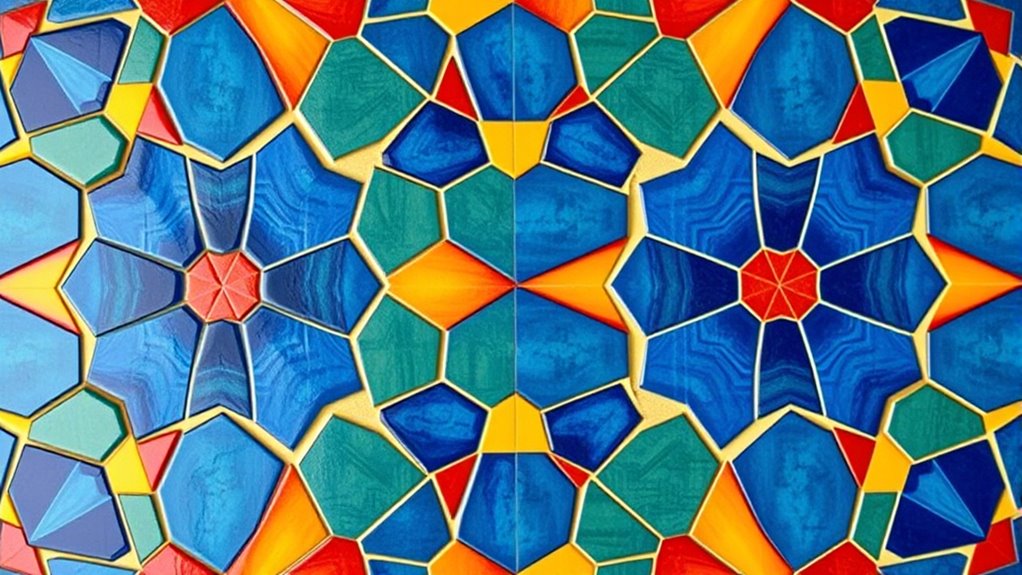

Tessellations are patterns where 2D shapes fit together perfectly, covering a surface without gaps or overlaps. You can use regular shapes like squares, triangles, or hexagons, which naturally tessellate, or create more complex designs with irregular shapes. The key is aligning edges precisely so the pattern repeats seamlessly. If you keep exploring, you’ll discover more about how shapes organize space and form mesmerizing patterns.

Prime made for students and young adults
- Fast, free delivery for dorm and study essentials
- Prime Video and Amazon Music included
- Member-only deals
Key Takeaways
- Tessellations involve fitting 2D shapes together without gaps or overlaps to cover a plane completely.
- Regular polygons like squares, triangles, and hexagons naturally tessellate due to their matching edges.
- Irregular shapes can also create tessellations by aligning edges precisely for seamless patterns.
- Tessellations are used in art and nature to demonstrate efficient space organization and visual harmony.
- Understanding shape properties and symmetry is essential for designing effective tessellations that tile the plane.

Have you ever wondered how you can cover a surface completely without any gaps or overlaps? The answer lies in tessellations—an intriguing way to fill a plane with repeated shapes that fit perfectly together. This concept isn’t just a mathematical curiosity; it appears all around you, from the intricate patterns in nature to stunning tessellation in art. By understanding how shapes work together, you can see how this technique creates seamless, eye-catching designs that seem to go on forever.
Patterns in nature often showcase tessellations without us even realizing it. Think of honeycombs crafted by bees, where hexagonal cells fit together without any wasted space. These natural tessellations are optimized for strength and efficiency, demonstrating how shapes can organically tessellate to serve a purpose. Similarly, the scales on a snake or the arrangement of pinecones display repeating patterns that tessellate beautifully, revealing nature’s innate ability to organize space smoothly. These examples highlight that tessellations aren’t just a human invention—they’re a fundamental part of the natural world, showing how simple shapes can create complex, efficient patterns.
In art, tessellation takes on a whole new life. Artists like M.C. Escher have popularized the technique, transforming simple shapes into mesmerizing designs that challenge perception. When you look at Escher’s work, you see how geometric forms tessellate to form interconnected scenes and illusions. Artists use tessellation in art to evoke harmony, rhythm, and visual interest, often playing with symmetry and repetition to captivate viewers. You might notice tessellated patterns in murals, textiles, or mosaics, where the repetition of shapes creates a sense of unity and balance. These artistic applications demonstrate how tessellation can turn plain shapes into elaborate, decorative compositions that are both aesthetically pleasing and intellectually engaging.
Artists like M.C. Escher turn simple shapes into captivating, interconnected tessellations that challenge perception and evoke harmony.
Understanding how shapes tessellate helps you appreciate the balance between simplicity and complexity in design. Whether in nature or art, the key is choosing the right shapes that can fit together seamlessly. Regular polygons like squares, triangles, and hexagons are common because they tessellate easily, but you can also create more complex patterns using irregular shapes. The process involves carefully aligning shapes so that their edges match perfectly, ensuring the pattern covers the surface without gaps or overlaps. This skill allows you to design your own tessellations, whether for artistic projects, interior decor, or just exploring mathematical beauty.
In essence, tessellations reveal how simple geometric principles can produce stunning, continuous patterns. They connect the natural world with human creativity, showing that the same fundamental idea—fitting shapes together—can be both practical and artistic. Once you understand these basics, you can start recognizing tessellations everywhere and even experiment with creating your own.
As an affiliate, we earn on qualifying purchases.
Frequently Asked Questions
Can Tessellations Be Created With 3D Shapes?
Yes, you can create tessellations with 3D shapes, known as polyhedral tilings. These involve fitting 3D shapes together without gaps or overlaps, much like 2D tessellations but in three dimensions. You might explore how polyhedral tilings work, such as stacking cubes or other polyhedra to fill space efficiently. This concept helps you understand complex patterns and structures found in nature and architecture.
What Is the History Behind the Discovery of Tessellations?
You might find it fascinating that tessellations’ historical origins trace back thousands of years, with early examples in ancient Egypt and Mesopotamia. These patterns held cultural significance, symbolizing unity and infinity in various civilizations. Throughout history, artists like M.C. Escher transformed tessellations into intricate art forms, showcasing their enduring importance. Today, understanding their origins enhances your appreciation for how these repeating patterns connect art, culture, and mathematics across time.
Are There Real-World Applications of Tessellations Outside Art?
Did you know that over 60% of modern architectural patterns incorporate tessellations? You can see their practical use in scientific modeling, such as in materials science and biology, where they help understand complex structures. Outside art, tessellations enhance the efficiency of space usage and structural stability. You might notice these patterns in tiling floors, designing lightweight structures, or creating innovative textiles, proving their relevance beyond just aesthetics.
How Do Mathematicians Classify Different Types of Tessellations?
Mathematicians classify tessellations using classification schemes based on their symmetry groups. You can analyze patterns by examining their translational, rotational, and reflective symmetries to determine their symmetry group type. This helps distinguish regular, semi-regular, and non-regular tessellations. By studying these classification schemes, you understand how shapes fit together seamlessly, revealing the underlying mathematical principles that govern their arrangement and symmetry in the plane.
Can Tessellations Be Used in Modern Digital Graphics?
Yes, tessellations are widely used in modern digital graphics. You can create digital tessellations to produce seamless patterns, textures, and backgrounds in graphic design projects. By applying digital tessellation techniques, you guarantee that your designs tile perfectly without gaps or overlaps. This approach enhances visual appeal and efficiency, making it a valuable tool for digital artists and designers aiming for intricate, repeating patterns in their work.
As an affiliate, we earn on qualifying purchases.
Conclusion
Now that you’ve mastered tessellations, imagine yourself as a mad artist, squishing and stretching shapes until they fit perfectly—like a puzzle gone rogue. With your newfound skills, you can turn any boring floor into a chaotic mosaic of triangles and squares, baffling visitors with your geometric genius. So go ahead, tessellate away! Just remember, if your tiles start plotting against you, it’s all part of the artistic chaos you’ve set free.
As an affiliate, we earn on qualifying purchases.
As an affiliate, we earn on qualifying purchases.
Fall Picks
fall essentials
As an affiliate, we earn on qualifying purchases.