

Understanding the circle involves exploring its key elements like chords, tangents, arcs, and sectors. Chords connect two points on the edge, while tangents touch at just one point and are perpendicular to the radius. Arcs are parts of the circumference, and sectors are pie-slice shapes formed by radii and an arc. Mastering these concepts helps you see how they relate and apply in real-world situations—discover more to deepen your knowledge.
Key Takeaways
- Chords connect two points on a circle’s edge and bisect at the center, revealing symmetry and internal relationships.
- Tangent lines touch the circle at one point and are perpendicular to the radius at that contact point.
- Arcs are parts of the circumference measured in degrees or radians, with their length depending on the central angle.
- Sectors are regions bounded by two radii and an arc, with area calculated using the sector formula based on the central angle.
- Understanding these elements aids in analyzing circle properties, solving geometry problems, and applying concepts in real-world contexts.
Understanding the Basic Elements of a Circle
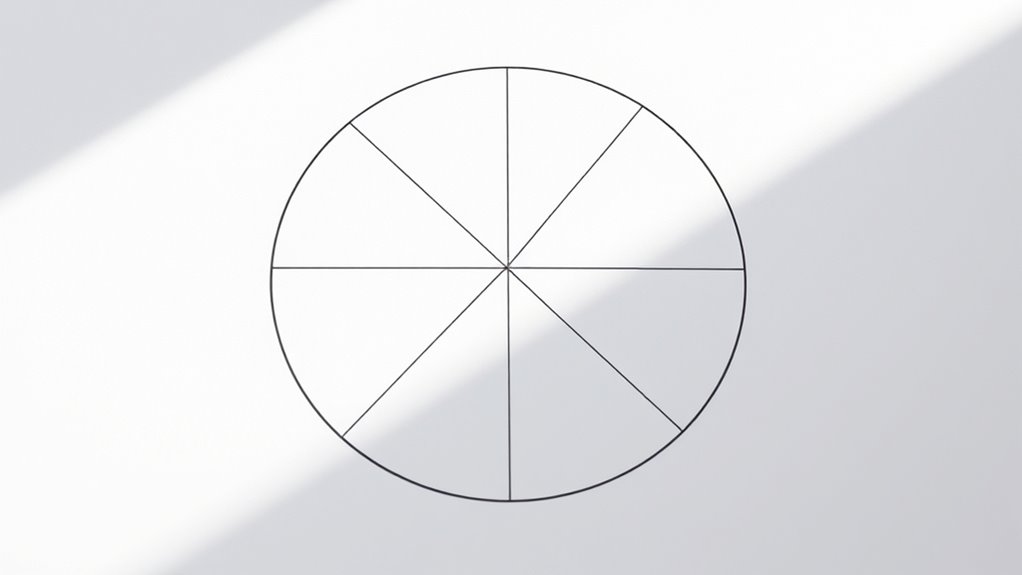
A circle is a perfectly round shape where all points on its edge are equidistant from a central point. This property gives the circle its unique circle symmetry, meaning it looks the same when rotated around its center. You can classify circles based on their features, such as concentric circles sharing the same center but different radii, or intersecting circles that cross at points. Understanding these basic elements helps you recognize how circles behave and relate to other geometric shapes. The core components include the radius, diameter, and the center, all fundamental in analyzing the circle’s properties. Additionally, the contrast ratio of a projector affects how well the circle’s dark and light areas are distinguished in images. By grasping these classifications and symmetries, you gain a clearer picture of how circles function in both simple and complex geometrical contexts.
Exploring Chords and Their Properties
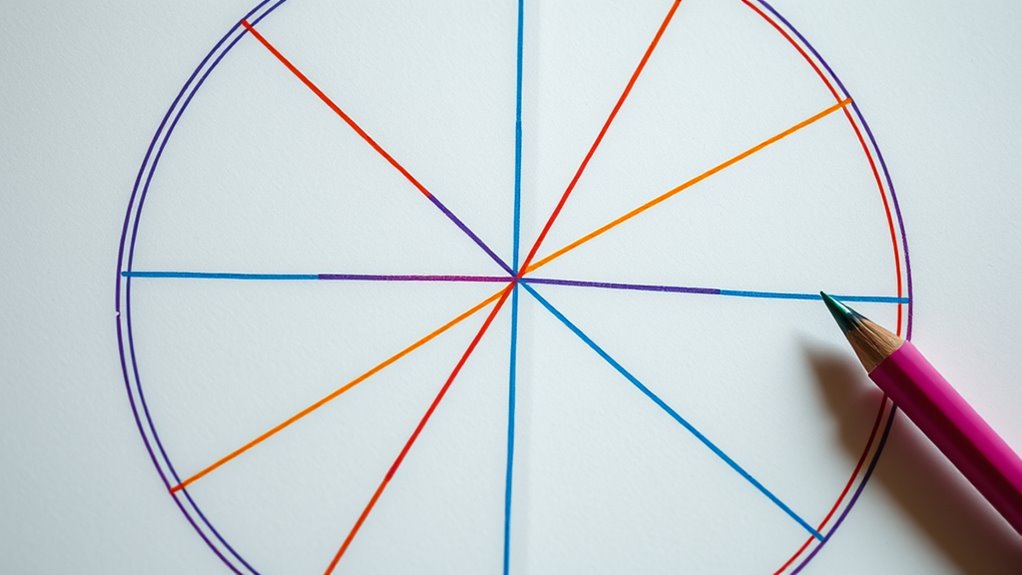
Chords are straight lines connecting two points on a circle’s edge, and they play a crucial role in understanding the circle’s internal structure. When a chord passes through the center, it becomes a diameter, highlighting circle symmetry. Chord bisectors are lines that divide a chord into two equal parts, and in a circle, they always pass through the circle’s center, emphasizing symmetry. You’ll notice that any chord’s bisector intersects at the circle’s center, revealing the deep connection between chords and the circle’s symmetry. This property helps in constructing equal segments and understanding relationships within the circle. Exploring chords and their bisectors enhances your grasp of the circle’s internal harmony, making it easier to analyze angles, arcs, and other geometric features.
The Significance of Tangents and Their Characteristics
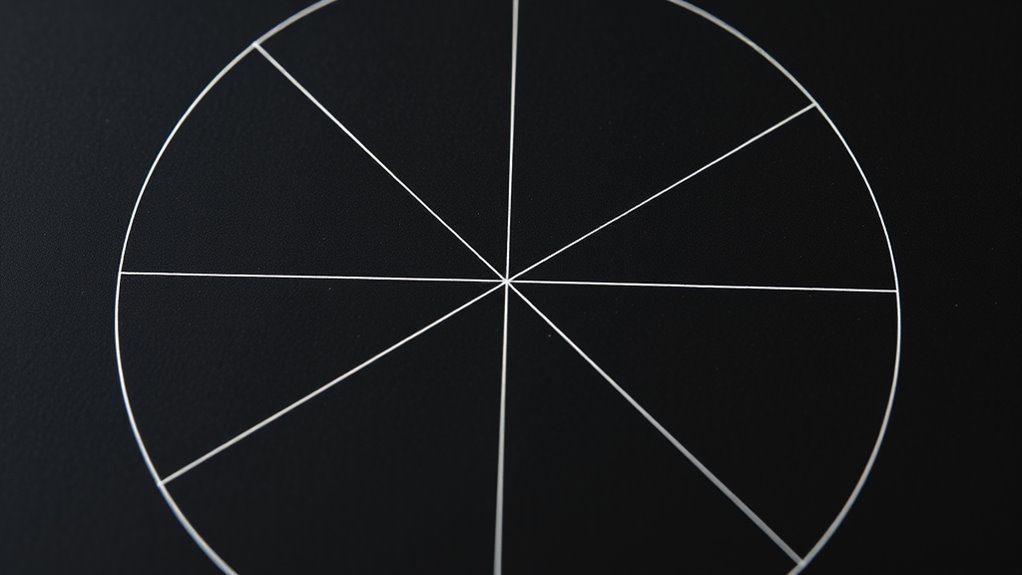
Tangents offer a unique perspective on a circle’s geometry by touching the circle at exactly one point. The properties of tangent lines are essential in understanding circle relationships. For instance, a tangent line is perpendicular to the radius at the point of contact, a key tangent property that helps identify right angles in diagrams. Tangent lines also never intersect the circle at more than one point, making them distinct from secants. This characteristic allows you to determine distances, angles, and relationships between circles and other lines. Recognizing these properties enables you to solve complex problems involving tangents, such as finding tangent lengths or angles formed by tangent lines and chords. Additionally, understanding digital literacy can assist in visualizing and exploring geometric concepts through interactive tools and software. Overall, tangent lines are fundamental in grasping the deeper geometric structure of circles.
What Are Arcs and How Are They Measured?
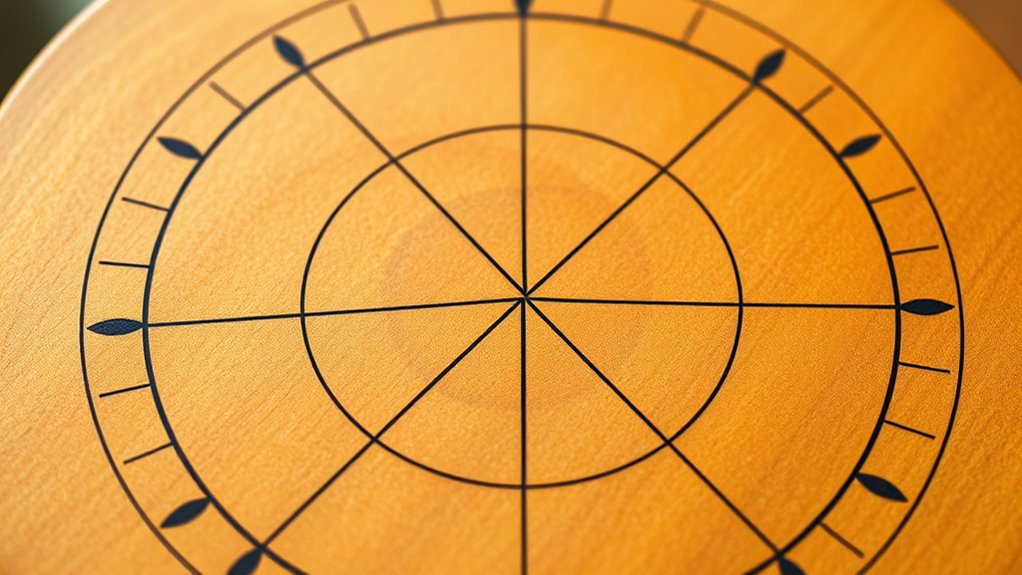
An arc is a part of a circle’s circumference, and understanding how to measure it helps you grasp the circle’s properties. You can measure arcs in degrees or radians, depending on the context. Knowing how to calculate arc length and convert between these units makes working with circles much easier. Additionally, understanding the importance of air quality can help you appreciate the significance of clear measurements in various applications.
Arc Length Measurement
Have you ever wondered how to measure the length of a curved line on a circle? To find the arc length, you can use angle formulas that relate the central angle to the entire circle. The arc length depends on the measure of the angle subtended at the center. If you know the circle’s radius and the central angle in degrees, the formula is straightforward: arc length equals the radius times the angle in radians. This means converting degrees to radians first. By applying this, you can accurately measure any arc’s length, whether it’s a small segment or a major arc. Knowing how to use these angle formulas helps you understand the relationship between angles and arc lengths clearly. Understanding radians is essential for precise calculations in circular geometry.
Degrees and Radians
Understanding how arcs are measured involves knowing about degrees and radians, two units used to specify angles. Degrees divide a circle into 360 parts, while radians relate to the circle’s radius. The radian definition states that one radian is the angle at which an arc’s length equals the radius. To convert between the two, you need to understand angle conversions. Here’s a quick comparison:
| Degrees | Radians |
|---|---|
| 180° | π radians |
| 90° | π/2 radians |
| 60° | π/3 radians |
| 45° | π/4 radians |
Mastering these conversions helps you measure arcs accurately, especially when working with different contexts requiring either degrees or radians. Understanding these units is essential in global intelligence and espionage where precise measurements are crucial.
The Concept of Circular Sectors and Their Applications

Ever wondered how circles are divided into smaller, meaningful parts? That’s where circular sectors come in. A sector is a region bounded by two radii and an arc, like a slice of pie. To find the sector area, you multiply the circle’s total area by the fraction of the circle the sector represents, often using the central angle. Sector applications are everywhere—from calculating the portion of a pizza you’re eating to determining the share of resources in circular plots. Architects use sectors to design curved structures, while engineers apply them in sectors of machinery. Understanding the concept of circular sectors helps you analyze and solve real-world problems involving partial areas of circles with ease. This knowledge links geometry to practical, everyday situations.
Relationships Between Chords, Arcs, and Angles

In a circle, the relationships between chords, arcs, and angles are fundamental to understanding its geometry. When two chords intersect inside a circle, the angles formed are related to the arcs they subtend. Specifically, an inscribed angle measures half the arc it intercepts, demonstrating the circle’s symmetry. Chord bisectors also play a key role; they pass through the circle’s center if the chord is a diameter, creating equal segments on either side. This symmetry indicates that the angles formed by intersecting chords can be directly linked to the arcs they cut off, revealing consistent relationships. Recognizing these connections helps you understand how chords, arcs, and angles work together to define the circle’s structure. Additionally, understanding the divorce statistics and the importance of legal representation can help individuals navigate complex situations with more confidence.
Calculating Lengths and Areas in Circular Segments

When working with chords, arcs, and angles, it’s natural to explore how to find specific lengths and areas within a circle. Circle symmetry helps simplify calculations, especially when dealing with segments. To find segment lengths, you can use the chord length formula: ( L = 2r sin(theta/2) ), where ( theta ) is the central angle. For segment areas, the formulas depend on the sector and triangle areas. Here’s a quick overview:
| Calculation Type | Formula/Method |
|---|---|
| Chord length | ( 2r sin(theta/2) ) |
| Segment area (major/minor) | ( frac{r^2}{2} (theta – sin theta) ) |
| Sector area | ( frac{theta}{360^circ} pi r^2 ) |
| Triangle in circle | ( frac{1}{2} r^2 sin theta ) |
| Segment area formulas | Use sector minus triangle formulas for precision |
These formulas enable precise calculations of lengths and areas within circular segments. Additionally, understanding how to apply these formulas can assist in various geometric problems involving circular segments and their properties.
Real-World Examples of Circular Components

Circular components are everywhere in everyday life, from the wheels that move vehicles to the gears in machinery. In urban planning, circular layouts optimize traffic flow and public spaces, making transportation more efficient. You’ll also see circles in architectural designs, such as roundabouts and domed structures. Furthermore, planetary orbits are perfect examples of natural circular components, illustrating how planets move predictably around the sun. These orbits follow precise circular or elliptical paths, showcasing the importance of understanding circles in astronomy and navigation. Recognizing these real-world applications helps you appreciate how circular shapes influence daily life and scientific understanding alike. Whether in engineering, city design, or the cosmos, circles serve as fundamental components that shape our environment. Understanding circles is essential for grasping many scientific and engineering principles that govern our world.
Tips for Visualizing and Drawing Circles Accurately

To accurately visualize and draw circles, start by selecting a reliable method, such as using a compass or tracing around a round object. This guarantees your circle maintains symmetry, which is essential for precise calculations and constructions. Practice recognizing circle symmetry and how circle transformations like translations or rotations affect your drawings. Use the table below to guide your approach:
| Step | Tip | Explanation |
|---|---|---|
| Choose tools | Use a compass or round object | Guarantees accuracy and consistency |
| Mark key points | Identify center and radius | Helps maintain symmetry during drawing |
| Practice transformations | Visualize rotations/translations | Reinforces understanding of circle transformations |
Frequently Asked Questions
How Do Circles Relate to Other Geometric Shapes?
You see, circles relate to other shapes through their unique properties like circle symmetry, which makes them perfectly balanced around their center. They also connect via circle tessellations, where multiple circles fit together without gaps, creating intricate patterns. These relationships help you understand how circles can complement polygons or fill spaces smoothly, showcasing their versatility in design and geometry. Recognizing these connections enhances your grasp of spatial relationships and symmetry in shapes.
What Are the Real-World Applications of Circle Mathematics?
Think of circle mathematics as a master key unfastening real-world solutions. You use circle sectors to determine areas in fields like architecture, while tangent properties guide the design of roads and bridges, ensuring smooth connections. Engineers and architects rely on these principles daily, applying circle concepts to optimize space, improve safety, and enhance aesthetics. So, your understanding of circle math directly impacts practical applications, shaping the world around you.
How Do Different Circle Theorems Interconnect?
You’ll see how different circle theorems interconnect through tangent properties and inscribed angles. For example, tangent properties show that a tangent meets a radius at a right angle, while inscribed angles relate to the arcs they subtend. These theorems often work together; understanding one helps you grasp others, like how angles subtended by the same arc are equal, creating a cohesive framework that reveals the circle’s elegant geometry.
Can Circles Be Inscribed Within Other Polygons?
Imagine fitting a tiny, perfect circle snugly inside a polygon, like a jewel nestled in a crown. Yes, circles can be inscribed within polygons, creating inscribed polygons with their circles perfectly touching each side. This is called circle packing, where the circle fits inside, touching all sides without crossing. These inscribed polygons are essential in geometry, helping us understand symmetry, angles, and the beauty of perfect fit.
How Do Coordinate Systems Help in Circle Geometry?
Coordinate systems help you analyze circle geometry more easily by allowing coordinate transformations that simplify complex problems. By using Cartesian coordinates, you can precisely locate points, centers, and radii, making calculations straightforward. This approach lets you visualize and solve geometric problems efficiently, especially when dealing with circle intersections or tangents. Fundamentally, coordinate systems give you a clear framework to understand and manipulate circles in a mathematical space.
Conclusion
Understanding circles open(s) many geometric secrets. Did you know that a diameter is the longest chord in a circle? Mastering chords, tangents, and arcs helps you solve real-world problems more confidently. With over 80% of natural and man-made structures involving circular shapes, your newfound knowledge can improve designs, calculations, and insights. Keep practicing your visualization skills, and you’ll find circles become easier—and even fascinating—to explore!