For most families, the National Geographic Dual LED Microscope Science Kit is the strongest all-around choice, combining a familiar compound-microscope design with lighting from above and below. The HEWEIMEI 1600X and TOMLOV DM302K stand out for children who prefer viewing specimens on a built-in screen, while the Uarzt 58-Piece Kit emphasizes accessories and portability. The main tradeoff is between hands-on slide viewing, digital convenience, and a larger bundle of tools; a high magnification number alone does not guarantee a clearer or easier view. Age, adult help, storage, and the types of samples a child wants to inspect can matter more than the biggest advertised number. Read on for the full breakdown and a guide to matching a microscope kit to your child.

Prime made for students and young adults
- Fast, free delivery for dorm and study essentials
- Prime Video and Amazon Music included
- Member-only deals
Key Takeaways
The National Geographic Dual LED kit leads for versatility: its two lighting directions give children more flexibility with transparent slides and solid objects than a single-light setup.
Digital models solve a different problem: the HEWEIMEI 1600X and TOMLOV DM302K put images on a screen, which can make group viewing easier, but they trade away some of the direct eyepiece experience of a compound microscope.
Accessory counts do not tell the whole story: the Uarzt 58-piece, 67-piece, and Novaluki 65-piece kits prioritize bundled materials, but families should weigh organization and actual use against the number of included items.
Magnification ranges vary widely: the National Geographic Junior model tops out at 250x, while several compound kits advertise ranges up to 1200x or 2000x; those maximum figures are not a standalone measure of image quality.
Portability and viewing style separate the field: handheld digital options such as the GEMUFO suit flexible viewing, while traditional compound models such as the AmScope M30-ABS-KT2-W are better suited to children ready to work at a fixed eyepiece and stage.
| Mileonaim Kids Microscope Kit with Prepared and Blank Slides |  | Best for Portable, Hands-On Exploring | Magnification: 100x, 400x, and 1200x | Set size: 61 pieces | Prepared slides: 12 | VIEW LATEST PRICE | See Our Full Breakdown |
| HEWEIMEI 1600X Kids Microscope with 4.0″ Digital Screen and Slides Kit |  | Best for Flexible Digital Viewing | Magnification range: 100x–1600x | Screen: 4.0-inch IPS | Camera: 48MP; 1080p video | VIEW LATEST PRICE | See Our Full Breakdown |
| TOMLOV DM302K Digital Microscope for Kids, 800x, with 4.3-Inch Screen |  | Best for Beginner-Friendly Screen Viewing | Model: DM302K | Magnification: 800x | Screen: 4.3 inches | VIEW LATEST PRICE | See Our Full Breakdown |
| HKMK 40X-2000X Compound Microscope with Experiment Kit and Phone Adapter for Adults, Kids, Students, Home Schooling and Lab |  | Best for Older Kids Ready for Compound Microscopy | Magnification range: 40x–2000x | Objective lenses: 4x, 10x, and 40x achromatic | Additional optics: 2x extender | VIEW LATEST PRICE | See Our Full Breakdown |
| Uarzt 58-Piece Kids Microscope Kit with Carrying Case |  | Best Value for a Classic Starter Kit | Piece count: 58 | Maximum magnification: 1200x | Prepared slides: 13 | VIEW LATEST PRICE | See Our Full Breakdown |
| National Geographic Dual LED Microscope Science Kit for Kids |  | Best for Exploring 3D Objects | Magnification: 20x and 50x | Lighting: Dual LED illumination | Prepared slides: 10 | VIEW LATEST PRICE | See Our Full Breakdown |
| AmScope M30-ABS-KT2-W Beginner Microscope STEM Kit, White |  | Best for High-Magnification Slide Work | Microscope type: Compound | Viewing head: Monocular | Magnification: 300x, 600x, and 1200x | VIEW LATEST PRICE | See Our Full Breakdown |
| Uarzt Kids Beginner Microscope Science Kit with 100x–1200x Magnification |  | Best for Making Lots of Slides | Magnification: 100x, 400x, and 1200x | Eyepiece diameter: 18 mm | Light source: Adjustable LED | VIEW LATEST PRICE | See Our Full Breakdown |
| 100X-1200X Kids Microscope Kit for Children – Compound Microscope |  | Best for Portable, Accessory-Rich Exploring | Magnification: 100x–1200x | Objective lens: 10x, 30x, and 60x | Light source: LED | VIEW LATEST PRICE | See Our Full Breakdown |
| National Geographic Junior Microscope Science Kit, 50x–250x Magnification |  | Best for Young Beginners | Magnification: 50x–250x | Lighting: LED above and below | Prepared slides: 6 | VIEW LATEST PRICE | See Our Full Breakdown |
| GEMUFO Kids Digital Handheld Microscope Kit, 200×–1000× Magnification, 2.4-Inch Screen, 12 Slides |  | Best for Portable Digital Exploring | Magnification: 200×–1000× | Screen: 2.4-inch IPS | Camera: 2MP | VIEW LATEST PRICE | See Our Full Breakdown |
| National Geographic Kids Microscope Kit, Up to 400x Magnification |  | Best for First-Time Microscope Users | Maximum magnification: 400x | Lighting: Upper and lower LED lights | Objective lens: Achromatic | VIEW LATEST PRICE | See Our Full Breakdown |
| Kids Microscope Science Kit – 67 Pieces, 100X-1200X Magnification, Slides & Tools, STEM Project Toy Gift for Boys and Girls Ages 3-12 |  | Best for Maximum Hands-On Supplies | Magnification: 100x–1200x | LED lighting: 7 colors | Total pieces: 67 | VIEW LATEST PRICE | See Our Full Breakdown |
| Novaluki 65-Piece Kids Microscope Kit, 100x–1200x Magnification |  | Best for Three-Step Magnification | Magnification: 100x, 600x, and 1200x | Lighting: Seven-color LED | Power: Battery powered; batteries not included | VIEW LATEST PRICE | See Our Full Breakdown |
| BEBANG PM1000 Kids Digital Microscope STEM Kit |  | Best Digital Kit with Storage Included | Magnification: 200×–1000× across 5 levels | Screen: 4K screen | Memory card: 32GB included | VIEW LATEST PRICE | See Our Full Breakdown |
| microscope kits for kid | Magnification | Lighting |
|---|---|---|
| Mileonaim Kids Microscope Kit | 100x, 400x, and 1200x | — |
| HEWEIMEI 1600X Kids Microscope | — | Six LED lights with three brightness levels |
| TOMLOV DM302K Digital Microsco | 800x | Dual LEDs |
| HKMK 40X-2000X Compound Micros | — | Battery-powered LED and built-in reflector |
| Uarzt 58-Piece Kids Microscope | — | — |
| National Geographic Dual LED M | 20x and 50x | Dual LED illumination |
| AmScope M30-ABS-KT2-W Beginner | 300x, 600x, and 1200x | LED and mirror illumination |
| Uarzt Kids Beginner Microscope | 100x, 400x, and 1200x | — |
| 100X-1200X Kids Microscope Kit | 100x–1200x | — |
| National Geographic Junior Mic | 50x–250x | LED above and below |
| GEMUFO Kids Digital Handheld M | 200×–1000× | — |
| National Geographic Kids Micro | — | Upper and lower LED lights |
| Kids Microscope Science Kit | 100x–1200x | — |
| Novaluki 65-Piece Kids Microsc | 100x, 600x, and 1200x | Seven-color LED |
| BEBANG PM1000 Kids Digital Mic | 200×–1000× across 5 levels | — |
More Details on Our Top Picks
Mileonaim Kids Microscope Kit with Prepared and Blank Slides
The Mileonaim is a strong fit for families who want a ready-to-carry activity kit rather than a screen-led microscope. Its 61 pieces include 12 prepared slides, 32 blank slides, and specimen tools, giving kids ways to start observing and then make their own samples. Compared with the Uarzt 58-Piece Kids Microscope Kit, Mileonaim includes one more prepared slide and one more piece overall, though both emphasize portable storage and hands-on activities. The three magnification settings offer flexibility for different specimens, but the listed maximum of 1200x does not by itself tell buyers how clear or easy-to-focus the view will be. I’d choose it for children who enjoy handling physical slides; families who want a large live display or recorded images should look at the HEWEIMEI or TOMLOV digital models instead.
Pros:- Includes 12 prepared slides and 32 blank plastic slides for both guided and self-directed activities.
- Three magnification settings cover a range of basic specimen-viewing tasks.
- Carrying case keeps the microscope and accessories together for storage or travel.
- Phone holder and specimen tools support varied ways to observe and document samples.
Cons:- Product details do not explain image clarity or how easy the microscope is to focus.
- Does not include a built-in digital screen for group viewing.
- The accessory count may feel less useful to buyers seeking a simpler starter setup.
Best for: Families with children ages 6–12 who want a portable kit with plenty of blank slides and tools for making their own specimens.
Not ideal for: Buyers who prioritize a built-in screen, photo and video capture, or detailed information about focusing and image clarity.
- Magnification:100x, 400x, and 1200x
- Set size:61 pieces
- Prepared slides:12
- Blank slides:32 plastic slides
- Included accessories:Tweezers, dropper, scalpel, mixing plate, LED light, phone holder, and carrying case
- Recommended age:6–12
- Material:ABS carrying case
- Warranty:2 years
Our verdict“Choose the Mileonaim for a portable, slide-focused kit with ample blank slides, not for screen-based viewing or documented image performance.”
HEWEIMEI 1600X Kids Microscope with 4.0″ Digital Screen and Slides Kit
The HEWEIMEI makes the most sense for families who want children to view specimens on a screen and save photos or videos, rather than rely on an eyepiece alone. Its 4-inch IPS display and built-in camera give siblings or adults a shared view, while the detachable design can be used on a desk or carried for closer looks. Compared with the TOMLOV DM302K, HEWEIMEI lists a wider magnification range and a three-mode adjustable light, while TOMLOV offers a slightly larger 4.3-inch screen and wireless phone viewing. HEWEIMEI’s 48MP and 1080p claims may appeal to families interested in recording observations, but the built-in, non-removable battery can limit uninterrupted sessions if it runs down. Its age range also stretches younger than the handling may suit, so I’d favor it for school-age children with adult help.
Pros:- 4-inch IPS screen lets children view specimens without depending on an eyepiece.
- Built-in camera supports photo and video recording of observations.
- Detachable desktop, handheld, and portable configurations suit different activities.
- Six LED lights with three brightness levels provide adjustable illumination.
Cons:- Built-in non-removable battery cannot be swapped out when depleted.
- The detachable design may be challenging for the youngest children in its stated age range.
- Compared with the TOMLOV DM302K, its screen is smaller and phone viewing is not listed as wireless.
Best for: Families with school-age children who want a shareable screen, photo and video capture, and a microscope that can be used in more than one configuration.
Not ideal for: Very young children who may struggle with the detachable setup, or buyers who need a replaceable battery for extended sessions.
- Magnification range:100x–1600x
- Screen:4.0-inch IPS
- Camera:48MP; 1080p video
- Configurations:Desktop, handheld, or portable
- Lighting:Six LED lights with three brightness levels
- Angle of view:45 degrees
- Battery:Built-in non-removable Li-Polymer pouch cell
- Stated age range:3–14
Our verdict“Pick the HEWEIMEI for flexible, screen-based viewing and recording, provided its built-in battery and setup suit your child.”
TOMLOV DM302K Digital Microscope for Kids, 800x, with 4.3-Inch Screen
The TOMLOV DM302K is a straightforward pick for children who would rather see specimens on a display than learn through a traditional eyepiece. Its 4.3-inch screen and easy-focus design make viewing and sharing observations more approachable, and the included 12 prepared slides provide a starting point before kids collect their own samples. Compared with the HEWEIMEI, TOMLOV lists a larger screen and wireless phone viewing, while HEWEIMEI offers a higher stated maximum magnification, adjustable LED brightness, and a detachable handheld setup. The TOMLOV’s 800x specification is a less expansive headline range, but its USB computer connection and photo and video recording give families useful ways to revisit observations. Wireless phone viewing requires an app, so this is less appealing if you want a screen-only setup with no phone involved.
Pros:- Large 4.3-inch display makes live viewing easier to share.
- Easy-focus feature suits children learning to position and inspect specimens.
- Photo and video recording lets kids revisit their observations.
- Includes 12 prepared slides plus WiFi phone viewing and USB computer connection.
Cons:- Wireless phone viewing requires a smartphone app.
- Its stated 800x magnification is lower than the HEWEIMEI’s listed 1600x maximum.
- The included slides are prepared samples, with no blank-slide count specified.
Best for: Children ages 6–12 who are new to microscopy and benefit from a large screen, simple focusing, and prepared slides to get started.
Not ideal for: Buyers seeking the widest stated magnification range or wireless viewing without installing a smartphone app.
- Model:DM302K
- Magnification:800x
- Screen:4.3 inches
- Connectivity:WiFi phone viewing and USB computer connection
- Recording:Photo and video
- Lighting:Dual LEDs
- Included slides:12 prepared slides
- Recommended age:6–12 years
- Warranty:1 year
Our verdict“Choose the TOMLOV for an accessible, large-screen introduction to digital microscopy, especially if the app and computer connections are useful to your family.”
HKMK 40X-2000X Compound Microscope with Experiment Kit and Phone Adapter for Adults, Kids, Students, Home Schooling and Lab
The HKMK is the most traditional, optics-focused choice here, aimed at families who want a child to learn with interchangeable objective lenses instead of a built-in digital screen. Its 4x, 10x, and 40x achromatic objectives, paired with a 2x extender, support a broader stated range than the Mileonaim or Uarzt kits. The LED and reflector lighting options also give users a choice of illumination, and the extensive accessories make it possible to prepare samples right away. That breadth comes with more setup and handling than the screen-based TOMLOV DM302K, which is likely easier for a beginner to share and use. HKMK includes only five specimen slides, fewer than the prepared-slide counts listed for Mileonaim and Uarzt, and its battery-powered LED means keeping replacement batteries available.
Pros:- Interchangeable achromatic objectives and a 2x extender provide a wide stated magnification range.
- LED and reflector lighting offer two ways to illuminate specimens.
- Includes slide-preparation and handling tools such as cover slips, a dropper, tweezers, and a scalpel.
- Phone mount can support recording or sharing observations with a compatible phone.
Cons:- Traditional optical setup is more involved than using the TOMLOV DM302K’s digital screen.
- Includes five specimen slides, fewer than the prepared-slide counts listed for Mileonaim and Uarzt.
- Battery-powered LED may require replacement batteries, and some plastic parts may be less suited to heavy use.
Best for: Older children, students, and homeschooling families who want a conventional compound microscope and are ready to learn slide preparation and optical setup.
Not ideal for: Young beginners who need simple screen viewing, or families who want a larger selection of prepared slides and a low-setup experience.
- Magnification range:40x–2000x
- Objective lenses:4x, 10x, and 40x achromatic
- Additional optics:2x extender
- Lighting:Battery-powered LED and built-in reflector
- Included specimen slides:5
- Slide accessories:100 cover slips
- Phone accessory:Phone mount
- Materials:Glass and metal
Our verdict“Choose the HKMK for a more involved compound-microscope experience with broad optics and experiment tools, not for the simplest first microscope.”
Uarzt 58-Piece Kids Microscope Kit with Carrying Case
The Uarzt 58-piece kit is a practical entry point for children who want the familiar combination of a microscope, slides, tools, and a guide. Its 13 prepared and 31 blank slides give beginners samples to inspect and room to try their own, while the carrying case helps keep small parts together between activities. Compared with the Mileonaim kit, Uarzt includes one more prepared slide but fewer blank slides and three fewer pieces overall; Mileonaim also lists a phone holder, while Uarzt specifies smartphone compatibility without describing the holder setup. Uarzt’s maximum 1200x magnification is suited to introductory exploration, but it should not be read as a promise of professional-level viewing. The need for two AA batteries, sold separately, adds a setup step, and this conventional kit is less suited to families who want a built-in screen like the HEWEIMEI.
Pros:- Includes 13 prepared slides and 31 blank slides for varied beginner activities.
- Carrying case supports organized storage and transport.
- Colorful guide and basic lab tools can help structure early science sessions.
- Smartphone compatibility offers an option for viewing with a device.
Cons:- Requires two AA batteries, which are not included.
- Its introductory design is not intended as professional lab equipment.
- Compared with the Mileonaim, it lists fewer blank slides and does not specify a phone holder.
Best for: Parents and teachers seeking a portable first microscope kit with prepared and blank slides for guided activities and basic experimentation.
Not ideal for: Families who want a built-in digital display, included batteries, or equipment designed for advanced lab work.
- Piece count:58
- Maximum magnification:1200x
- Prepared slides:13
- Blank slides:31
- Microscope dimensions:4.6 × 2.75 × 8.15 inches
- Batteries:2 AA, not included
- Light source:LED
- Compatible device:Smartphone
Our verdict“Pick the Uarzt for a classic, organized starter kit with both prepared and blank slides, as long as you are comfortable supplying the batteries.”
National Geographic Dual LED Microscope Science Kit for Kids
The dual LED illumination is the defining advantage here: light from below helps with slides, while light from above makes it easier to inspect a small solid object such as the included geode. That gives younger explorers more ways to start than the National Geographic Junior kit, which offers a broader 50x–250x range but is geared toward slide-based activities. This kit also supplies prepared and blank slides, specimen-preparation tools, and a learning guide, so kids can move from looking at samples to making their own. The tradeoff is a narrow choice of just 20x and 50x magnification; children seeking fine detail or a more conventional compound-microscope experience should look at the AmScope M30-ABS-KT2-W instead. Best suited to curiosity-led exploration, not advanced microscopy.
Pros:- Upper and lower LED lights suit both solid objects and slides.
- Includes prepared slides as well as blank slides for making specimens.
- More than 50 accessories, a geode, and a learning guide support varied activities.
Cons:- 20x and 50x magnification offer less detail than the higher-powered AmScope and Uarzt options.
- The broad accessory assortment may require adult help to organize and use.
Best for: Children ages 8–12 who want to inspect both prepared slides and small three-dimensional objects with adult help nearby.
Not ideal for: Kids seeking high magnification for detailed slide work; the two settings stop at 50x.
- Magnification:20x and 50x
- Lighting:Dual LED illumination
- Prepared slides:10
- Blank slides:10
- Accessories:50+ pieces
- Recommended age:8–12 years
- Warranty:1 year against manufacturer defects
Our verdict“Choose this National Geographic kit for varied, hands-on viewing of slides and 3D finds, not for high-magnification work.”
AmScope M30-ABS-KT2-W Beginner Microscope STEM Kit, White
For kids ready to focus on prepared specimens, the 300x, 600x, and 1200x settings make this a more microscope-focused choice than the National Geographic Dual LED kit, whose 20x and 50x magnification is better suited to broad exploration. The AmScope pairs those settings with a color filter wheel, LED and mirror illumination, and a 52-piece assortment that includes slides, specimen tools, brine shrimp eggs, and a hatchery. A hard-sided case and included batteries also make setup and storage more straightforward than with kits that require buyers to source power separately. The tradeoff is a monocular eyepiece and coaxial coarse focus, which may feel less intuitive for children who need fine adjustments or prefer viewing with both eyes. I’d choose it for guided experiments, not casual inspection of larger objects.
Pros:- Three magnification settings reach 1200x for detailed slide exploration.
- LED and mirror illumination offer lighting choices.
- The color filter wheel adds flexibility when viewing specimens.
- Includes 52 kit pieces, two AA batteries, and a hard-sided carrying case.
Cons:- Monocular viewing means looking through one eyepiece, which may be less comfortable for some children.
- Coarse focus does not provide the fine adjustment some users may want at higher magnifications.
- Its compound-microscope setup is less suited to viewing larger three-dimensional objects than the National Geographic Dual LED kit.
Best for: School-age beginners who want a traditional compound microscope, high magnification, and a supplied set of slide-based activities.
Not ideal for: Younger children who need simple viewing of solid objects or would benefit from an easier-to-use, lower-magnification setup.
- Microscope type:Compound
- Viewing head:Monocular
- Magnification:300x, 600x, and 1200x
- Lighting:LED and mirror illumination
- Focus:Coaxial coarse focus
- Stage:Plain stage with clips
- Accessory kit:52 pieces
- Power and case:Two AA batteries included; hard-sided plastic carrying case
Our verdict“Pick the AmScope for children ready to work with slides at higher magnification and able to manage a more traditional microscope.”
Uarzt Kids Beginner Microscope Science Kit with 100x–1200x Magnification
The Uarzt kit’s strongest case is its 31 blank slides, a generous supply for children who want to prepare and revisit their own specimens rather than rely only on included samples. It also comes with 13 prepared slides and a guide, while its 100x, 400x, and 1200x settings cover more magnification steps than the National Geographic Dual LED kit. Adjustable LED lighting helps tailor illumination, though the listed details don’t describe an upper light for viewing solid objects, so this is better approached as a slide-based starter set. Compared with the AmScope M30-ABS-KT2-W, it provides many blank slides but does not list a carrying case or included batteries. The battery-powered design and unclear 240-volt specification also make the power information less straightforward than the AmScope’s stated battery setup.
Pros:- Includes 31 blank slides for repeated specimen preparation.
- Offers 100x, 400x, and 1200x magnification settings.
- Adjustable LED lighting supports changes in specimen illumination.
- Prepared slides and a learning guide give beginners a starting point.
Cons:- Battery-powered operation means batteries are required.
- The listed 240-volt specification is unclear for a battery-powered microscope.
- The product details do not list a carrying case.
Best for: Children who want to practice making their own slides and benefit from a guide plus a large supply of blank slides.
Not ideal for: Buyers who want clearly specified power requirements, included batteries, or a hard-sided storage case.
- Magnification:100x, 400x, and 1200x
- Eyepiece diameter:18 mm
- Light source:Adjustable LED
- Power source:Battery powered
- Prepared slides:13
- Blank slides:31
- Objective lens:Achromatic
- Enclosure material:ABS
Our verdict“Choose Uarzt if slide-making practice matters more than a clearly documented power setup or included case.”
100X-1200X Kids Microscope Kit for Children – Compound Microscope
The MAXLAPTER kit combines 100x–1200x magnification with more than 50 accessories and an ABS carrying case, making it a practical pick for families who want one package to store and move between a desk and a learning space. Its rotating color filter wheel and LED illumination add hands-on ways to adjust the view. Compared with the AmScope M30-ABS-KT2-W, it also reaches 1200x and lists a portable case, but the AmScope provides more detail about its lighting, stage, and included batteries. MAXLAPTER’s battery-powered LED means families need to supply and replace batteries, and the plastic components may not suit rough or frequent handling. Its wide range may appeal to older children, but younger kids may need adult guidance to use the tools and higher settings effectively.
Pros:- Magnification range extends from 100x to 1200x.
- More than 50 accessories support specimen preparation and experiments.
- LED lighting and a rotating color filter wheel give children options for adjusting the view.
- ABS carrying case helps keep the kit together and portable.
Cons:- Battery-powered lighting requires replacement batteries over time.
- Some plastic components may be less suited to heavy use.
- Higher magnification and the accessory set may require adult supervision for younger children.
Best for: Families looking for a portable, accessory-heavy kit for older children who will use it with adult guidance.
Not ideal for: Very young children or households wanting a clearly specified battery-in-the-box setup and sturdier components for heavy use.
- Magnification:100x–1200x
- Objective lens:10x, 30x, and 60x
- Light source:LED
- Power source:Battery powered
- Accessories:50+
- Dimensions:5 × 3.4 × 9 inches
- Weight:350 g
- Enclosure material:Metal and plastic
Our verdict“Choose MAXLAPTER for portable storage and a wide accessory assortment, provided an adult can help younger users.”
National Geographic Junior Microscope Science Kit, 50x–250x Magnification
The National Geographic Junior is the most approachable choice here for children starting with slide-based activities: its 50x–250x range avoids the more ambitious settings offered by the AmScope and Uarzt kits, while still giving beginners room to compare specimens at different levels. Adjustable focus and platform controls help children position a sample, and LEDs above and below support viewing with different lighting directions. The kit includes six prepared slides, six blank slides, covers, basic tools, and a lab guide, giving families a manageable set of first experiments rather than MAXLAPTER’s larger accessory assortment. Its limits are clear: the plastic construction and battery power suit a starter kit, not frequent demanding use, and the magnification range is modest for children who want more detailed slide work. Choose it for guided introductions, not for advanced exploration.
Pros:- 50x–250x magnification provides a more beginner-oriented range than the higher-powered options in this batch.
- LEDs above and below support different specimen-viewing setups.
- Adjustable focus and platform controls help with positioning and viewing.
- Includes prepared and blank slides, covers, tools, instructions, and a lab guide.
Cons:- The magnification range is limited compared with the AmScope, Uarzt, and MAXLAPTER kits.
- Battery-powered operation requires batteries.
- Plastic construction is better suited to beginner use than heavy, frequent handling.
Best for: Younger school-age beginners who want a guided introduction to slides, basic specimen tools, and simple experiments.
Not ideal for: Children already asking for high-magnification slide work or families seeking a more durable, advanced setup.
- Magnification:50x–250x
- Lighting:LED above and below
- Prepared slides:6
- Blank slides:6
- Slide covers:6
- Power source:Battery powered
- Weight:14.4 ounces
- Enclosure material:Plastic
Our verdict“Pick the National Geographic Junior for guided first steps with slides, but choose another kit if higher magnification is the priority.”
GEMUFO Kids Digital Handheld Microscope Kit, 200×–1000× Magnification, 2.4-Inch Screen, 12 Slides
The GEMUFO makes more sense for children who want to inspect objects around the house or outside than for families seeking a traditional eyepiece microscope. Its detachable handheld body, built-in screen, and rechargeable battery make it easier to move from a specimen slide to a leaf or fabric without keeping a child fixed at a desk. Compared with the BEBANG PM1000, it includes more slides and specimen tools, but its 2.4-inch screen is smaller and expandable storage requires a separate TF card. The 2MP camera and USB connection let kids save or share observations, while the included stable base can help during slide work. The tradeoff is a kit that leans on digital viewing rather than a more classic microscope experience.
Pros:- Handheld microscope detaches from the stable base for portable exploring
- Built-in screen and 2MP camera support photo and video capture
- Includes 12 slides, specimen tools, and both prepared and blank slides
- Rechargeable and connects to a computer or phone through USB
Cons:- TF card for expandable storage is sold separately
- The 2.4-inch display is smaller than the BEBANG PM1000’s listed 4K screen
- Digital handheld viewing offers a different experience from a conventional eyepiece microscope
Best for: Families with children who want a portable screen-based microscope for exploring both prepared slides and everyday objects.
Not ideal for: Buyers who want a large display or ready-to-use photo storage; the screen is 2.4 inches and a TF card is not included.
- Magnification:200×–1000×
- Screen:2.4-inch IPS
- Camera:2MP
- Slides:12 total: 8 prepared and 4 blank
- Power:Rechargeable battery
- Connectivity:USB
- Expandable storage:TF card supported; card not included
- Recommended age:3–12 years
Our verdict“Choose the GEMUFO for kids who value portable digital exploration and included specimen tools more than a larger screen or built-in storage card.”
National Geographic Kids Microscope Kit, Up to 400x Magnification
This National Geographic kit is the most straightforward choice here for a child learning how to focus and handle specimens. Large focus knobs, a soft-touch eyepiece, and an adjustable platform make the basic steps easier to manage than the higher-magnification Xelabrion and Novaluki kits, whose broader ranges may demand more trial and error. Its upper and lower LED lights suit different kinds of samples, and the mix of prepared slides, rocks, minerals, and simple tools gives beginners several ways to start exploring. The lab guide adds structure for kids who benefit from activities rather than open-ended experimentation. The limits are real: 400x is less than the 1200x claims on several kits, and battery power plus a plastic body make it less appealing for buyers prioritizing sturdiness or longer sessions.
Pros:- Large focus knobs and adjustable platform support beginner handling
- LED lights above and below accommodate different specimen types
- Includes prepared and blank slides, rocks, minerals, and experiment tools
- Lab guide provides child-friendly activities and direction
Cons:- Maximum magnification of 400x is lower than the Xelabrion and Novaluki kits
- Battery-powered operation means batteries need to be maintained
- Plastic enclosure is less substantial than a more durable microscope body
Best for: Children ages six and up who are new to microscopy and need accessible controls, guided activities, and varied starter specimens.
Not ideal for: Families seeking high magnification claims, digital image capture, or a kit that avoids battery replacement.
- Maximum magnification:400x
- Lighting:Upper and lower LED lights
- Objective lens:Achromatic
- Power:Battery powered
- Included slides:6 prepared plant slides and 6 blank slides
- Other specimens:6 rocks and minerals
- Dimensions:11 x 6.7 x 12 inches
- Recommended age:6+
Our verdict“Pick this National Geographic set for a young beginner who benefits more from easy controls and guided activities than high magnification.”
Kids Microscope Science Kit – 67 Pieces, 100X-1200X Magnification, Slides & Tools, STEM Project Toy Gift for Boys and Girls Ages 3-12
The Xelabrion’s main draw is its 67-piece assortment, especially the 45 blank slides that let children prepare their own samples rather than relying only on the 12 prepared ones. That makes it a better fit for repeat projects than the National Geographic Kids Microscope, which offers a more guided beginner experience and a lower magnification ceiling. Its 100x–1200x range and seven-color LED lighting add flexibility, but the numbers and color options do not automatically make setup easier. The product description notes that adjusting focus and angle can challenge very young children, and finding a useful light color may take experimentation. Its lightweight plastic body suits carrying between home and classroom, though buyers should expect a hands-on kit that may need adult help at the start.
Pros:- 67-piece kit includes 45 blank slides for making many samples
- Includes 12 prepared slides and tools such as tweezers and a dropper
- 100x–1200x magnification range and seven LED color options
- Lightweight ABS construction is portable for home or classroom use
Cons:- Focus and angle adjustments may be difficult for the youngest users
- Choosing an LED color for useful illumination can involve trial and error
- Large accessory count may feel less useful to children who prefer guided activities
Best for: Families or classrooms looking for a large supply of blank slides and accessories for repeated specimen-preparation activities.
Not ideal for: Very young children who need simple, low-adjustment setup or caregivers seeking a clearly guided beginner microscope.
- Magnification:100x–1200x
- LED lighting:7 colors
- Total pieces:67
- Prepared slides:12
- Blank slides:45
- Cover slides:5
- Material:ABS plastic
- Recommended age:3–12 years
Our verdict“Choose the Xelabrion when a generous supply of blank slides and project materials matters more than the simpler instruction-led setup of the National Geographic kit.”
Novaluki 65-Piece Kids Microscope Kit, 100x–1200x Magnification
Novaluki keeps its magnification choices simple: 100x, 600x, and 1200x, rather than the broader ranges advertised by the Xelabrion or the GEMUFO’s continuous-looking 200x–1000x span. That gives children a small set of defined settings to work through, while the 65-piece kit brings 12 prepared specimens, 45 blank specimens, and collection accessories for making more samples. Its seven-color LED and achromatic objective lens add useful flexibility for slide viewing. This is a practical pick for children ready to experiment, but it is not as beginner-directed as the National Geographic kit, which includes a lab guide and controls emphasized for easy use. Novaluki is battery powered and batteries are not included, so it requires a separate purchase before the first session.
Pros:- Three distinct magnification settings are easy to compare
- Includes 12 prepared specimens, 45 blank specimens, and collection tools
- Seven-color LED illumination and an achromatic objective lens
- Storage box and instructions are included
Cons:- Batteries are not included
- Full product dimensions are not provided
- Unlike the National Geographic kit, the listed contents do not include a lab guide
Best for: Children who want a conventional microscope kit with three defined magnification settings and plenty of materials for making slides.
Not ideal for: Families who need batteries included, full size information, or a more guided introduction with a lab activity guide.
- Magnification:100x, 600x, and 1200x
- Lighting:Seven-color LED
- Power:Battery powered; batteries not included
- Total pieces:65
- Kit contents:12 prepared specimens and 45 blank specimens, plus collection tools
- Objective lens:Achromatic
- Material:ABS
- Real angle of view:90 degrees
Our verdict“Choose Novaluki for defined magnification steps and a generous supply of slide materials, provided you are prepared to supply batteries and help with setup.”
BEBANG PM1000 Kids Digital Microscope STEM Kit
The BEBANG is the strongest fit in this group for a child who wants to save microscope photos and videos without buying extra storage first. Its included 32GB memory card gives it an advantage over the GEMUFO, which supports a TF card but does not include one. The listed 4K screen, five magnification levels, and lightweight handheld design suit portable digital viewing, while the neck strap and EVA case help keep the kit together between outings. In exchange, the BEBANG supplies only five glass slides, fewer than the GEMUFO’s 12 and far fewer than the large Xelabrion and Novaluki sets. Glass slides also call for careful handling, and its approximate 2.5-hour battery life is a limit for longer activities. This is a focused digital tool, not the best choice for accessory-rich slide projects.
Pros:- 32GB memory card is included for storing photos and videos
- 4K screen and five magnification levels support digital viewing
- Lightweight 0.34 lb design includes a neck strap and EVA case
- Rechargeable battery and Type-C charging cable are included
Cons:- Includes only five glass slides, fewer than the GEMUFO and the Xelabrion
- Glass slides require careful handling by children
- Approximate battery life of 2.5 hours may limit extended sessions
Best for: Families who want a portable digital microscope with included photo and video storage and a protective carrying case.
Not ideal for: Children who need a large slide-and-tool assortment or may not be ready to handle glass slides carefully.
- Magnification:200×–1000× across 5 levels
- Screen:4K screen
- Memory card:32GB included
- Slides:5 real glass slides
- Weight:0.34 lb
- Battery life:Approximately 2.5 hours
- Charging:Rechargeable; Type-C cable included
- Warranty:1 year
Our verdict“Choose the BEBANG for portable digital observation with storage ready to use, but favor the GEMUFO or Xelabrion if slide variety is the priority.”
How We Picked
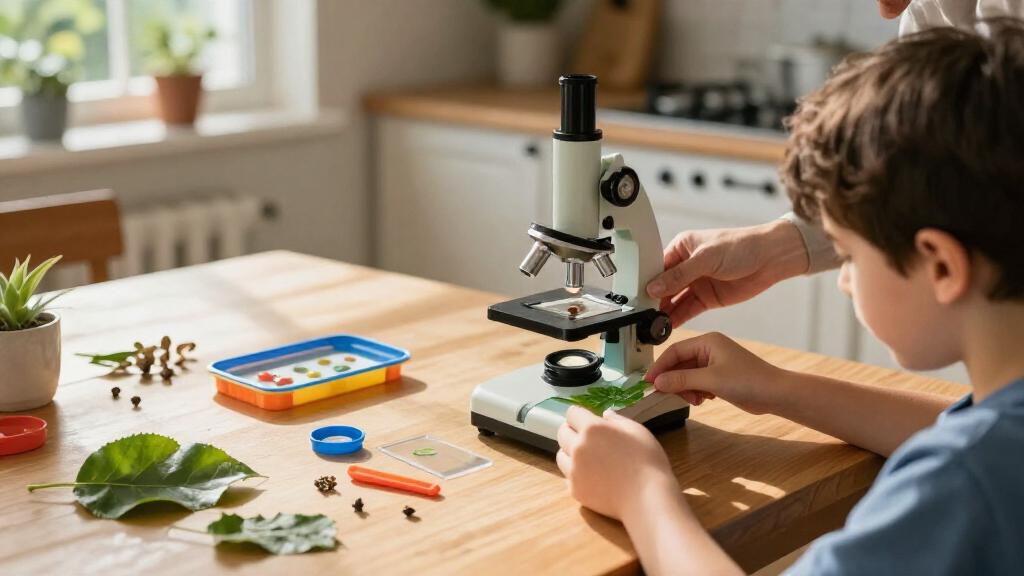
I ranked these microscope kits for kids by how well their design matches real family use: whether a child can get started, how the viewing method supports different specimens, what the kit includes, and how practical it is to store and use with adult help. I also weighed build and handling cues suggested by the product formats, such as a carrying case, a digital display, or a phone adapter. Advertised magnification ranges were treated as one factor, not a guarantee of image clarity.
The ranking favors kits with a clear role and a useful balance of usability, versatility, and included materials. The National Geographic Dual LED model places first for its flexible illumination and approachable science-kit format; screen-based models rank higher for shared viewing, not as universal upgrades. Large bundles and broad magnification claims can suit particular buyers, but they rank lower when their main advantage is quantity or a headline specification rather than a distinct ease-of-use benefit. Since children vary in age and patience, I also distinguish beginner-friendly choices from models that may need more setup or supervision.
Factors to Consider When Choosing Microscope Kits For Kids
Choosing among microscope kits is easier when you start with how a child will use one, rather than comparing headline magnification numbers. These factors can help narrow the options before you decide which features deserve priority.
Choose a viewing style before comparing magnification
A compound microscope uses an eyepiece and stage, giving children practice with a traditional lab-style setup. A digital microscope displays the image on a screen, which can reduce the coordination needed to share a view with siblings or adults. Handheld digital models offer a different kind of flexibility for examining objects that are awkward to place on a stage. These styles are not interchangeable: a screen can be convenient, but it changes the hands-on experience and may rely on power or charging. Decide whether your child is most interested in slide work, group viewing, or moving around to inspect objects.
Treat maximum magnification as a claim to investigate
Magnification describes how large an image appears, not how much detail the optics can resolve. A kit advertising 1600x or 2000x may not show more useful detail than a lower-range model if the image becomes dim, soft, or difficult to focus at the top setting. For a first microscope, smooth focusing and a clear view at commonly used settings often matter more than reaching the largest number. Think about the samples your child will use: prepared slides, thin plant material, or solid objects each call for different lighting and setup. Look for a balanced set of optics and illumination instead of buying on the maximum figure alone.
Match the setup to the child’s patience and coordination
Getting a microscope image into focus can require small adjustments, careful slide placement, and a steady hand. Younger children may need an adult to prepare specimens, manage small tools, or guide the focusing process. A screen-based model can make shared viewing simpler, while a classic eyepiece microscope may be more rewarding for a child who enjoys learning a lab routine. Consider whether the child can sit comfortably at a table and keep the instrument stable. A kit that suits their attention span is more likely to be used than one chosen mainly for advanced-sounding specifications.
Check what the accessories are for
A large piece count can include useful slides and tools, but it can also mean more small parts to sort and store. Prepared slides offer an immediate starting point, while blank slides invite children to collect and prepare their own samples with adult guidance. A carrying case can help keep pieces together, though it does not replace checking how the microscope itself should be stored. Before choosing a bundle, ask whether the included materials support the child’s first few sessions and whether you can identify what each tool does. A smaller, purposeful set may be a better fit than a larger assortment that stays in the box.
Plan for lighting, power, and the space you have
Illumination affects which samples are practical to view: light passing through a slide suits transparent specimens, while top lighting can help reveal the surface of solid objects. Dual lighting offers more options, but the child still needs to learn when to use each source. Digital screens may need batteries or charging, so check the power arrangement and think about where the kit will be used. A fixed compound microscope needs a stable surface and room for slides and accessories. If storage space is limited or the child wants to explore away from a desk, a compact or handheld format may be easier to keep in regular use.
Decide when an upgrade is worth it
Paying for a more involved kit makes sense when the child already enjoys slide-based exploration, wants to share images on a display, or will use included accessories regularly. A premium-feeling feature is less valuable if the child is still learning basic focusing or loses interest after short sessions. For beginners, accessible setup and a clear first activity can matter more than a phone adapter or a broad magnification range. Families buying for siblings may value a screen that lets several people see the same specimen at once. Match the extra features to a habit or need you can name, rather than treating more specifications as an automatic improvement.
Frequently Asked Questions
Should I choose a digital microscope or a traditional eyepiece model for my child?
Choose a digital model if shared viewing is a priority or your child finds it easier to look at a screen than align an eye with an eyepiece. A traditional compound microscope offers direct practice with slide placement and focusing, which may appeal to a child who wants a lab-style experience. Handheld digital models add mobility, but they are less like a fixed stage-and-slide setup. Also check the power requirements and screen size before choosing a digital option. The best fit depends on how your child plans to explore, not simply whether one format sounds more advanced.
Does a 1200x, 1600x, or 2000x microscope show more detail than a 250x model?
Not automatically: a larger magnification number means a bigger image, but it does not guarantee clearer detail. Optics, lighting, focusing stability, and the specimen all affect what a child can actually see. A lower-range microscope may be easier to use for basic exploration, while higher advertised ranges can offer more settings for a curious user. The National Geographic Junior model’s 50x–250x range is a different proposition from kits advertising up to 1200x or more, not necessarily a measure of overall quality. Prioritize a usable view and suitable samples over the largest number on the box.
Are large accessory bundles worth choosing for a first microscope?
They can be helpful when the kit includes items a child will use right away, such as prepared slides for quick first observations and blank slides for simple projects. A high piece count by itself does not show how useful or easy to manage the bundle will be. More small tools can mean more sorting, supervision, and storage work for an adult. Compare the purpose of the included materials and whether they fit the child’s age and interests. If immediate, low-preparation exploration is the goal, prepared slides may matter more than a larger total count.
Can one microscope kit handle both slides and solid objects?
Some designs are more flexible than others, largely because of their lighting. A compound microscope with illumination from below is suited to light passing through thin specimens, while top lighting can help reveal the surface of solid objects. Dual-light models provide more options, though they still require the child to place and position each sample appropriately. A handheld digital microscope can be useful for objects that are difficult to fit on a stage. Think about the specimens your child is likely to explore before choosing a format.
What should I prioritize if the microscope is a gift for a young beginner?
Prioritize straightforward setup, comfortable viewing, and materials that make the first session easy to start. A simple science-kit format or prepared slides can help a beginner see an example without first learning to prepare a specimen. Consider whether an adult will be available to guide focusing and handle small accessories. Avoid choosing solely for a very high magnification claim or the largest bundle, since those features may add complexity without helping a child get started. For a child who prefers watching together, a display may be more useful than an eyepiece-only design.
Conclusion
For the best overall pick, I recommend the National Geographic Dual LED Microscope Science Kit for its flexible illumination and approachable format. The best value direction is the Uarzt 58-Piece Kit for families who want a bundled set with a carrying case, while the best premium-style choice is the HEWEIMEI 1600X for buyers drawn to a larger digital display and screen-based viewing. For a beginner, the National Geographic Junior model offers a more modest magnification range that may be easier to approach; for screen sharing, compare the HEWEIMEI with the TOMLOV DM302K, and for portability, consider the GEMUFO handheld kit. Choose by the child’s preferred way to explore and the adult help available, rather than by magnification or piece count alone.
Halloween Picks

Spirit Halloween Scary Sitting Scarecrow Animatronic, 4 ft 6 in

Haunted Hill Farm 4.6‑Ft Head‑Spinning Beatrix Halloween Animatronic Prop

8.5 Foot Halloween Inflatable Haunted House Castle with Skeleton, Ghost & Skulls
As an affiliate, we earn on qualifying purchases.