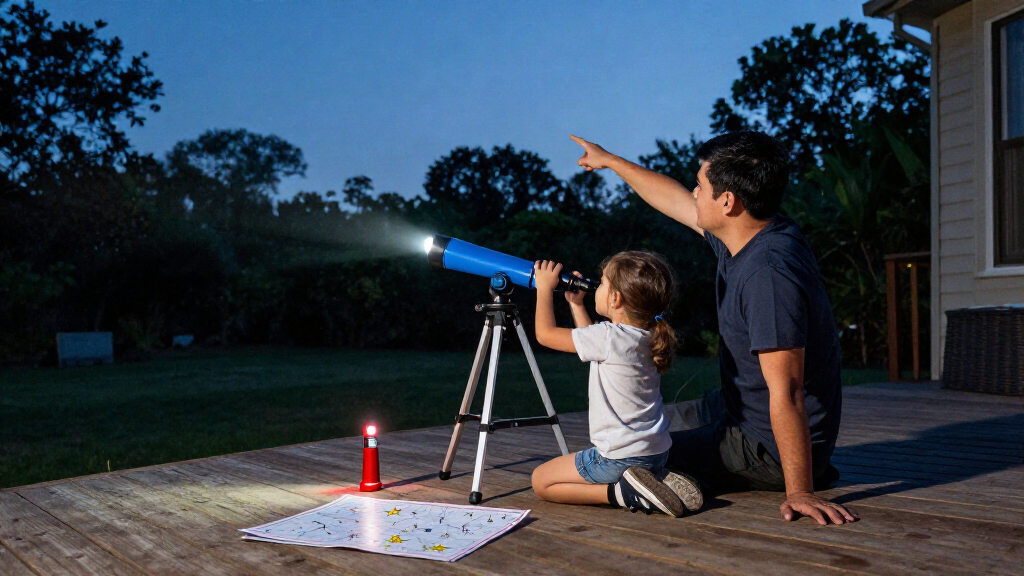
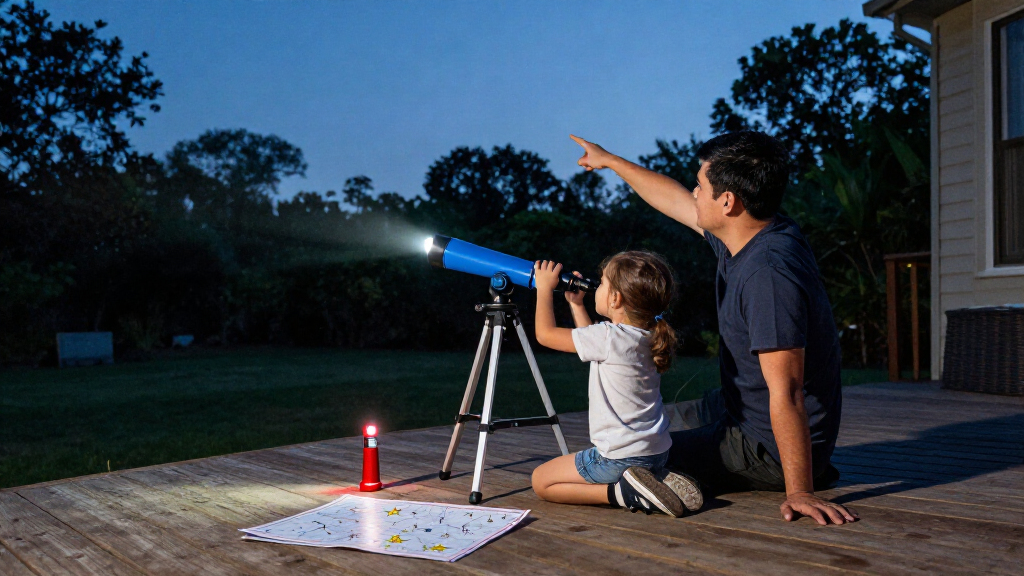
For most families, I’d start with the Gskyer 70mm Refractor as the best overall choice because its included accessories support a flexible first look at the night sky. The UncleHu 80mm FMC Refractor stands out for its larger aperture, while the Educational Insights GeoSafari Starview is aimed at children who need a simpler, child-focused introduction. The main tradeoff is between a more capable telescope that takes patience to aim and a simpler kit that is easier to start using but more limited. I compared 15 options across setup, viewing potential, portability, and learning value. Read on for the full breakdown and help matching a telescope to your child’s age, interests, and tolerance for fiddly equipment.

Prime made for students and young adults
- Fast, free delivery for dorm and study essentials
- Prime Video and Amazon Music included
- Member-only deals
Key Takeaways
- The Gskyer 70mm Refractor is the most balanced starting point in this lineup: its accessory bundle offers more flexibility than a basic child-focused scope, though extra pieces can add setup steps.
- The 80mm aperture models stand apart on light-gathering potential, but a larger opening does not make focusing or locating objects easier for a young beginner.
- Several products are designed around learning and simplicity rather than maximum sky detail, including the GeoSafari Starview and Nancy B’s Science Club MoonScope.
- Portability and mount stability matter as much as magnification claims: a shaky or awkward setup can make a theoretically stronger telescope frustrating to use.
- The LCD-display model changes the viewing experience by offering a screen-based approach, while traditional refractors teach direct eyepiece viewing and require more patience.
| Gskyer 70mm Refractor Telescope with 400mm Focal Length, Tripod, Carry Bag, Smartphone Adapter, and Remote |  | Best for Portable Stargazing | Telescope type: Refractor | Objective aperture: 70mm | Focal length: 400mm (f/5.7) | VIEW LATEST PRICE | See Our Full Breakdown |
| UncleHu 80mm FMC Refractor Telescope for Beginners |  | Best for a Stable Tabletop Setup | Telescope type: Refractor | Objective aperture: 80mm | Focal length: 400mm | VIEW LATEST PRICE | See Our Full Breakdown |
| Hawkko 80mm Refractor Telescope Kit for Kids and Beginners |  | Best Learning Kit | Telescope type: Refractor | Objective aperture: 80mm | Focal length: 500mm | VIEW LATEST PRICE | See Our Full Breakdown |
| Little World Kids’ Telescope with 20x–40x Magnification and Portable Tripod |  | Best for Simple First Use | Magnification: 20×, 30×, and 40× | Mount: Altazimuth with slow-motion adjustment knobs | Focus: Manual | VIEW LATEST PRICE | See Our Full Breakdown |
| Hawkko 80mm Aperture, 500mm Refractor Telescope for Beginners |  | Best for Phone-Assisted Observing | Telescope type: Refractor | Objective aperture: 80mm | Focal length: 500mm | VIEW LATEST PRICE | See Our Full Breakdown |
| NASA Lunar Telescope for Kids with Tripod and Finder Scope |  | Best for Moon-Focused Beginners | Recommended age: 8 years and up | Objective lens diameter: 25 mm | Magnification: Up to 90x | VIEW LATEST PRICE | See Our Full Breakdown |
| Bresser Junior 70/400 Telescope for Children |  | Best for Sky and Land Versatility | Telescope type: Refractor | Recommended age: 8 years and up | Objective lens diameter: 70 mm | VIEW LATEST PRICE | See Our Full Breakdown |
| Educational Insights GeoSafari Starview Beginner Telescope for Kids |  | Best for Guided First-Time Exploring | Eyepiece magnifications: 10× and 50× | Mount type: Altazimuth | Focus: Manual | VIEW LATEST PRICE | See Our Full Breakdown |
| Educational Insights GeoSafari Vega 600 Telescope |  | Best for a Taller Adjustable Tripod | Telescope type: Refractor | Objective lens diameter: 50 mm | Focal length: 1667 mm | VIEW LATEST PRICE | See Our Full Breakdown |
| Educational Insights Nancy B’s Science Club MoonScope Telescope |  | Best Moon-Viewing Activity Kit | Recommended age: 8–11 years | Magnification: 18× and 90× | Eyepieces: 4 mm and 20 mm, all-glass | VIEW LATEST PRICE | See Our Full Breakdown |
| MaxUSee Kids Refractor Telescope, 400mm Focal Length, with Tripod and Finder Scope |  | Best for Guided First Sky Searches | Telescope type: Refractor | Objective lens: 40 mm | Focal length: 400 mm | VIEW LATEST PRICE | See Our Full Breakdown |
| Fuoibl 70mm Refracting Telescope with Phone Adapter |  | Best Value for Flexible Viewing | Telescope type: Refracting | Aperture: 70 mm | Focal length: 300 mm | VIEW LATEST PRICE | See Our Full Breakdown |
| Explore Scientific National Geographic 50mm Tabletop Telescope for Kids |  | Best Compact Backpack Pick | Objective lens diameter: 50 mm | Focal length: 360 mm | Eyepiece: Huygens | VIEW LATEST PRICE | See Our Full Breakdown |
| Educational Insights GeoSafari Telescope and Microscope Set |  | Best Two-in-One Science Set | Set includes: Telescope and microscope | Telescope focal length: 360 mm | Telescope objective lens: 50 mm achromatic | VIEW LATEST PRICE | See Our Full Breakdown |
| 70mm Refractor Telescope with 4.5-Inch LCD Display |  | Best for Screen-Based Viewing and Recording | Aperture: 70 mm | Focal length: 400 mm | Focal ratio: f/5.6 | VIEW LATEST PRICE | See Our Full Breakdown |
| beginner telescopes for kid | Focal length | Mount | Eyepieces | Telescope type |
|---|---|---|---|---|
| Gskyer 70mm Refractor Telescop | 400mm (f/5.7) | Altazimuth | 25mm (16×) and 10mm (40×) | Refractor |
| UncleHu 80mm FMC Refractor Tel | 400mm | Altazimuth | 25mm and 10mm | Refractor |
| Hawkko 80mm Refractor Telescop | 500mm | Altazimuth | 25mm and 10mm | Refractor |
| Little World Kids’ Telescope w | — | Altazimuth with slow-motion adjustment knobs | — | — |
| Hawkko 80mm Aperture | 500mm | Altazimuth | 10mm and 25mm | Refractor |
| NASA Lunar Telescope for Kids | — | — | Low-power and high-power | — |
| Bresser Junior 70/400 Telescop | 400 mm | Altazimuth | 3 (H20, H12, H6) | Refractor |
| Educational Insights GeoSafari | — | — | — | — |
| Educational Insights GeoSafari | 1667 mm | Altazimuth | — | Refractor |
| Educational Insights Nancy B’s | 396 mm | Altazimuth | 4 mm and 20 mm, all-glass | — |
| MaxUSee Kids Refractor Telesco | 400 mm | Altazimuth | H20 mm, H12.5 mm, H6 mm | Refractor |
| Fuoibl 70mm Refracting Telesco | 300 mm | — | 6 mm and 20 mm | Refracting |
| Explore Scientific National Ge | 360 mm | Tabletop altitude-azimuth | — | — |
| Educational Insights GeoSafari | — | — | — | — |
| 70mm Refractor Telescope with | 400 mm | — | — | — |
More Details on Our Top Picks
Gskyer 70mm Refractor Telescope with 400mm Focal Length, Tripod, Carry Bag, Smartphone Adapter, and Remote
The Gskyer makes the most sense for families who want a telescope they can carry between the backyard and a campsite. Its 70mm aperture and fully coated optics suit bright targets such as the Moon, while the included bag keeps the scope and accessories together. Two eyepieces provide a useful starting range, and the phone adapter and wireless remote give kids a way to try basic astrophotography without touching the phone during a shot. Compared with the Hawkko 80mm Refractor Telescope Kit, it has a smaller aperture and shorter focal length, but its bundled carry bag and remote are practical portability perks. The tradeoff is a manual-focus setup and an adjustable tripod that tops out at a stated 65cm height, so it may feel low for some observers. Its listed 120× maximum also does not guarantee useful detail at that magnification.
Pros:- Carry bag makes transport and storage more convenient.
- Includes two eyepieces and a 3× Barlow lens for changing magnification.
- Smartphone adapter and wireless remote support hands-off image capture.
- Fully coated optics and an erecting prism support celestial and daytime viewing.
Cons:- The 70mm aperture is smaller than the 80mm openings on several alternatives.
- Manual focusing and aiming require hands-on adjustment.
- The 65cm stated tripod height may be too low for comfortable standing use.
Best for: Families seeking a portable starter scope with a carry bag and a simple way for kids to experiment with phone photos.
Not ideal for: Children who need a taller viewing position or families prioritizing the larger 80mm aperture offered by the Hawkko and UncleHu models.
- Telescope type:Refractor
- Objective aperture:70mm
- Focal length:400mm (f/5.7)
- Mount:Altazimuth
- Eyepieces:25mm (16×) and 10mm (40×)
- Barlow lens:3×
- Maximum magnification:120×
- Tripod:Adjustable aluminum, 65cm stated height
- Included accessories:Carry bag, smartphone adapter, wireless camera remote
Our verdict“Choose the Gskyer if portability and phone-photo accessories matter more than the larger aperture of the 80mm alternatives.”
UncleHu 80mm FMC Refractor Telescope for Beginners
The UncleHu is a fit for kids who will observe from a patio table, balcony, or other raised, steady surface. Its 80mm aperture and fully multi-coated optics give it a larger light-gathering opening than the Gskyer 70mm, while the 400mm focal length keeps the design compact. The two eyepieces and 3× Barlow offer a broad listed range, and the included 45° zenith mirror can make looking through the scope more comfortable when targets sit high overhead. DIY stickers add a small activity for young owners, but they are not a substitute for observing guidance. Unlike the Hawkko 80mm kit, this one comes with a short tabletop tripod rather than an adjustable full-height tripod. That makes it less flexible outdoors and requires a stable raised surface; manual focus also means an adult may need to help younger children get a sharp view.
Pros:- 80mm aperture is larger than the Gskyer’s 70mm objective.
- Fully multi-coated optics are specified for brighter, higher-contrast views.
- Includes 25mm and 10mm eyepieces, a 3× Barlow, and a finder scope.
- 45° zenith mirror and DIY stickers add comfort and a hands-on activity.
Cons:- Short tabletop tripod limits viewing positions and needs a stable raised surface.
- Manual focusing can require adult help for younger children.
- The included accessories do not provide the portability of the Hawkko kit’s backpack.
Best for: Families with a sturdy table or balcony surface who want an 80mm starter refractor for Moon viewing and daytime scenery.
Not ideal for: Kids who plan to observe while standing or move frequently between locations, since the short tabletop tripod needs a raised, stable surface.
- Telescope type:Refractor
- Objective aperture:80mm
- Focal length:400mm
- Magnification range:16×–120×
- Eyepieces:25mm and 10mm
- Optics coating:Fully multi-coated
- Mount:Altazimuth
- Included accessories:3× Barlow lens, straight-through finder scope, 45° zenith mirror, short AZ tripod
- Additional items:DIY stickers and folding stool
Our verdict“Pick the UncleHu for a home setup with a dependable table, but choose an adjustable-tripod model for more flexible outdoor observing.”
Hawkko 80mm Refractor Telescope Kit for Kids and Beginners
For a child who is as interested in learning about the sky as looking through a lens, this Hawkko kit brings more activity-oriented support than the simpler Little World telescope. The Moon learning guide, observation log, and themed stickers can help turn a first look at the Moon into a repeatable hobby, while the 80mm aperture and 500mm focal length provide a more substantial beginner setup than the Little World’s basic 20×–40× design. A backpack and phone adapter add flexibility for trips and simple image experiments. The longer focal length and listed 20×–150× range offer more viewing options than the UncleHu 80mm, though the practical view still depends on conditions and setup. This is not a fully guided or automated scope: focusing and target finding remain manual, and its kit features may be unnecessary for a child who only wants occasional casual viewing.
Pros:- Moon guide and observation log support structured learning beyond looking through the eyepiece.
- 80mm aperture and 500mm focal length provide a more capable starter configuration than the Little World model.
- Backpack, smartphone adapter, and adjustable aluminum tripod support travel and phone experiments.
- Two eyepieces and a 3× Barlow lens provide several magnification combinations.
Cons:- Manual focusing and a straight-through finder require practice and adult guidance for many children.
- The accessory-rich kit may be more than a casual young observer needs.
- The listed high magnification is not a promise of consistently detailed views.
Best for: Curious kids who enjoy activity guides and recording observations, with an adult available to help set up and focus the telescope.
Not ideal for: Families seeking the simplest, lowest-effort occasional-use scope or buyers who do not need the included learning materials and backpack.
- Telescope type:Refractor
- Objective aperture:80mm
- Focal length:500mm
- Magnification range:20×–150×
- Eyepieces:25mm and 10mm
- Mount:Altazimuth
- Tripod:Adjustable aluminum
- Weight:2.8kg
- Included learning and carry items:Backpack, phone adapter, Moon and space learning guide, observation log, themed stickers
Our verdict“Choose this Hawkko kit for a child ready to keep an observation log and learn, rather than for occasional unstructured viewing.”
Little World Kids’ Telescope with 20x–40x Magnification and Portable Tripod
The Little World keeps the first telescope experience uncomplicated: it assembles without tools, has three stated magnification settings, and uses an altazimuth mount with slow-motion adjustment knobs for controlled aiming. That makes it less accessory-heavy than either Hawkko 80mm kit and a reasonable fit for a child who wants to view the Moon, terrain, or wildlife without a long list of parts. Its compact, light design also suits short outings. The tradeoff is capability: its basic eyepiece and 20×–40× range are far more limited than the Gskyer’s eyepiece-and-Barlow options or the 80mm Hawkko models. The supplied data does not specify an aperture, so I would not choose it over those larger-aperture alternatives for families prioritizing light gathering. Manual focus remains part of the learning curve, and the basic optics set modest expectations.
Pros:- Tool-free assembly reduces setup steps for a child’s first telescope.
- Slow-motion adjustment knobs support more controlled aiming than a basic free-moving mount.
- Lightweight at 0.54kg and suited to indoor or outdoor use.
- Three stated magnification settings cover simple beginner observations.
Cons:- 20×–40× magnification range is narrower than the Gskyer and Hawkko alternatives.
- Basic eyepiece limits the scope’s flexibility for growing observers.
- No objective aperture is provided in the supplied specifications, making light-gathering comparisons difficult.
Best for: Younger first-time users who need tool-free setup and simple, low-magnification viewing for the Moon and nearby scenery.
Not ideal for: Families focused on brighter astronomical views, higher magnification choices, or a more complete optical kit than its basic eyepiece provides.
- Magnification:20×, 30×, and 40×
- Mount:Altazimuth with slow-motion adjustment knobs
- Focus:Manual
- Eyepiece:Basic
- Finderscope:Reflex
- Lens coating:Fully coated
- Field of view:220 meters
- Weight:0.54kg
- Assembly:Tool-free
Our verdict“Choose the Little World for easy assembly and simple first looks, not for a child who wants room to expand magnification options.”
Hawkko 80mm Aperture, 500mm Refractor Telescope for Beginners
This Hawkko is the straightforward choice for families who want an 80mm scope with a phone adapter but do not need the learning extras of the other Hawkko kit. It pairs a fully multi-coated 80mm objective and 500mm focal length with two eyepieces and a 3× Barlow, giving it more listed magnification flexibility than the Little World’s 20×–40× setup. The adjustable tripod and straight-through finder make it more suited to outdoor sessions than the UncleHu’s short tabletop tripod, while the smartphone adapter gives kids a way to try recording what they see. Compared with the Hawkko 80mm Refractor Telescope Kit for Kids and Beginners, this version lists stickers and an instruction manual but not a Moon guide, observation log, or backpack. Manual focusing is common across these options, and the supplied 20×–150× range should be treated as a selection range rather than a guarantee of clear high-power views.
Pros:- 80mm fully multi-coated objective is larger than the Gskyer’s 70mm aperture.
- Two eyepieces and a 3× Barlow provide multiple magnification combinations.
- Adjustable aluminum alloy tripod supports more flexible positioning than the UncleHu tabletop tripod.
- Smartphone adapter supports basic image-taking experiments.
Cons:- Manual focus and straight-through target finding take practice.
- Unlike the other Hawkko kit, the listed package does not include a Moon guide, observation log, or backpack.
- The 20×–150× range does not guarantee sharp results at its upper end.
Best for: Families wanting an adjustable-tripod 80mm starter telescope with a phone adapter, without needing a bundled observation curriculum.
Not ideal for: Kids who benefit from guided Moon activities or families who want a backpack for carrying the telescope and accessories.
- Telescope type:Refractor
- Objective aperture:80mm
- Focal length:500mm
- Magnification range:20×–150×
- Eyepieces:10mm and 25mm
- Barlow lens:3×
- Mount:Altazimuth
- Tripod:Adjustable aluminum alloy
- Included accessories:Smartphone adapter, straight-through finder scope, space-themed stickers, instruction manual
Our verdict“Pick this Hawkko for an adjustable 80mm setup and phone adapter; choose the other Hawkko kit if learning materials and a backpack matter more.”
NASA Lunar Telescope for Kids with Tripod and Finder Scope
I’d choose this model for a child whose first astronomy goal is finding and studying the Moon, rather than trying a little of everything. The finder scope and two eyepieces give beginners separate tools for locating the target and switching magnification, while the included learning guide can turn lunar observing into a guided activity. Compared with the Nancy B’s Science Club MoonScope, this telescope offers a similar Moon-centered approach but lacks that model’s built-in red LED and moon filter. Its 25 mm objective lens and tabletop tripod keep the setup compact, though the small aperture limits how much detail it can gather. The tripod also needs a steady table or other firm surface, which makes it less flexible outdoors than the full-height Bresser Junior 70/400.
Pros:- Finder scope and two eyepieces support locating the Moon and changing viewing power.
- Learning guide gives children a structured starting point for lunar observation.
- Compact tabletop tripod suits a small indoor storage space or steady outdoor table.
Cons:- The 25 mm objective lens gathers less light than the larger apertures in models such as the Bresser Junior 70/400.
- Tabletop tripod limits viewing locations to places with a stable surface.
- Moon-focused design offers less versatility for families prioritizing daytime nature viewing.
Best for: Children ages 8 and up who want a compact, guided introduction to finding and observing the Moon from a stable table.
Not ideal for: Families seeking a full-height tripod, broader sky-viewing ambitions, or a telescope that can be set up comfortably without a sturdy surface.
- Recommended age:8 years and up
- Objective lens diameter:25 mm
- Magnification:Up to 90x
- Eyepieces:Low-power and high-power
- Finder scope:Straight-through
- Mount type:Equatorial
- Focus:Manual
- Included support:Tabletop tripod
Our verdict“Choose this compact kit for a child focused on guided Moon viewing, but pick the Bresser Junior 70/400 for a larger lens and a full-height tripod.”
Bresser Junior 70/400 Telescope for Children
Among these five picks, I’d put the Bresser Junior 70/400 first for families who want one beginner telescope to move between the night sky and daytime scenery. Its 70 mm objective lens is wider than the 25 mm lens on the NASA Lunar Telescope, giving it a stronger foundation for gathering light, while the adjustable aluminum tripod is more adaptable than a tabletop stand. Three eyepieces, a 5×24 finder, and a reversing lens add ways to explore different views; the smartphone holder and backpack also make outings easier to plan. The tradeoff is a busier kit: children must focus manually and learn which accessory suits each task. Compared with the simpler GeoSafari Starview, it offers more equipment and a taller setup, but demands more setup and organization.
Pros:- 70 mm objective lens provides a larger aperture than the NASA Lunar Telescope’s 25 mm lens.
- Adjustable aluminum tripod supports viewing from more locations than a tabletop stand.
- Includes a backpack, smartphone holder, and accessories for transport and varied viewing.
- Can be used for both sky and land observations.
Cons:- Manual focus means a child must make adjustments to bring views into focus.
- The multiple eyepieces and accessories add setup and storage steps.
- A 0.44-degree field of view is narrower than the Nancy B’s Science Club MoonScope’s listed 1.5 degrees.
Best for: Families with children ages 8 and up who want a portable beginner scope for both backyard astronomy and daytime nature viewing.
Not ideal for: Children who need the simplest possible setup or families who prefer a compact tabletop telescope with fewer accessories to manage.
- Telescope type:Refractor
- Recommended age:8 years and up
- Objective lens diameter:70 mm
- Focal length:400 mm
- Magnification:20–100×
- Mount:Altazimuth
- Eyepieces:3 (H20, H12, H6)
- Finder scope:5×24
- Included accessories:Adjustable aluminum tripod, smartphone holder, backpack, zenith prism, and 1.5× reversing lens
Our verdict“Pick the Bresser for a child ready to explore both the sky and nearby nature with a larger aperture and portable full-height setup.”
Educational Insights GeoSafari Starview Beginner Telescope for Kids
The GeoSafari Starview is the most activity-led option here: its stargazing journal gives a beginner something to do beyond looking through the eyepiece. The two eyepieces offer 10× and 50× views, and the stated uses extend from the Moon and stars to birds and other nature subjects. That makes it a more flexible learning project than the Moon-focused NASA Lunar Telescope, though the available specifications provide less detail about aperture and magnification range than the Bresser Junior 70/400. Its portable tabletop tripod is easy to place indoors or outdoors, but it still needs a firm surface. The manual focus is part of the hands-on experience, yet may frustrate children expecting quick, effortless viewing. I’d favor this model for guided exploration, not for families prioritizing a taller tripod or a more fully specified optical setup.
Pros:- Activity journal provides guided stargazing projects for hands-on learning.
- Two eyepiece magnifications support both lower- and higher-power viewing.
- Designed for Moon, star, bird, and other nature observations.
- Portable tabletop tripod suits indoor and outdoor use where a firm surface is available.
Cons:- Tabletop tripod requires a stable surface and limits where children can observe.
- Manual focus requires ongoing adjustment by the viewer.
- The provided product data does not specify objective lens diameter, limiting direct optical comparisons with the Bresser Junior 70/400.
Best for: Children beginning astronomy who enjoy journals and guided activities, with an adult available to help set up a stable viewing spot.
Not ideal for: Families who need a full-height tripod, detailed published aperture information, or a setup that avoids manual focusing.
- Eyepiece magnifications:10× and 50×
- Mount type:Altazimuth
- Focus:Manual
- Eyepiece lens description:Plossl
- Included tripod:Portable tabletop tripod
- Included learning material:Activity journal with guided projects
- Intended use:Beginner astronomy and nature viewing
Our verdict“Choose Starview for a child who will enjoy guided observing projects, but choose the Bresser Junior 70/400 for a full-height tripod and stated 70 mm aperture.”
Educational Insights GeoSafari Vega 600 Telescope
The Vega 600 suits families who want a height-adjustable tripod without moving up to the Bresser Junior 70/400’s 70 mm objective. Its tripod reaches 50 inches, a practical advantage over the tabletop stands on the NASA Lunar Telescope and GeoSafari Starview when no stable table is nearby. The all-glass, multi-coated optics, 5×24 finder scope, and two eyepieces give a child several parts to learn, while an image erector supports daytime viewing. There is a specification wrinkle: the data lists magnification from 30× to 150×, while the description also mentions up to 225×. I would not choose it based on the higher figure. Its 50 mm aperture is also smaller than the Bresser’s, so the Bresser is the stronger fit for families favoring a larger objective over the Vega’s adjustable support.
Pros:- Adjustable tripod reaches up to 50 inches, unlike the tabletop supports on the NASA Lunar Telescope and GeoSafari Starview.
- All-glass, multi-coated optics and two eyepieces provide a range of viewing setups.
- Finder scope helps beginners locate viewing targets.
- Image erector supports daytime nature observation.
Cons:- Magnification information conflicts: specs state 30× to 150×, while the description mentions up to 225×.
- The 50 mm objective lens is smaller than the Bresser Junior 70/400’s 70 mm lens.
- Manual rack-and-pinion focusing requires the user to adjust focus.
Best for: Families who want an adjustable tripod for children to observe from varied locations, including daytime nature viewing.
Not ideal for: Buyers who need consistent magnification information or want the larger 70 mm objective lens offered by the Bresser Junior 70/400.
- Telescope type:Refractor
- Objective lens diameter:50 mm
- Focal length:1667 mm
- Listed magnification:30× to 150×; description also mentions up to 225×
- Optics:All-glass, multi-coated; 2-element achromatic objective
- Focusing:Manual rack-and-pinion
- Mount:Altazimuth
- Tripod:Adjustable, up to 50 inches
- Included accessories:Finder scope, two eyepieces, 3× image erector, and adjustable tripod
Our verdict“Choose the Vega 600 if an adjustable full-height tripod matters more than the Bresser’s larger aperture, and treat the listed 30×–150× range as the dependable specification.”
Educational Insights Nancy B’s Science Club MoonScope Telescope
I’d pick the MoonScope for children who learn best when observing comes with a project to complete. Its 22-page activity journal, moon filter, and glow-in-the-dark finder make the kit more intentionally focused on lunar learning than the GeoSafari Starview, whose journal supports broader stargazing and nature activities. The listed 18× and 90× magnifications give beginners two viewing choices, and the tripod’s built-in red LED is a distinctive aid for nighttime setup. The tradeoff is a narrow mission: compared with the Bresser Junior 70/400, this model is less suited to families wanting both sky and land use, and the supplied data does not state an objective lens diameter. Manual operation also calls for hands-on adjustment. The recommended age is 8–11, and the product contains small parts unsuitable for children under 3.
Pros:- 22-page activity journal adds structured astronomy, writing, and drawing tasks.
- Moon filter and glow-in-the-dark finder support a lunar-focused observing routine.
- Tripod includes a built-in red LED for night viewing.
- Two listed magnifications offer different approaches to viewing the Moon and planets.
Cons:- Manual focus and operation require hands-on adjustments.
- Moon-centered accessories make it less versatile for daytime nature viewing than the Bresser Junior 70/400.
- Small parts make it unsuitable for children under 3.
Best for: Children ages 8–11 who want Moon-centered observing paired with drawing, writing, and guided astronomy activities.
Not ideal for: Families seeking a broad day-and-night nature scope, or children who need automatic focusing and minimal hands-on setup.
- Recommended age:8–11 years
- Magnification:18× and 90×
- Eyepieces:4 mm and 20 mm, all-glass
- Focal length:396 mm
- Field of view:1.5 degrees
- Mount:Altazimuth
- Focus:Manual
- Finder scope:Glow-in-the-dark
- Included accessories:Moon filter, tripod with built-in red LED, and 22-page activity journal
Our verdict“Choose the MoonScope for a child who wants Moon viewing tied to guided activities, but pick the Bresser Junior 70/400 for broader sky-and-land use.”
MaxUSee Kids Refractor Telescope, 400mm Focal Length, with Tripod and Finder Scope
The MaxUSee F40040M suits children who are more interested in learning how to find things in the sky than in getting the brightest possible view. Its finder scope, built-in compass, and included moon and star map give beginners several ways to orient themselves, while three eyepieces let them try different viewing options. At just 2.2 pounds, it is easier to carry than the larger 70mm Fuoibl, though its 40mm objective lens gathers less light. That smaller aperture limits how much detail a child can expect, and the advertised 400x magnification should not be treated as a promise of useful views. Manual focus also means an adult may need to help at first. Choose it for portable, map-led exploration; skip it if brighter views are the priority.
Pros:- Finder scope, compass, and included sky map support guided object locating.
- Three interchangeable eyepieces offer different viewing options.
- Lightweight 2.2-pound design is convenient to carry.
- Includes a moon mirror for lunar viewing.
Cons:- The 40mm objective lens gathers less light than the 70mm Fuoibl.
- Manual focusing requires adjustment and may need adult help.
- The stated 400x magnification can set unrealistic expectations for usable detail.
Best for: Families seeking a lightweight first telescope for children who enjoy using a star map and learning to aim at sky objects.
Not ideal for: Buyers prioritizing brighter, more detailed views or a simple setup without hands-on focusing; the 40mm aperture and manual controls are limiting.
- Telescope type:Refractor
- Objective lens:40 mm
- Focal length:400 mm
- Eyepieces:H20 mm, H12.5 mm, H6 mm
- Mount:Altazimuth
- Finderscope:Straight-through
- Weight:2.2 lb
- Additional features:Built-in compass and moon mirror
Our verdict“Pick the MaxUSee for a portable, map-supported introduction to finding celestial objects, not for the brightest views in this group.”
Fuoibl 70mm Refracting Telescope with Phone Adapter
The Fuoibl BY-001 offers a more capable optical starting point than the 40mm MaxUSee, pairing a 70mm aperture with fully multi-coated optics for lunar, planetary, and daytime viewing. Its 20mm and 6mm eyepieces cover different viewing needs, while the included 3× Barlow, phone adapter, and wireless remote add ways to experiment and share what the telescope shows. Tool-free setup and a tripod that extends to 45 inches make it a practical family option. The tradeoff is that it still depends on manual focus, and its inverted finderscope image can confuse a child learning to aim. Compared with the LCD-equipped 70mm refractor in this roundup, it relies on a phone for digital capture rather than offering its own screen.
Pros:- 70mm aperture and fully multi-coated optics offer a stronger light-gathering starting point than the MaxUSee.
- Includes 6mm and 20mm eyepieces plus a 3× Barlow lens.
- Phone adapter and wireless remote support smartphone viewing and capture.
- Tool-free setup and an adjustable tripod up to 45 inches suit family use.
Cons:- Manual focusing requires hands-on adjustment.
- The finderscope image is inverted, which can make aiming less intuitive.
- Phone-based capture depends on a compatible smartphone and adapter alignment.
Best for: Families wanting a 70mm starter telescope with included eyepieces and phone-photo accessories for both sky and distant daytime viewing.
Not ideal for: Children who need a built-in digital display or an especially straightforward aiming experience; focusing is manual and the finder image is inverted.
- Telescope type:Refracting
- Aperture:70 mm
- Focal length:300 mm
- Magnification range:15×–150×
- Eyepieces:6 mm and 20 mm
- Barlow lens:3×
- Finderscope:5×24
- Tripod maximum height:45 in
- Phone accessories:Phone adapter and wireless remote included
Our verdict“Choose the Fuoibl if you want a 70mm beginner scope with flexible eyepieces and phone accessories without stepping up to a built-in screen.”
Explore Scientific National Geographic 50mm Tabletop Telescope for Kids
At 1.9 pounds, this National Geographic tabletop telescope is the easiest of these options to pack for a trip or keep ready for a quick look outside. Its 50mm objective lens is larger than the MaxUSee’s 40mm lens, but it remains a compact starter instrument rather than a choice for maximizing faint detail. The reflex finderscope offers a different aiming approach from the MaxUSee’s straight-through finder, while the aluminum tabletop tripod keeps the kit light. That compact setup brings a practical limitation: a child needs a stable, flat surface, so it is less flexible than the Fuoibl with its adjustable full-height tripod. Manual focus also calls for patience. The short 30-day warranty is another drawback for families planning to keep the kit for years.
Pros:- At 1.9 pounds, it is lighter than the MaxUSee and easy to pack.
- 50mm objective lens gathers more light than the MaxUSee’s 40mm lens.
- Aluminum tabletop tripod keeps the kit compact.
- Reflex finderscope provides an alternative aiming aid.
Cons:- Tabletop mount requires a stable, flat surface.
- Manual focus can take patience from a young beginner.
- 30-day warranty is shorter than the two-year warranty listed for the MaxUSee.
Best for: Families who want a very lightweight telescope for backpack trips, travel, or short observing sessions from a table or other stable surface.
Not ideal for: Children who will observe where no flat support is available, or families seeking a longer warranty and more flexible tripod placement.
- Objective lens diameter:50 mm
- Focal length:360 mm
- Eyepiece:Huygens
- Mount:Tabletop altitude-azimuth
- Finderscope:Reflex
- Tripod material:Aluminum
- Weight:1.9 lb
- Focus type:Manual
- Warranty:30 days
Our verdict“Choose this model when low weight and backpack portability matter more than a full-height tripod or a longer warranty.”
Educational Insights GeoSafari Telescope and Microscope Set
This set earns its place by giving a curious child two kinds of investigation in one kit: a 50mm refractor telescope for sky viewing and a metal microscope for specimens. The telescope offers 18x–80x magnification and a tabletop alt-azimuth mount, making it more like the compact National Geographic 50mm than the tripod-based Fuoibl. Its standout is the die-cast metal microscope, which adds a built-in light, focusing mechanism, prepared slides, and supplies for making more. That breadth can keep a young learner engaged on cloudy nights, but it is not the most focused choice for stargazing alone. The tabletop telescope needs a suitable surface, and the microscope light takes two AA batteries that are not included. Choose the set for hands-on science across day and night; skip it if telescope performance is the main goal.
Pros:- Combines a telescope and microscope for varied science activities.
- All-glass telescope optics and two interchangeable glass eyepieces.
- Die-cast metal microscope includes built-in light and rack-and-pinion focusing.
- Prepared slides and slide-making supplies support continued exploration.
Cons:- Telescope uses a tabletop tripod rather than a full-size tripod.
- Microscope light requires two AA batteries, which are not included.
- The combined kit is less focused on telescope use than the Fuoibl 70mm refractor.
Best for: Families with a child who wants to explore prepared specimens and make slides as well as use a basic telescope.
Not ideal for: Buyers focused mainly on sky viewing or children who need a telescope that can be set up away from a table.
- Set includes:Telescope and microscope
- Telescope focal length:360 mm
- Telescope objective lens:50 mm achromatic
- Telescope magnification:18×–80×
- Telescope eyepieces:Two interchangeable glass eyepieces
- Telescope mount:Alt-azimuth tabletop tripod
- Microscope magnification:50×–600×
- Microscope construction:Die-cast metal
- Microscope light power:2 AA batteries, not included
Our verdict“Pick this set for a child whose curiosity extends from the night sky to microscope slides, rather than for telescope viewing alone.”
70mm Refractor Telescope with 4.5-Inch LCD Display
The 4.5-inch LCD makes this 70mm refractor the most screen-oriented option here: a child can view and record without holding a phone to the eyepiece. Its 16× optical eyepiece also preserves a traditional way to observe, while the rechargeable battery, wireless remote, and 1080p video recording add flexibility for family sessions. Compared with the Fuoibl, it has a longer 400mm focal length and a built-in display, but the Fuoibl includes multiple eyepieces and a 3× Barlow, giving it more listed magnification options. This model still requires manual focusing, and its included 32MB memory is limited; a memory card is needed for expanded storage and is sold separately. It suits children drawn to recording and screen viewing, not families seeking the simplest optical-only kit.
Pros:- LCD display and optical eyepiece support both screen-based and direct viewing.
- Records photos up to 48MP and video at 1080p without a smartphone.
- Rechargeable battery supports portable use.
- Adjustable metal tripod extends up to 1.3m.
Cons:- Manual focusing still requires user adjustment.
- A memory card is sold separately for expanded storage.
- The included 25mm eyepiece provides fewer listed viewing options than the Fuoibl’s two eyepieces and Barlow lens.
Best for: Families whose child prefers viewing on a screen and wants to record lunar or daytime observations without relying on a smartphone.
Not ideal for: Buyers seeking a simple optical telescope with several included eyepieces, or those who do not want to add a memory card for longer recording sessions.
- Aperture:70 mm
- Focal length:400 mm
- Focal ratio:f/5.6
- Display:4.5-inch LCD
- Optical eyepiece:25 mm; 16× magnification
- Field of view:4.6°
- Battery:2000mAh rechargeable; up to 4.5 hours of use
- Recording:Photos up to 48MP; video at 1080p
- Tripod:Adjustable metal tripod, up to 1.3 m
Our verdict“Choose this telescope for a child who will enjoy screen viewing and recording, but choose the Fuoibl for more included optical magnification options.”
How We Picked
I ranked these beginner telescopes for kids by how well their design matches a child’s first observing sessions: manageable setup, understandable controls, useful included accessories, practical portability, and a realistic path to viewing the Moon and bright targets. Aperture and optical design informed the comparison, but I did not treat advertised magnification as a shortcut to quality; steady images, a usable mount, and straightforward focusing matter more to a beginner than a large number on a box. I also considered whether each kit encourages hands-on sky observation or favors a child-friendly educational experience.
The ranking gives priority to models that balance useful viewing potential with an approachable learning curve, rather than those that lead on a single specification. More capable 70mm and 80mm refractors rank ahead when their added flexibility justifies the extra setup demands. Child-oriented or tabletop designs can be a better match for younger users, but their narrower use or simpler performance keeps them from being the default pick for every family. Because accessories, mounts, and included features vary, buyers should confirm the current package contents before ordering.
| beginner telescopes for kid | Telescope type | Mount |
|---|---|---|
| Gskyer 70mm Refractor Telescop | Refractor | Altazimuth |
| UncleHu 80mm FMC Refractor Tel | Refractor | Altazimuth |
| Hawkko 80mm Refractor Telescop | Refractor | Altazimuth |
| Little World Kids’ Telescope w | — | Altazimuth with slow-motion adjustment knobs |
| Hawkko 80mm Aperture | Refractor | Altazimuth |
| NASA Lunar Telescope for Kids | — | — |
| Bresser Junior 70/400 Telescop | Refractor | Altazimuth |
| Educational Insights GeoSafari | — | — |
| Educational Insights GeoSafari | Refractor | Altazimuth |
| Educational Insights Nancy B’s | — | Altazimuth |
| MaxUSee Kids Refractor Telesco | Refractor | Altazimuth |
| Fuoibl 70mm Refracting Telesco | Refracting | — |
| Explore Scientific National Ge | — | Tabletop altitude-azimuth |
| Educational Insights GeoSafari | — | — |
| 70mm Refractor Telescope with | — | — |
Factors to Consider When Choosing Beginner Telescopes For Kids
A child’s first telescope works best when it suits both the young observer and the adult who may help set it up. Before choosing, I’d focus on the experience you want to create: independent lunar viewing, a shared learning activity, travel-friendly observing, or an introduction to several kinds of science.
Match the telescope to the child’s age and patience
A telescope can be optically capable yet a poor first fit if the child cannot aim it or keep an object in view. Younger children often benefit from a simpler design and short observing sessions with an adult nearby. Older children who enjoy adjusting equipment may get more out of a conventional refractor with separate eyepieces and a finder. Think about whether your child likes trial and error or becomes discouraged when setup takes time. A parent’s willingness to help at the start can widen the range of suitable models. Avoid choosing by age label alone; a child’s interest and attention span often tell you more.
Treat magnification claims with caution
High magnification enlarges an image, but it also magnifies vibration and makes objects harder to keep centered. For a first telescope, a steady, bright view at modest power is usually more satisfying than a dim, shaky view at the maximum advertised setting. The Moon is a forgiving first target because it is bright and easy to locate, while faint galaxies and nebulae are poor expectations for small beginner scopes under light-polluted skies. Check whether the eyepieces provide a useful range of viewing powers rather than focusing on one headline number. A child can learn to locate and focus on a clear target before moving to higher magnification. This approach prevents a common letdown: expecting a telescope to show every object like a detailed photograph.
Give the mount and tripod equal attention
The mount controls how easily a child can point the telescope and keep it steady, so it shapes the experience as much as the optical tube. A light tripod may be convenient to carry but can wobble when a child touches the focuser or adjusts direction. Tabletop models avoid a tall tripod, but they need a firm, level surface at a comfortable height. Before buying, consider where the telescope will be used and whether there is a stable place to set it up. A balcony railing, soft ground, or crowded table can make aiming harder. It is often better to accept a little more setup effort for a stable view than to choose a kit that is portable but frustrating to operate.
Choose accessories for real use, not bundle size
Finders, carrying cases, phone adapters, and remote shutters can be useful, but every accessory adds a step that a beginner must understand. A finder can help locate targets when it is aligned correctly; an unaligned finder may send a child searching in the wrong place. Phone adapters support snapshots but can be tricky to center over an eyepiece, so they should be treated as an extra rather than the main reason to buy. A carry bag matters more if the telescope will travel than if it will stay set up at home. Check which parts are included and whether the instructions explain how to use them. For a first telescope, a small set of clear, workable tools is more helpful than a large bundle with accessories that rarely leave the box.
Plan for where the telescope will be used
Dark skies help, but families can still enjoy the Moon and bright objects from many neighborhoods. If you expect to observe from a car, campsite, or shared space, prioritize manageable size and quick setup over features that require careful alignment. For home use, storage space and a safe place to leave the telescope assembled can make spontaneous sessions easier. Electronic or screen-based viewing may appeal to a child who dislikes looking through an eyepiece, while a traditional telescope offers a more direct observing experience. Neither format is automatically better; the right choice depends on how your child prefers to learn. Consider access to clear skies and an adult helper before paying for capabilities your family may seldom use.
Know when paying more adds useful capability
A more capable model can be worthwhile when a child has already shown sustained interest and wants to observe regularly. Larger aperture may gather more light, but it does not remove the need for a steady mount, careful focusing, or realistic expectations. A premium kit earns its place when its optics, construction, or included tools solve a specific problem for your family. If the telescope is a first experiment, a simpler and easier-to-manage option may be a better match than a feature-heavy setup. Consider the cost of replacement or additional eyepieces only after checking what the kit already includes. The best upgrade is one that supports more observing, not one that merely promises a bigger number.
Frequently Asked Questions
Should I buy a telescope or binoculars for a child’s first look at the sky?
Binoculars are often easier to point and carry, so they can suit a child who mainly wants to explore wide star fields or view distant scenery by day. A telescope is the stronger choice when the child is especially interested in the Moon and wants to see its features at greater scale. Telescopes also ask for more setup and steadier handling, particularly when used at higher magnification. If you are unsure whether astronomy will hold your child’s interest, borrowing binoculars or attending a local skywatching event can help clarify what kind of viewing they enjoy. Choose based on the targets and experience your child wants, not on the assumption that a telescope is always the better first instrument.
Will a beginner telescope show planets clearly from a city?
Bright planets can be visible from a city, but what you see depends on the telescope, atmospheric steadiness, light pollution, and how well the instrument is focused. Expect small views rather than the large, richly detailed images often shown in photographs. The Moon is usually the most rewarding first target because it is bright and offers visible surface detail. A stable setup and modest magnification can produce a more satisfying view than pushing the telescope to its advertised maximum power. If your child expects colorful, photo-like planets, explain the difference between looking through an eyepiece and viewing processed astronomy images before buying.
Is an 80mm telescope automatically better for a child than a 70mm model?
An 80mm aperture can collect more light than a 70mm aperture, which may help when viewing dimmer targets under suitable conditions. That advantage does not make the larger model easier to aim, focus, or carry. A less steady mount or more complicated setup can outweigh a modest gain in aperture for a young beginner. Compare the complete package, including tripod stability, finder, eyepieces, and instructions, rather than judging by the opening size alone. For a child’s first telescope, the model they can use with confidence may deliver more enjoyable sessions than the one with the larger specification.
Do phone adapters make telescope viewing easier for kids?
A phone adapter can help capture a picture through an eyepiece, but aligning the phone camera takes patience and may be harder than looking through the telescope directly. It is most useful when an adult can help with setup or when the child enjoys documenting observations. Phone photos may not match the detail or color of professional astronomy images, and camera compatibility can vary. For a first observing session, get the telescope focused by eye before adding a phone to the setup. Treat the adapter as a bonus feature rather than a requirement for a good beginner telescope.
Should I choose a telescope-and-microscope set instead of a standalone telescope?
A combination set makes sense when a child is curious about several areas of science and you want one package for daytime exploration and skywatching. The tradeoff is that each instrument may offer less focused capability than a dedicated telescope or microscope chosen for that single interest. Consider whether your child is likely to use both tools, and whether you have suitable samples and observing opportunities for the microscope. If astronomy is the clear priority, a standalone telescope may provide a more coherent first experience. If varied hands-on activities are the goal, the set can encourage broader exploration even if it is not the strongest choice for telescope performance alone.
Conclusion
For most families, I’d choose the Gskyer 70mm Refractor as best overall for its balance of viewing potential and included accessories. The Educational Insights GeoSafari Starview is my pick for a child who needs a simpler, more approachable start, while the UncleHu 80mm FMC Refractor suits buyers who want an 80mm model and are comfortable with a little more setup. For value, compare the basic 70mm kits—such as the MaxUSee or Fuoibl—by checking their included parts and choosing the one that best fits your child’s needs. Families seeking a broader science activity can look at the GeoSafari Telescope and Microscope Set, and those interested in screen-based viewing can consider the LCD-display model. My final choice would depend less on the biggest magnification claim than on which setup your child can use steadily and wants to return to.
Black Friday Picks

Vitamix 5200 Blender with 64 oz. Container, Black
As an affiliate, we earn on qualifying purchases.