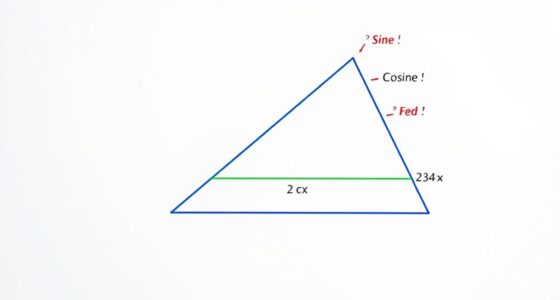

To solve a triangle using the Law of Sines or Cosines, start by gathering your known measurements—angles and sides. Use the Law of Sines when you know an angle and its opposite side or two angles and a side, setting up ratios to find unknown parts. Use the Law of Cosines when you have two sides and the included angle or all three sides, relating them directly. Choosing the right law depends on your given data, and mastering this helps you solve triangles efficiently. If you continue, you’ll discover how to apply these laws confidently to different problem types.
Key Takeaways
- Use the Law of Sines when you know an angle and its opposite side, or two angles and one side.
- Apply the Law of Cosines when you know two sides and the included angle or all three sides.
- Verify the triangle’s validity with triangle inequalities before solving.
- Calculate missing angles or sides by setting up ratios with the appropriate law.
- Choose the Law of Sines or Cosines based on the given measurements for efficient problem-solving.

Have you ever wondered how to find the missing sides and angles of a triangle? When tackling this problem, the first step is understanding the fundamental principles that govern triangles, such as the triangle inequalities. These inequalities state that the sum of any two sides must be greater than the remaining side, which helps you determine whether a set of given measurements can form a valid triangle. They serve as a quick check before diving into more complex calculations. Once you confirm the triangle’s existence, you can explore various methods to find the unknown parts, with the Law of Tangents being a particularly useful tool in some cases.
The Law of Tangents provides a way to relate the differences and sums of sides to angles, especially when dealing with oblique triangles where two sides and an angle are known. It’s often employed after you’ve identified specific measurements and need to find an angle or side that isn’t immediately apparent. For example, if you’re given two sides and the included angle or two angles and a side, the Law of Tangents can help you solve for the remaining unknowns efficiently. It’s especially handy when the Law of Sines or Cosines doesn’t directly apply or when you’re working with ambiguous cases.
In practice, you might start by applying the Law of Tangents if you have the necessary information, but more often, you’ll rely on the Law of Sines or Cosines. The Law of Sines is handy when you know either an angle and its opposite side or two angles and a side, enabling you to set up ratios to find the missing parts. Meanwhile, the Law of Cosines is ideal for cases where you have two sides and the included angle or all three sides, as it directly relates sides to the cosine of an angle. Choosing the right law depends on the information you’re provided and what you need to find.
Understanding these principles allows you to approach solving any triangle with confidence. Remember, confirming the triangle inequalities first ensures your calculations are based on a valid triangle. Additionally, water efficiency considerations can be integrated into designing or choosing tools, even when solving geometric problems involving measurements or constraints. Then, based on your known measurements, select the appropriate law—whether it’s the Law of Sines, Cosines, or sometimes the Law of Tangents—to find the missing sides or angles. With practice, you’ll develop an intuitive sense of which method to use and how to apply it effectively. This systematic approach makes solving triangles straightforward, whether for academic purposes, engineering, or everyday problem-solving.
Frequently Asked Questions
Can the Law of Sines Be Used in Right Triangles?
Yes, you can use the law of sines in a right triangle. While it’s often more straightforward to use basic trigonometry, the law of sines helps when you know two angles and a side or two sides and an angle not included between them. It’s especially useful for solving right triangles when the given information doesn’t fit the standard right triangle ratios, making it a versatile tool in your toolbox.
What Are Common Mistakes When Applying the Law of Cosines?
When applying the law of cosines, you often make mistakes like confusing the formula, especially mixing up the terms or signs. Be careful with the angle ambiguity, which can lead you to choose the wrong solution. Always double-check that you’re using the correct formula for your given situation, and verify your angles and sides are properly labeled to avoid errors in calculations.
How Do You Choose Which Law to Use?
You choose which law to use based on the information you have. If you know two sides and the included angle (side angle), the Law of Cosines helps you find the third side. If you know two angles and a side (angle side), then the Law of Sines is your go-to. Consider the given data and the known angle or side to decide, ensuring you apply the appropriate law for accurate results.
Are There Special Cases Where Neither Law Applies?
In some degenerate or ambiguous cases, neither Law of Sines nor Law of Cosines works well. For example, when the given data leads to a straight line (a degenerate triangle), these laws don’t apply. Ambiguous cases, like SSA (side-side-angle), can produce zero, one, or two solutions, making it tricky. In these situations, you might need additional information or use geometric reasoning to resolve the problem accurately.
How Does Triangle Inequality Affect Solving Triangles?
The triangle inequality plays a vital role in solving triangles because it sets inequality constraints on side lengths, ensuring the sum of any two sides exceeds the third. These constraints prevent triangle ambiguity, where multiple solutions might exist, or no solutions at all. If the inequality isn’t satisfied, you can’t form a valid triangle, so always check these conditions first before applying the Law of Sines or Cosines.
Conclusion
By mastering the Law of Sines and Cosines, you can confidently solve any triangle, whether it’s acute, obtuse, or right-angled. Did you know that about 70% of triangle problems in real-world engineering involve these laws? Remember, practice makes perfect—so keep working through different examples. With these tools, you’ll be solving triangles efficiently and accurately, opening up a whole new world of geometric possibilities. Keep exploring, and you’ll become a pro in no time!