
TL;DR
Open a free Amazon Business account
Business pricing, bulk buying and tax-exempt orders.
Create a free accountAs an affiliate, we earn on qualifying purchases.
Anthropic’s $65 billion Series H is less a valuation and more a strategic move to lock in compute capacity. The company is investing heavily in chips, memory, and cloud infrastructure, making it a landmark capacity deal that shapes AI’s future. Revenue growth is fueling this push, not just investor hype.
When you hear about a company raising $65 billion at a nearly trillion-dollar valuation, it sounds like hype. But behind the headlines, there’s a deeper story — a story about the future of AI hardware, chips, and capacity. Anthropic’s latest round isn’t just a funding milestone; it’s a massive wager on the raw power needed to build the next generation of AI models.
Think of this as a high-stakes race to control the chips, memory, and cloud resources that keep these giant models running. It’s about securing the infrastructure to handle the explosion of AI demand, not just throwing money at growth. This article peels back the curtain on what this historic round really means — for AI, for infrastructure, and for the companies racing to build the future.
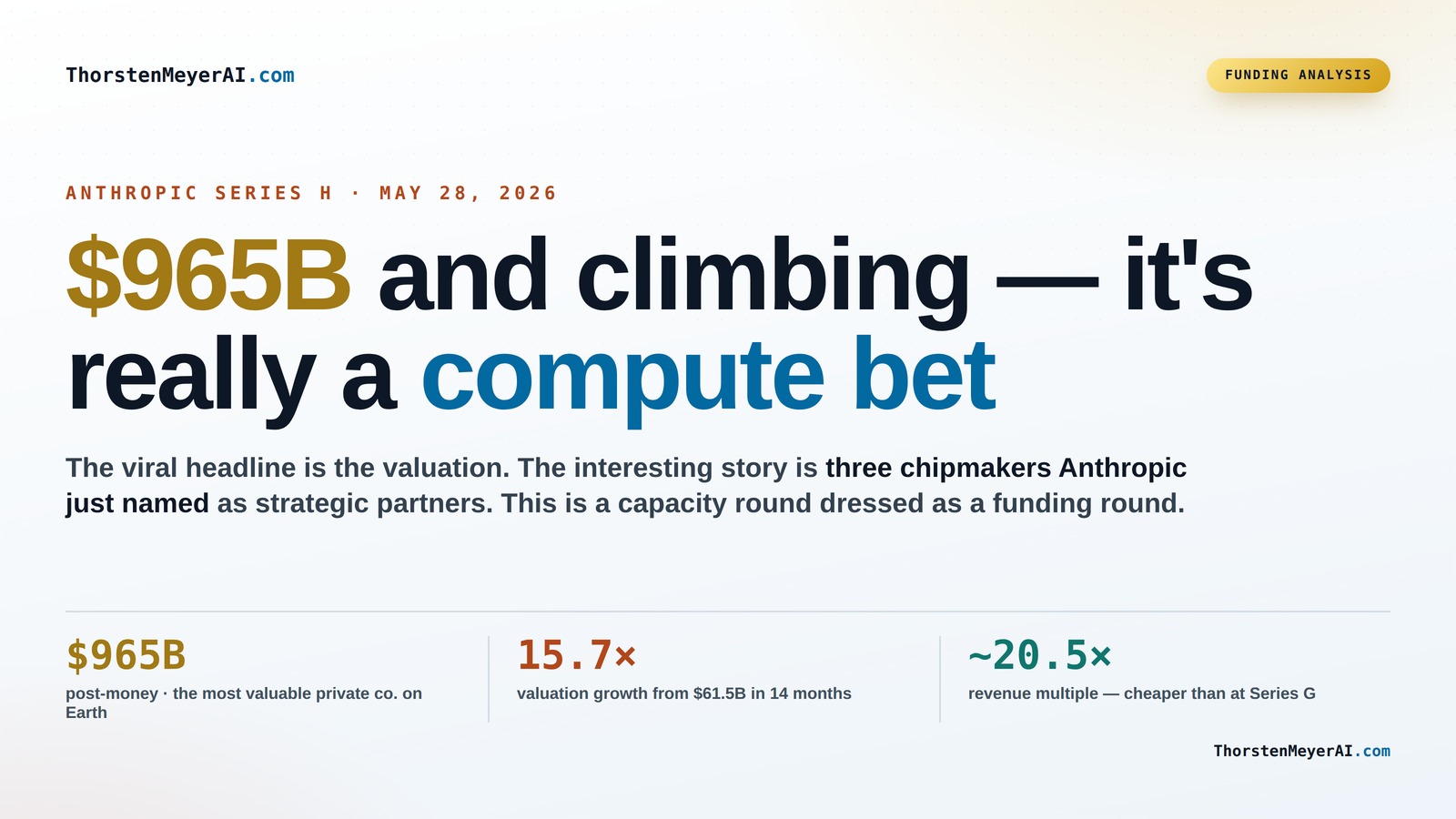
$965B and climbing — it’s really a compute bet
The viral headline is the valuation. The interesting story is in the press release’s middle paragraphs — and in three chipmakers Anthropic just named as strategic partners. This is a capacity round dressed as a funding round.
The numbers nobody can quite parse in sequence
Read together they describe a trajectory with no precedent in enterprise software. Read individually, each looks like a typo.
From $61.5B to $965B in fourteen months
Salesforce took roughly two decades to reach revenue numbers Anthropic just blew past. The sequence below is the part most coverage skips — it’s not the size, it’s the shape.
Anthropic’s valuation ladder · Mar 2025 → May 2026
Five rounds, fourteen months. Bar height is the valuation; the climb itself is the story. Tap any milestone for context.
The multiple actually got cheaper
Bubbles look like multiples expanding while revenue lags. Anthropic’s pattern is the inverse — the valuation tripled, but revenue grew faster, and the multiple compressed.
Revenue-to-valuation multiple · Series G → Series H
Same company, three months apart. The denominator (revenue) is outrunning the numerator (valuation) — exactly the opposite of what a bubble narrative predicts.
10+ gigawatts and three chipmakers
When you name Micron, Samsung & SK hynix alongside your equity backers, you’re saying the binding constraint isn’t demand or model quality — it’s the physical supply of memory chips. The Series H is a capacity round.
Compute commitments backing Anthropic’s capacity bet
$200B+ in announced compute spend across multi-year contracts. The $65B Series H raise has to be read against that bill, not against operating losses.
A genuinely durable bet — or a structural exposure?
Both readings can be true at once. The answer arrives over the next 18–24 months as the gigawatts come online and either fill with paying demand or don’t.
Revenue growth has no precedent in B2B software ($1B → $47B in 17 months). The multiple is compressing, not expanding. Claude is the only frontier model on all 3 major clouds. Enterprise AI spend share went from ~10% to >65% in a year. Compute commitments are tied to specific contracts with capacity dates.
20× revenue is not cheap by any historical software-investing standard. Revenue is reported gross of cloud-reseller pass-throughs, which inflates the top line. Profitability is 2 years out. Amodei’s own warning: a 12-month delay in AI progress “would make him bankrupt” — the compute commitments are a structural exposure to demand persistence.
The valuation race — and the IPO context
Anthropic shipped Opus 4.8 the same morning as Series H — not a coincidence. One week after OpenAI filed confidentially for IPO. The late-2026 frame is set: two frontier AI companies racing to public markets, each pitching durability.
Key Takeaways
- Anthropic’s $965 billion valuation is driven by its focus on securing massive compute capacity, not just revenue or market size.
- The company’s revenue growth is outpacing its valuation, causing its valuation multiple to shrink — a sign of confidence, not a bubble.
- Strategic hardware partnerships with chipmakers and hyperscalers lock in supply and control over the raw materials of AI development.
- The $65 billion investment is primarily infrastructure spending, building data centers, GPUs, and storage to support AI growth.
- This capacity-focused push signals a shift in AI economics — competing on hardware access as much as on model quality.
As an affiliate, we earn on qualifying purchases.
Why a $965 Billion Valuation Is Less About Cash and More About Compute Power
Anthropic’s $965 billion valuation isn’t just a number — it’s a statement. It signals how much investors believe the company’s ability to scale compute capacity will define its future dominance. Unlike traditional companies, AI firms need endless chips, memory, and cloud power to keep growing.
Imagine trying to train a trillion-parameter model. It’s like trying to light up an entire city with a flickering candle, highlighting the importance of AI compute infrastructure. The real bottleneck isn’t money — it’s hardware. This round shows that Anthropic is betting big on hardware access, not just software or data.
For example, the company has named three memory chipmakers — Micron, Samsung, SK hynix — as strategic partners. This isn’t coincidental. They’re locking in supply of the critical components that fuel AI’s growth, much like a major car manufacturer securing a rare semiconductor supply during a chip shortage. This emphasis on hardware access underscores a fundamental shift: in AI, control over physical infrastructure is becoming as crucial as control over the models themselves. Learn more about AI tooling and infrastructure. Without reliable, scalable hardware, even the most innovative algorithms can’t reach their potential. This means future AI leaders will be those who secure and manage this infrastructure effectively, trading short-term costs for long-term dominance.

As an affiliate, we earn on qualifying purchases.
How Anthropic’s Revenue Growth Is Reshaping the Investment Multiple
Here’s the surprising part: as Anthropic’s valuation skyrocketed, its revenue growth outpaced it. From $9 billion at the end of 2025 to over $47 billion in early May 2026, revenue exploded — a 5.4x jump in just a few months.
This rapid growth in revenue, contrasted with a relatively slower increase in valuation, causes the company’s valuation multiple—its price-to-revenue ratio—to shrink. This shift indicates that investors are beginning to see the company’s revenue as more predictive of its value, rather than relying solely on speculative future potential. It suggests a maturing confidence that Anthropic’s growth is sustainable and rooted in real demand.
Compare this to OpenAI, which trades at a multiple of around 30x. Anthropic, despite its higher valuation, now trades at a multiple closer to 20.5x. This lower multiple isn’t a sign of weakness; it reflects a market that’s starting to value revenue and infrastructure investments more heavily than hype. It also signals that investors are increasingly betting on scalable, revenue-generating infrastructure rather than just innovative AI models. This trend could lead to a more stable valuation environment for AI companies, where infrastructure capacity and revenue growth are increasingly intertwined, reducing the risk of bubble-like behavior.

As an affiliate, we earn on qualifying purchases.
Behind the Curtain: The Infrastructure and Chip Partnerships That Matter
Anthropic’s funding isn’t just about cash — it’s a strategic move to secure hardware. The company has committed over 10 gigawatts of compute capacity, with $15 billion already in hyperscaler investments. That includes $5 billion from Amazon alone.
Partnering with chipmakers like Micron, Samsung, and SK hynix is a game-changer. For more on AI hardware, see AI hardware investments. These companies supply the memory and chips that power AI models. It’s like a tight-knit supply chain of the future, where control over hardware equals control over AI progress.
These relationships aren’t casual. They’re designed to guarantee access to the latest GPUs, memory, and storage — the raw materials of the AI arms race. This isn’t just about immediate needs; it’s about securing a competitive advantage that can be leveraged over years. By locking in supply and forming deep partnerships, Anthropic aims to reduce supply chain risks, ensure priority access to cutting-edge hardware, and avoid the bottlenecks that can stall AI development. This strategic infrastructure build-up is a foundational shift, signaling that the future of AI will be as much about controlling physical resources as it is about algorithms.
As an affiliate, we earn on qualifying purchases.
What a $65 Billion Investment in Compute Looks Like in Practice
Spending $65 billion on compute isn’t like buying a new laptop. It’s a sprawling, multi-year investment into data centers, hardware, and cloud capacity. Imagine hundreds of thousands of high-end GPUs humming in a warehouse, ready to train the next big model.
Anthropic’s plan is to build the infrastructure to process billions of queries, train trillion-parameter models, and serve AI at scale. This isn’t just about hardware; it’s about creating an ecosystem that can sustain exponential growth in AI capabilities. Every dollar spent on infrastructure translates into increased capacity, faster training times, and more reliable deployment — all critical for maintaining technological leadership.
This infrastructure isn’t only a means to an end; it becomes a strategic asset, enabling Anthropic to scale rapidly and respond to emerging AI demands. Discover more about statistical analysis and tech resources. The massive investment in hardware and data centers also acts as a barrier to entry for competitors, consolidating Anthropic’s position in the AI landscape. Read about AI infrastructure strategies. Ultimately, this approach underscores that in AI, hardware isn’t just a support function—it’s the foundation of future innovation and revenue growth.

Is This the End of the AI Bubble? Why This Round Looks Different
Many worry about AI valuations inflating like a bubble. But Anthropic’s case suggests something different: revenue is catching up to valuation, not lags behind. The company’s revenue has grown faster than its valuation, which is a sign of real demand, not just hype.
In the past, bubbles saw multiples expand without meaningful revenue growth. Here, the multiple is shrinking even as the valuation hits nearly a trillion dollars. This indicates that investor confidence is rooted in tangible growth prospects, particularly the company’s ability to capitalize on infrastructure investments to generate revenue. It also reflects a broader shift: the AI industry is moving away from speculative hype toward a focus on sustainable, infrastructure-driven growth. This is a sign that the market recognizes the importance of controlling physical resources—such as chips, data centers, and cloud capacity—as critical to future success. The tradeoff is that while valuations may look high, they are increasingly backed by real, scalable infrastructure investments that can support long-term growth.
This signals a maturation in the industry, where infrastructure and revenue are becoming the real drivers of valuation, reducing the likelihood of a bubble burst and paving the way for more stable, long-term investment in AI.

What This Means for the Future of AI: Bigger, Faster, and More Powerful
With Anthropic’s new funding, the focus shifts from just building better models to building the infrastructure to support those models. It’s like upgrading from a bicycle to a spaceship — the scale and speed are staggering.
Expect more rapid deployment of massive models, enterprise AI solutions, and real-time applications. The infrastructure investments will lower costs, increase speed, and expand capabilities across industries — from healthcare to finance.
In practical terms, businesses will see faster, more reliable AI services, driven by access to massive compute resources. This enables AI to become more embedded in daily operations, creating new efficiencies and opportunities. The increased capacity will also facilitate innovations in latency-sensitive applications like autonomous vehicles and real-time analytics. Overall, this shift means AI’s growth will accelerate, becoming more accessible and impactful across sectors—fueling economic and technological transformations that were previously limited by hardware constraints.
Frequently Asked Questions
Why does Anthropic need so much money?
Anthropic needs the funds to build and secure the massive infrastructure required for training and deploying frontier AI models. It’s about locking in chips, memory, and cloud capacity at a scale that can support explosive growth.
How much of the $65 billion is new cash vs. infrastructure commitments?
Most of the $65 billion is infrastructure spending, including previously committed investments from hyperscalers like Amazon and new hardware partnerships. It’s a strategic push to secure the raw materials of AI, not just a cash infusion.
What exactly does “compute deal” mean here?
It means Anthropic is investing heavily in chips, memory, storage, and cloud capacity. They’re locking in hardware supply to ensure they can train and serve massive models without bottlenecks, essentially buying the raw power needed for AI’s future.
Is Anthropic profitable, or is revenue growth masking costs?
While revenue is soaring, infrastructure costs are also massive. The focus on capacity suggests that profit isn’t the immediate goal — building a robust, scalable AI infrastructure is the priority, which may mean short-term losses.
How does Anthropic’s valuation compare with OpenAI’s?
Despite being larger in valuation, Anthropic’s multiple (around 20.5x revenue) is lower than OpenAI’s (~30x), indicating investor confidence in its revenue growth and infrastructure strategy.
Conclusion
Anthropic’s historic round isn’t just about valuation — it’s a signal that the future of AI depends on controlling the infrastructure. As the industry moves from models to hardware, the race to secure chips, memory, and cloud capacity will define who leads.
This isn’t just a big number; it’s a blueprint for the AI arms race. For anyone invested in AI’s next chapter, the message is clear: hardware is the new gold.

Flea & tick season Picks
flea and tick prevention
As an affiliate, we earn on qualifying purchases.