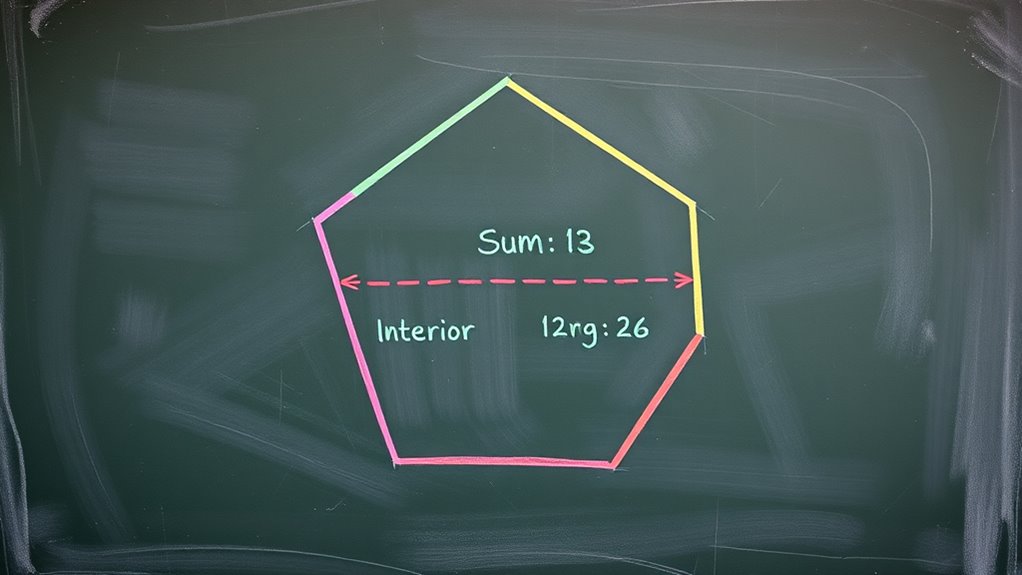
To prove the sum of interior angles in an n-sided polygon, you can imagine dividing the polygon into (n – 2) triangles by drawing diagonals from one vertex to all non-adjacent vertices. Since each triangle’s interior angles add up to 180 degrees, multiplying that by the number of triangles gives you the total. This clear approach not only confirms the formula but also opens the door to more geometric insights if you keep exploring.
Key Takeaways
- Dividing an n-sided polygon into (n-2) triangles, each with 180°, establishes the total interior angle sum.
- Connecting one vertex to all non-adjacent vertices creates the necessary triangles for the proof.
- The sum of interior angles equals the number of triangles times 180°, derived from the triangle angle sum.
- The formula (n−2)×180° directly results from counting the triangles formed within the polygon.
- This method applies universally, confirming the interior angle sum formula for any polygon.

Have you ever wondered how to find the total measure of all interior angles in a polygon with multiple sides? If so, you’re about to discover a simple yet powerful method rooted in the polygon formula and geometry principles. The key idea is that the sum of interior angles depends on the number of sides your polygon has, and this relationship is consistent for all polygons. To understand this, picture dividing your polygon into triangles. Since each triangle has an angle sum of 180 degrees, and the number of triangles you can draw inside the polygon relates directly to its sides, you can find the total interior angle measure with ease.
Start by considering a polygon with ( n ) sides. To find its angle sum, you can think about how many triangles can be formed by connecting one vertex to all other non-adjacent vertices. This division always results in ( n – 2 ) triangles. Each of these triangles contributes 180 degrees to the interior angle sum. Hence, the total measure of all interior angles in the polygon can be calculated by multiplying the number of triangles by 180 degrees. This reasoning leads directly to the polygon formula: the sum of interior angles equals ( (n – 2) times 180^circ ).
Dividing a polygon into (n – 2) triangles helps find its interior angle sum.
Understanding the geometric proof helps solidify your grasp of polygon geometry. The beauty of this approach is that it applies universally—regardless of how irregular or regular your polygon is. Whether it’s a pentagon, hexagon, or octagon, the same principle holds. Once you know the number of sides, simply substitute ( n ) into the formula. For example, if you have a hexagon, which has 6 sides, you calculate ( (6 – 2) times 180^circ ), resulting in a total interior angle sum of 720 degrees. This straightforward calculation is a direct consequence of the polygon formula and the way triangles can be used to partition polygons.
Understanding the proof behind the sum of interior angles helps solidify your grasp of polygon geometry. It shows that the angle sum isn’t arbitrary but follows a logical pattern based on dividing the polygon into triangles. This method also makes it easier to find individual interior angles if you know the total sum and the number of sides. Ultimately, mastering the polygon formula not only simplifies calculations but also deepens your geometric understanding, making it easier to explore more complex shapes and their properties.
Frequently Asked Questions
How Can I Find Each Interior Angle in a Regular Polygon?
To find each interior angle in a regular polygon, you divide the total sum of interior angles by the number of sides. Since regular polygons are symmetric, all angles are equal. You can also use angle bisectors to understand how each angle splits evenly. Simply use the formula: (180(n-2))/n, where n is the number of sides. This approach guarantees accurate, straightforward calculations of each interior angle.
What Is the Sum of Exterior Angles in Any Polygon?
You’ll find that the sum of exterior angles in any polygon equals 360 degrees, regardless of the number of sides. This is because each exterior angle forms a linear pair with its corresponding interior angle, and as you go around the polygon, these angles collectively add up to a full rotation. So, no matter how many sides your polygon has, the angle sum of all exterior angles remains constant at 360 degrees.
Do Interior Angles Change With Different Polygon Sizes?
You’ll find that interior angles do change with different polygon sizes. As the polygon size increases, the total sum of interior angles also increases, and the average angle per vertex varies accordingly. Although the sum of interior angles depends on the number of sides, individual angle variation occurs because each vertex’s angle adjusts to accommodate the overall shape. So, larger polygons generally have different interior angles compared to smaller ones.
How Does the Proof Differ for Concave Versus Convex Polygons?
Imagine you’re a medieval cartographer, but instead of mapping lands, you’re mapping angles. For convex polygons, the proof relies on interior angles summing to ((n-2) times 180^circ). For concave polygons, the proof adjusts for vertex concavity, and the interior angles can be less than 180°, affecting angle orientation. The core idea remains, but you must account for the inward dents that change the angle sum.
Can the Formula Be Applied to Three-Dimensional Shapes?
You can’t directly apply the polygon interior angles formula to 3D shapes because it only works for flat polygons, which are 2D. Polygon properties are specific to 2D figures, so for a 3D shape, you’d need to analyze its faces and their angles separately. While some concepts transfer, the interior angle sum formula isn’t valid for 3D shapes like polyhedra, which have different geometric rules.
Conclusion
Now that you’ve seen how the sum of interior angles in an n-sided polygon is calculated, you’re well-equipped to tackle any polygon problem that comes your way. Remember, understanding this concept is the key to revealing more advanced geometry topics. Keep in mind, knowing the angles isn’t just about numbers—it’s about seeing the bigger picture. With this knowledge, you can confidently navigate geometry’s twists and turns, because every puzzle has a solution if you look at it from the right angle.