
You observe that orbits are more often elliptical than perfect circles because gravity and velocity constantly interact, creating slightly stretched paths. As a body moves closer to a star, it speeds up, and when it moves farther away, it slows down, resulting in an elongated shape. External influences like nearby planets can also shift orbits over time. This dynamic balance keeps orbits naturally elliptical, and if you explore further, you’ll discover how these forces shape celestial motion in detail.

Prime made for students and young adults
- Fast, free delivery for dorm and study essentials
- Prime Video and Amazon Music included
- Member-only deals
Key Takeaways
- Gravitational forces and initial conditions naturally produce elliptical rather than circular orbits.
- Small external influences and perturbations tend to distort perfect circles into ellipses.
- Inertia and gravity balance to create stable elliptical paths, with perfect circles as a special case.
- Conservation of energy and angular momentum lead to varying speeds along elliptical orbits.
- Perfect circles require highly specific initial conditions, making ellipses the more common natural outcome.

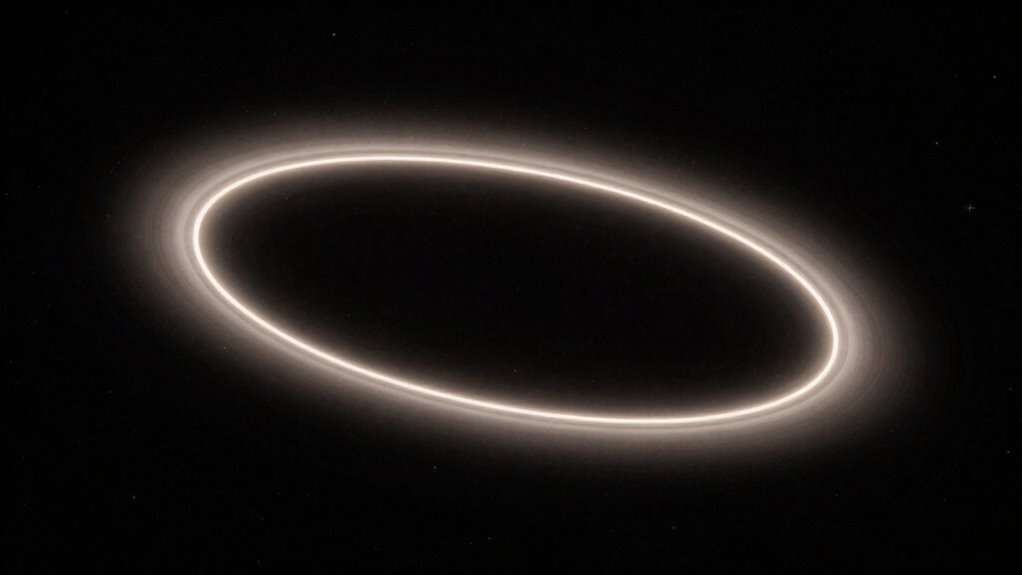
When it comes to the paths planets and other celestial bodies follow around stars, they rarely move in perfect circles. Instead, their orbits tend to be elliptical, which means they’re more like stretched-out circles. This isn’t just a random quirk; it’s rooted in the laws of physics, specifically the way gravitational influence shapes their paths. You might think that a planet’s orbit is a simple, steady circle, but in reality, the forces at play make perfect circles nearly impossible. Instead, the natural outcome of these forces is an ellipse, with the star sitting at one focus of the ellipse rather than at its center.
The reason behind this preference for ellipses traces back to the gravitational influence between a star and its orbiting body. When a planet moves around a star, gravity pulls it inward, constantly tugging it toward the star. At the same time, the planet’s own motion, or planetary rotation, causes it to continue moving forward. This balance between gravitational pull and the planet’s inertia results in an elliptical orbit. If the orbit were perfectly circular, it would mean that the gravitational force and the orbital speed are exactly balanced at all points, which is an idealized scenario. In real life, slight variations in velocity and gravitational influence cause the orbit to become elliptical rather than perfectly round.
You might also notice that the shape of an orbit can change over time due to gravitational influences from other bodies, such as nearby planets, moons, or even passing stars. These influences can introduce small variations, nudging the orbit into an ellipse rather than a circle. These gravitational influences can cause subtle shifts in orbital parameters, making the orbit a dynamic and ever-changing path. The elliptical shape allows the orbiting body to have varying speeds along its path—moving faster when it’s closer to the star and slower when it’s farther away. This variation is a direct consequence of the conservation of angular momentum and energy, which are fundamental principles in celestial mechanics. Additionally, the Gravitational influence is a key factor in determining the shape of an orbit, and understanding it helps explain why perfect circles are so rare in celestial mechanics. In fact, orbital eccentricity measures how much an orbit deviates from a perfect circle, highlighting the dynamic nature of celestial paths. This interplay results in a dynamic and constantly evolving orbital shape, which is a hallmark of celestial mechanics.
Furthermore, the laws of motion further govern how celestial bodies traverse these elliptical paths, shaping the dynamics we observe in our universe. In essence, the preference for ellipses isn’t about some celestial aesthetic choice; it’s a fundamental outcome of the laws governing gravity and motion. By understanding these principles, you see that perfect circles are a mathematical ideal, while actual orbits are shaped by the complex interplay of gravitational influence and planetary rotation. That’s why, when you look up at the night sky, you’re witnessing a universe where ellipses are the natural, elegant paths that planets and celestial bodies follow around their stars.
As an affiliate, we earn on qualifying purchases.
Frequently Asked Questions
How Do Gravitational Anomalies Affect Orbital Shapes?
Gravitational anomalies cause orbital perturbations, which can distort an otherwise smooth elliptical path. You’ll notice that irregularities in Earth’s gravitational field, like variations in mass distribution, lead to changes in orbit shape and stability. These gravitational irregularities make satellites shift slightly from their predicted paths, often requiring adjustments. So, gravitational anomalies directly influence orbital shapes, making them less perfect ellipses and more complex in real-world scenarios.
Can an Orbit Ever Become a Perfect Circle Naturally?
An orbit can become a perfect circle naturally, but it’s rare. Factors like orbital stability and tidal influences play significant roles. Over time, gravitational interactions and tidal forces tend to circularize orbits, especially for moons close to their planets. However, external perturbations or variations in mass distribution often prevent a perfect circle from forming or maintaining itself long-term. So, while possible, a perfectly circular orbit is generally uncommon in nature.
What Role Does Initial Velocity Play in Orbit Shape?
Your initial velocity plays a vital role in shaping your orbit, especially your orbital speed and velocity vectors. If you start with just the right velocity, you can achieve a nearly circular orbit, where the velocity vectors are perpendicular to the gravitational pull. However, slight variations in initial velocity cause the orbit to become elliptical, with changing distances from the central body, since the velocity vectors vary throughout the orbit.
Are Elliptical Orbits More Energy-Efficient Than Circular Ones?
Elliptical orbits are generally more energy-efficient than circular ones because of orbital eccentricity. You use less energy to maintain an elliptical orbit at certain points, thanks to natural energy conservation principles. When you start with a low eccentricity, the orbit is nearly circular, but as eccentricity increases, the orbit becomes elongated, which can reduce the energy needed at specific points. This makes elliptical paths more adaptable and efficient for celestial bodies.
How Do Spacecraft Adjust Their Orbits Over Time?
You adjust your orbit like tuning a musical instrument, using thrusters as your fingers. To counter orbital decay caused by space debris and atmospheric drag, you fire engines briefly to raise your altitude or change your path. These small, precise pushes help maintain your trajectory, ensuring you stay on course. With each adjustment, you keep dancing smoothly through space, balancing forces and avoiding the chaos of debris and decay.
solar system elliptical orbit model
As an affiliate, we earn on qualifying purchases.
As an affiliate, we earn on qualifying purchases.
Conclusion
Just as the Earth’s dance around the Sun isn’t a perfect circle but an elegant ellipse, your own journey isn’t a straight line but a series of curves and turns. Embrace these deviations, for they mirror the universe’s natural rhythm—reminding us that beauty and growth often lie in imperfection. Like the celestial bodies, your path’s unique shape holds the potential for discovery, showing that sometimes, it’s the crooked route that leads to the most extraordinary destinations.
celestial mechanics educational kit
As an affiliate, we earn on qualifying purchases.
As an affiliate, we earn on qualifying purchases.
As an affiliate, we earn on qualifying purchases.
Halloween Picks
halloween
As an affiliate, we earn on qualifying purchases.