
Imagine space as a flexible fabric that can dip and bend when heavy objects like planets sit on it. Instead of thinking of gravity as a force, picture objects following curved paths around these dips—like rolling balls on a trampoline. Light also bends as it passes these curves, causing distant objects to look warped. This idea of curved space helps you understand how the universe works without heavy physics—if you keep exploring, you’ll discover how it all fits together.

Prime made for students and young adults
- Fast, free delivery for dorm and study essentials
- Prime Video and Amazon Music included
- Member-only deals
Key Takeaways
- Space is like a flexible fabric that can bend and dip under mass, affecting the movement of objects and light.
- Heavy objects create dips in space, guiding planets and stars along curved paths instead of straight lines.
- Light bends when passing near massive objects, causing phenomena like gravitational lensing and warped images of distant galaxies.
- Variations in mass and energy change space’s shape, influencing the formation and evolution of cosmic structures.
- Understanding space as a dynamic, curved fabric helps explain the universe’s structure without complex physics.

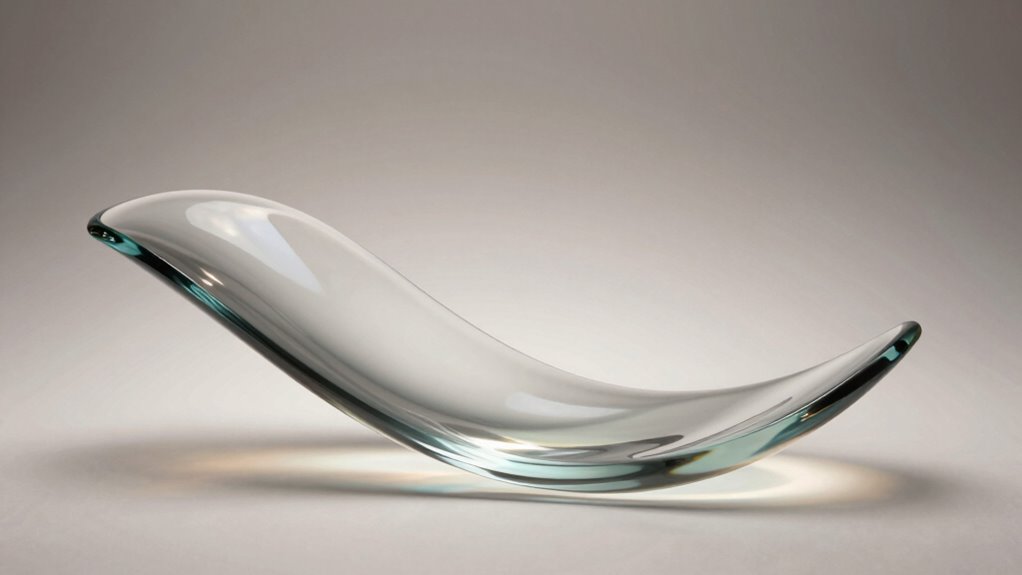
Have you ever wondered how space itself can bend and curve? It’s a fascinating idea that challenges our everyday understanding of the universe. When you picture space as a vast, empty stretch, it’s easy to imagine it as flat and unchanging. But in reality, space isn’t just a passive backdrop; it’s a dynamic fabric that can bend and distort. This phenomenon is known as space-time distortion, and it’s at the heart of what we call curved space. Instead of thinking of space as a flat sheet, imagine it as a flexible trampoline. When you place a heavy object, like a bowling ball, on the trampoline, it causes the surface to dip. This dip is a simple way to visualize how massive objects like planets and stars create curves in space. These curves are what we refer to as gravitational effects, and they influence how objects move around each other.
In everyday life, you might think of gravity as a force pulling objects downward. But on the cosmic scale, gravity is better understood as the result of curved space. When a planet orbits a star, it’s not because of an invisible force pulling it in, but because it’s following the straightest possible path through a curved space. To put it simply, the planet moves along a curved route because space itself is bent by the star’s mass. This is the essence of gravitational effects caused by space-time distortion. It’s like rolling a marble across a distorted rubber sheet—you’ll notice it curves toward the dip, just like planets orbit stars.
Understanding curved space helps explain many phenomena we observe in the universe. Light, for example, doesn’t always travel in straight lines; it follows the curvature of space around massive objects. That’s why we see gravitational lensing, where light from distant galaxies bends around closer objects, creating warped images. This effect is a direct consequence of the space-time distortion, which explains how the fabric of space influences the path of light. Recognizing that space is a dynamic fabric rather than a static void further enhances our understanding of these phenomena. Additionally, the concept of space curvature provides insight into the overall structure and evolution of the universe. It’s important to note that the curvature of space can vary greatly depending on the distribution of mass and energy in the cosmos. The structure of the universe is shaped by these variations, affecting how galaxies and other large-scale features form and evolve. So, when you think about curved space, remember it’s a way of visualizing the universe’s structure without heavy physics. It’s about understanding how massive objects shape the fabric of space and how that shaping influences everything from planetary orbits to the path of light traveling through the cosmos.
As an affiliate, we earn on qualifying purchases.
Frequently Asked Questions
How Does Curved Space Affect Everyday Objects?
Curved space affects everyday objects subtly but profoundly. You might notice it through phenomena like gravitational lensing, where light bends around massive objects, altering how you see distant stars. This curvature is part of the space-time fabric that shapes gravity’s pull. Although you don’t feel it directly, curved space influences satellite paths, GPS accuracy, and even how objects fall, all because of the way mass warps the space around us.
Can Curved Space Be Visualized Easily?
You might find it surprising, but curved space can be visualized through simple mathematical models and visual illusions. These tools help you see how space bends, like the way a landscape distorts in a funhouse mirror. By observing these illusions, you grasp how gravity influences space without heavy physics. While not a literal picture, these visualizations make the concept more accessible and engaging, showing the elegant shape of the universe.
How Is Curved Space Different From Curved Surfaces?
Curved space differs from curved surfaces because it involves the fabric of space-time itself, not just a two-dimensional surface. In curved space, geodesic paths—like the shortest routes between points—bend around mass and energy, illustrating how gravity works. You can think of space as a flexible, dynamic fabric that warps, guiding objects along curved trajectories, whereas curved surfaces are limited to two dimensions without the complex interplay of time.
Does Curved Space Influence Time?
Yes, curved space influences time through spacetime warping. Gravitational time dilation occurs when massive objects bend spacetime, causing time to pass slower near them. You’d notice this effect if you were close to a massive body like a planet or black hole, with time ticking differently than farther away. This interplay between space and time highlights how gravitational forces shape not just the universe’s structure but the very flow of time itself.
Why Is Curved Space Important in Cosmology?
You need curved space in cosmology because it explains how the universe behaves. It helps you understand how dark matter influences galaxy formations and why objects bend light through gravitational lensing. Without considering curvature, your models wouldn’t match observations, making it impossible to grasp the universe’s true structure. Curved space reveals the unseen forces shaping everything from tiny particles to vast cosmic structures.
As an affiliate, we earn on qualifying purchases.
Conclusion
So, next time you walk around, just remember—you’re not just moving through space, but through a fabric that bends around massive objects. It’s like walking on a trampoline, where everything dips and curves beneath your steps. Ironically, this invisible “curving” makes your universe feel so normal, yet it’s the very reason planets stay put and light bends. Who knew that the universe’s shape could be so simple—yet so mind-bending?
physics demonstration trampoline
As an affiliate, we earn on qualifying purchases.
As an affiliate, we earn on qualifying purchases.
As an affiliate, we earn on qualifying purchases.
Halloween Picks
halloween
As an affiliate, we earn on qualifying purchases.