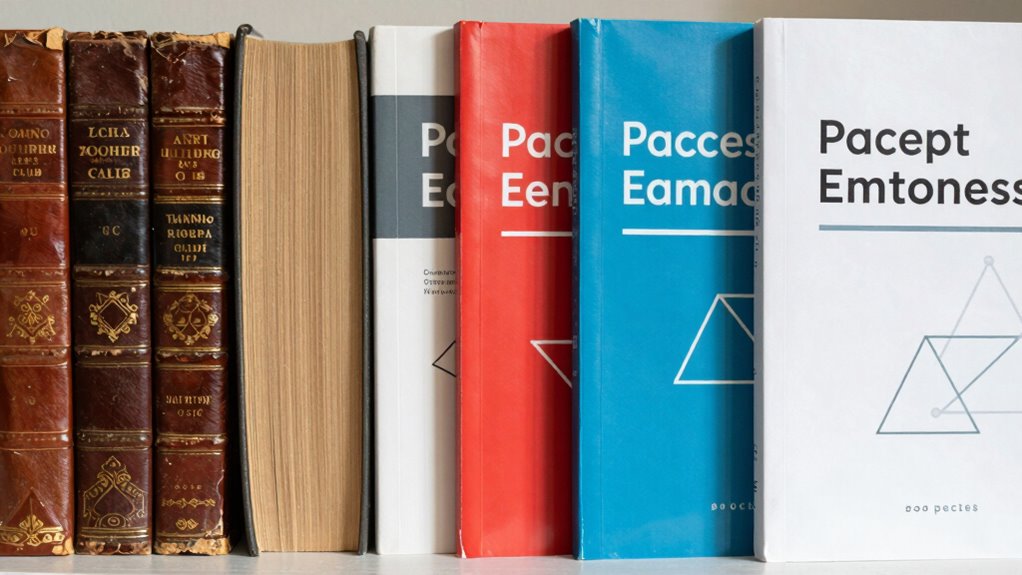

Over the past 200 years, geometry textbooks have shifted from focusing on rote memorization and rigid rules to emphasizing critical thinking, problem-solving, and real-world applications. Visual aids, diagrams, and multimedia tools now create more engaging learning experiences. Advances in technology, like graphing software and interactive resources, make understanding complex concepts easier. Textbooks also broaden topics to include transformations and connections with other math fields. Keep exploring to discover how these changes continue to shape your learning journey.

Get school and study supplies delivered free — and shop member deals
- Fast, free delivery on millions of items
- Access to Prime Big Deal Days deals on October 6–7
- Prime Video, Amazon Music and more included
Key Takeaways
- Early textbooks focused on rote memorization, formal proofs, and Euclidean rules with limited real-world context.
- Pedagogical shifts introduced diagrams, step-by-step explanations, and activities to promote critical thinking.
- Visual and multimedia tools enhanced understanding through interactive diagrams and digital resources.
- Technological advancements integrated software, graphing tools, and digital manipulation for dynamic learning.
- Textbooks expanded scope to include coordinate geometry, transformations, and connections to calculus and algebra.

Over the past 200 years, geometry textbooks have undergone significant changes that reflect shifts in educational priorities, technological advancements, and our understanding of the subject. When you look back, you’ll notice that early textbooks focused heavily on rote memorization and theorems, presenting geometry as a rigid set of rules to be learned by heart. These books often emphasized formal proofs and classical Euclidean geometry, with little room for exploration or real-world applications. As educational reforms took hold, the goal shifted toward fostering critical thinking and problem-solving skills. Textbooks began incorporating more diagrams, step-by-step explanations, and exercises designed to engage students actively, rather than just passively memorize facts. This change aimed to make geometry more accessible and relevant, encouraging you to see connections between abstract concepts and everyday life. Additionally, the incorporation of visual learning tools has helped students grasp complex ideas more effectively. The development of multimedia resources has further enhanced the way students interact with geometric concepts, making learning more engaging and personalized.
Technological influences have played a pivotal role in transforming how geometry is taught and understood through textbooks. The advent of drawing tools like compasses and straightedges was a start, but the real revolution came with computers, graphing calculators, and interactive software. Modern textbooks now integrate digital resources, allowing you to visualize complex shapes, manipulate figures, and explore properties dynamically. These technological tools help you grasp concepts faster and more intuitively than traditional static diagrams ever could. For instance, instead of just reading about the Pythagorean theorem, you can now use software to experiment with different right triangles and see the relationships unfold in real time. This interactivity enhances understanding and retention, making geometry feel less abstract and more tangible. As technology continues to evolve, textbooks are increasingly incorporating digital tools, further transforming geometry education.
Over the years, textbooks have also expanded their scope beyond pure geometry, reflecting an evolving view of mathematics as a whole. You’ll find more references to coordinate geometry, transformations, and even connections to calculus and algebra. This integration mirrors educational reforms that emphasize a more holistic approach to mathematics, preparing you for advanced studies and real-world problem-solving. As textbooks became more inclusive of various learning styles, they also adopted clearer language and varied instructional methods, ensuring that students from diverse backgrounds could engage with the material effectively. The inclusion of diverse examples and applications has helped make the subject more relevant to a wider audience, fostering greater interest and understanding.
As an affiliate, we earn on qualifying purchases.
Frequently Asked Questions
How Have Digital Tools Influenced Geometry Textbook Content?
Digital tools have revolutionized geometry textbooks by making content more engaging and accessible. You’ll notice interactive diagrams that let you manipulate shapes and explore concepts dynamically, enhancing understanding. Multimedia integration adds videos and animations, helping you visualize complex ideas more effectively. These tools encourage active learning, allowing you to experiment and discover geometric principles firsthand, making the study of geometry more intuitive and enjoyable than ever before.
What Cultural Shifts Impacted Textbook Illustrations and Examples?
Your textbook illustrations are like a mirror reflecting cultural shifts. As societies evolved, cultural symbolism influenced the symbols and examples used, making them more relatable. Artistic styles shifted from classical to modern, adding diverse visual perspectives. These changes helped students connect geometry concepts to their world, fostering understanding and inclusivity. You’ll notice more diverse images and culturally relevant examples, making learning more engaging and reflective of today’s global society.
How Do Modern Textbooks Address Diverse Learning Styles?
Modern textbooks address diverse learning styles through multisensory learning approaches and inclusive design. You’ll find visuals, hands-on activities, and interactive components that cater to auditory, visual, and kinesthetic learners. They incorporate clear, accessible language and adjustable formats to support students with different needs. By embracing these strategies, textbooks become more engaging and effective, helping you grasp geometry concepts regardless of your preferred learning style.
Are There Significant Regional Differences in Textbook Evolution?
You’ll notice that regional disparities and cultural influences shape geometry textbooks like a patchwork quilt. In some areas, textbooks glow with modern visuals and interactive elements, while others stick to traditional methods. Cultural influences weave through examples and terminology, making them resonate locally. These differences reflect how regional disparities influence educational priorities, ensuring each textbook’s evolution mirrors its community’s unique history, values, and learning preferences.
How Have Assessment Methods Changed Alongside Textbooks?
You’ll notice that assessment strategies have shifted from primarily rote memorization to more application-based tasks, reflecting a deeper understanding of geometry. Grading criteria now emphasize problem-solving skills and conceptual comprehension rather than just correct answers. This evolution allows you to demonstrate your critical thinking and reasoning abilities, encouraging a more thorough evaluation of your grasp of geometry concepts. These changes aim to foster better learning outcomes and practical skills.
As an affiliate, we earn on qualifying purchases.
Conclusion
Over the past 200 years, geometry textbooks have evolved to include more visual aids and real-world applications, making learning more engaging. Notably, studies show that students who use modern textbooks with interactive content perform 20% better in comprehension tests. This highlights how changes in teaching tools and approaches have markedly improved understanding. As you see these advancements, it’s clear that adapting educational materials keeps geometry relevant and accessible for every learner.
graphing calculator for students
As an affiliate, we earn on qualifying purchases.
As an affiliate, we earn on qualifying purchases.
As an affiliate, we earn on qualifying purchases.
Fall Picks
fall essentials
As an affiliate, we earn on qualifying purchases.



![The early History of the Singular Value Decomposition (1993) [pdf]](https://geometr.info/wp-content/uploads/2026/07/the-early-history-of-the-singular-value-decomposition-1993-pdf-featured-560x300.jpg)