
Geometry plays a crucial role in Mars missions, guiding your rover’s navigation, mapping, and exploration. It helps interpret surroundings by calculating distances, angles, and spatial relationships, ensuring safe routes across rough terrains. Geometric techniques create detailed maps from satellite data and enable autonomous decisions when communication delays occur. This unseen blueprint allows robots to analyze their environment and make smart choices, paving the way for more advanced exploration. Keep your curiosity about how geometry transforms space missions.
Key Takeaways
- Geometry enables accurate mapping and 3D visualization of Mars terrain for mission planning and scientific analysis.
- It underpins autonomous navigation systems, allowing rovers to interpret surroundings and avoid hazards in real time.
- Geometric algorithms help calculate distances, slopes, and angles essential for safe traversal across challenging landscapes.
- Data from orbiters and landers are processed through geometric transformations to create detailed, high-resolution planetary maps.
- Advanced geometric reasoning supports autonomous decision-making, ensuring efficient exploration despite communication delays with Earth.
Have you ever wondered what the latest discoveries in space science reveal about our universe? One of the most exciting advancements comes from how researchers are using geometry to enhance Mars missions. This might sound abstract, but it has a direct impact on how robotic explorers navigate and map the Red Planet. The combination of robotic navigation and planetary mapping depends heavily on geometric principles to guarantee that robots can move efficiently and gather precise data.
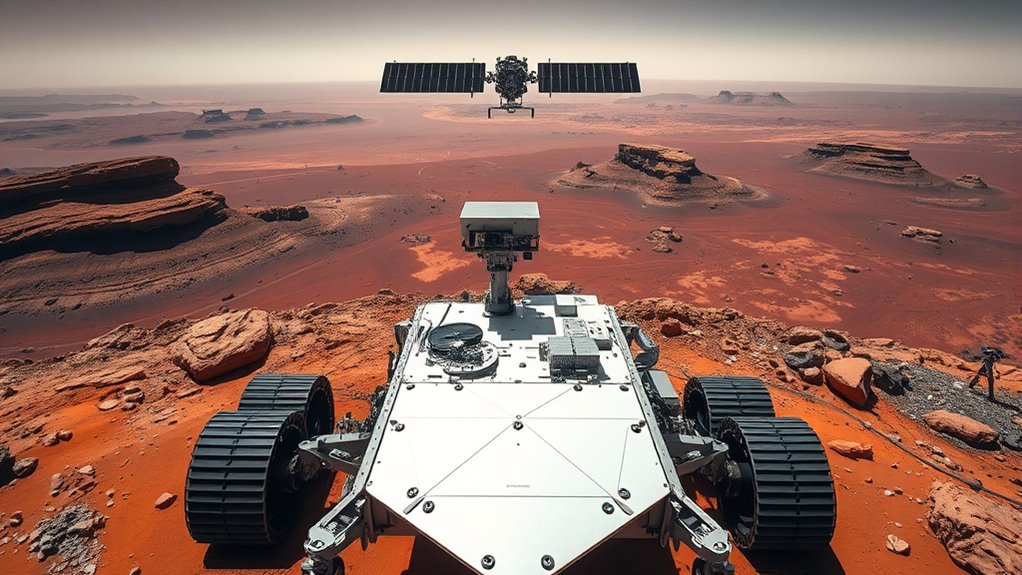
When rovers like Perseverance explore Mars, they rely on advanced robotic navigation systems. These systems use geometry to interpret their surroundings accurately, allowing the rover to plot safe paths across tricky terrains. Instead of blindly moving forward, the rover’s software calculates distances between rocks, slopes, and craters by applying geometric algorithms. This helps avoid hazards and makes certain the mission’s safety. The geometry involved isn’t just about straight lines; it includes angles, curves, and spatial relationships that help the rover understand its environment in three dimensions.
Robots like Perseverance use geometry to navigate and avoid hazards on Mars safely.
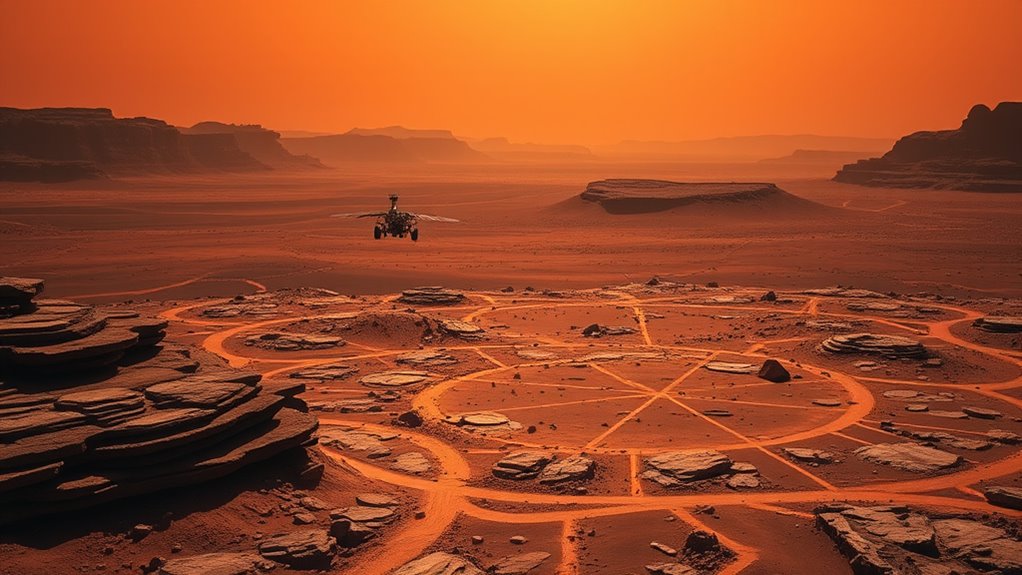
Planetary mapping is another area where geometry plays a vital role. To create detailed, accurate maps of Mars, scientists use geometric data collected from orbiters and landers. They analyze images and sensor readings by applying geometric transformations—rotations, translations, and projections—to stitch together different datasets into cohesive, high-resolution maps. This process enables scientists to visualize the terrain precisely, identify interesting geological features, and plan future exploration routes.
The importance of geometric reasoning extends to autonomous decision-making. As robotic explorers venture into uncharted areas, they must interpret geometric cues in real time. For example, recognizing the shape of a cliff or the slope of a hill helps the rover decide whether to continue forward or find an alternative route. This real-time geometric analysis is essential for maintaining momentum in missions where communication delays with Earth can be hours long.
In essence, geometry acts as the backbone of modern Mars exploration. It empowers robotic systems with the ability to navigate complex terrains confidently and to create detailed planetary maps that guide scientific investigation. As space agencies develop more sophisticated algorithms rooted in geometric principles, future missions will become even more autonomous, efficient, and capable of uncovering the secrets of Mars. So, next time you think about space exploration, remember how fundamental geometry is—turning abstract shapes and measurements into tangible progress on our journey to understand the cosmos.
Frequently Asked Questions
How Does Geometry Influence Rover Navigation on Mars?
You might wonder how geometry influences rover navigation on Mars. It plays a crucial role in understanding the Martian atmosphere, helping you plan safe routes. Proper geometric calculations ensure your rover’s solar panel alignment is optimized for sunlight, which is vital for power. By using geometric principles, you can accurately interpret terrain features, avoid hazards, and navigate efficiently, ensuring your mission’s success despite the challenging Martian environment.
What Geometric Tools Are Used to Analyze Martian Terrain?
You use geometric tools like geometric pattern recognition and topographical mapping to analyze Martian terrain. These tools help you identify terrain features, such as slopes and craters, by recognizing shapes and patterns. Topographical maps provide detailed elevation data, guiding your rover’s navigation and scientific exploration. By applying these geometric methods, you guarantee safer, more efficient movements across the Martian surface, maximizing your mission’s success.
How Is Geometry Applied in Designing Mars Spacecraft Trajectories?
Imagine plotting a cosmic treasure map, where every twist and turn guides your spaceship safely to Mars. You use geometry to craft an orbital transfer, ensuring smooth sailing through space. Trajectory optimization becomes your secret weapon, helping you find the shortest, safest route. With precise calculations, you avoid space pirates and black holes, making sure your spacecraft follows the perfect path, turning complex math into a stellar adventure.
What Role Does Geometry Play in Mars Habitat Construction?
You use geometry to design stable Mars habitats by analyzing Martian geology to select ideal locations. Geometry helps you determine the best angles and shapes for structures, guaranteeing habitat stability against Mars’ harsh conditions. By understanding surface slopes and subsurface features, you can create secure foundations. This strategic use of geometry ensures safe, durable habitats that can withstand environmental challenges, making human exploration on Mars more feasible and sustainable.
Are There Geometric Challenges Unique to Mars Exploration?
Like steering uncharted waters, you face unique geometric challenges on Mars. Its atmospheric conditions demand precise shielding designs, while cosmic rays pose constant threats. You must adapt your geometric strategies to balance protection and resource efficiency, ensuring habitats withstand Mars’ harsh environment. These challenges test your ingenuity, pushing you to rethink traditional geometry to keep explorers safe and resilient in this alien world.
Conclusion
As you explore the role of geometry in Mars missions, you see how it shapes navigation, guides exploration, and reveal mysteries. Geometry helps you understand terrain, plan routes, and analyze data, turning complex challenges into clear solutions. It empowers you to innovate, discover, and push boundaries. With geometry as your guide, you’re not just observing Mars—you’re actively shaping its exploration, transforming curiosity into achievement, and turning possibilities into realities.