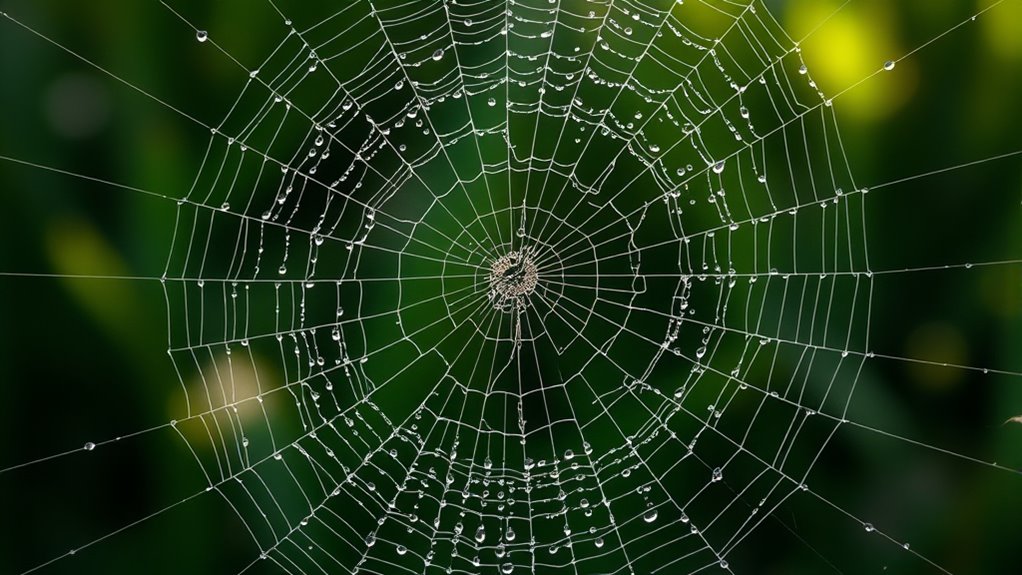

Spiderwebs display impressive radial symmetry, which you can see in how the silk strands extend from a central point like spokes on a wheel. This geometric pattern evenly distributes tension and forces from prey impact or wind, making the web both strong and stable. The radial lines work with concentric circles to maximize surface area for trapping insects while maintaining resilience. If you keep exploring, you’ll discover how this clever design reflects nature’s engineering mastery.
Key Takeaways
- Spiderwebs utilize radial lines arranged symmetrically to evenly distribute tension and enhance stability.
- Radial symmetry ensures effective prey capture by evenly spreading impact forces across the web.
- The geometric pattern combines radial spokes with concentric circles for maximum surface area and trapping efficiency.
- Symmetrical design improves web resilience against environmental forces like wind and prey struggles.
- The structured geometry reflects natural engineering principles, optimizing both strength and functionality of the web.

Have you ever wondered what makes a spider’s web so strong and efficient? The answer lies in the remarkable silk tensile properties and the intricate web construction patterns that spiders expertly craft. Spider silk isn’t just sticky; it’s incredibly durable, elastic, and lightweight. Its tensile properties allow it to stretch substantially under tension without snapping, which is essential for absorbing the impact of flying insects. This flexibility combined with strength makes the web a resilient trap, capable of holding prey despite sudden movements or struggles. The silk’s unique composition, including proteins like spidroin, grants it these exceptional qualities, enabling spiders to produce webs that are both strong and adaptable. When you observe a web, you’re witnessing a marvel of natural engineering, where the silk’s tensile properties are perfectly matched to the web’s function.
The construction of the web is a masterclass in geometry, particularly radial symmetry. As you watch a spider spin its web, you’ll notice how it begins with a sturdy anchor line, often stretched between two points. From there, it constructs a series of radial lines that extend outward like spokes on a wheel. These radial lines form the framework, providing support and structure. Between these spokes, the spider meticulously adds concentric circles or spiral threads, creating a pattern that maximizes surface area and trapping potential. This radial symmetry isn’t accidental; it’s a deliberate design that distributes tension evenly across the web, ensuring stability and efficiency. The pattern allows the web to withstand various forces, such as wind or the impact of prey, by dispersing stress throughout the entire structure.
This geometric arrangement also plays a vital role in prey capture. When an insect hits the web, the radial symmetry helps distribute the force evenly across the silk threads, preventing any single point from failing. The spiral threads often have sticky droplets, designed to entrap insects efficiently. The combination of precise web construction patterns and the silk’s tensile properties results in a web that’s both resilient and highly effective. Understanding this, you can appreciate how each component, from the silk’s molecular strength to the symmetry of the design, works together seamlessly. It’s a brilliant example of nature’s engineering—where form and function align perfectly to create a web that’s as beautiful as it is functional.
Frequently Asked Questions
How Do Spiders Determine the Placement of Radial Threads?
You determine the placement of radial threads by observing how spiders use silk elasticity and web durability. They start from the center, stretching and attaching silk threads outward in evenly spaced intervals. This guarantees the web’s strength and flexibility, allowing it to absorb impacts. As you build, you focus on maintaining consistent spacing and tension, creating a balanced, durable web that effectively captures prey and withstands environmental forces.
What Is the Mathematical Basis for Web Symmetry?
You can understand web symmetry through mathematical modeling and symmetry algorithms. These tools analyze how spiders create evenly spaced radial and spiral threads, resulting in radial symmetry. By applying symmetry algorithms, you see patterns and regularities in web design, revealing the underlying mathematical principles. This approach helps explain the precise, balanced structure of webs, showcasing nature’s use of geometry and mathematical modeling to achieve perfect radial symmetry.
Do Different Spider Species Create Different Geometric Patterns?
Yes, different spider species create different geometric patterns, showcasing web pattern diversity and species-specific designs. You’ll notice that orb-weavers, for example, construct perfect circles with radiating spokes, while cobweb spiders produce irregular, tangled structures. Each species adapts its web pattern to its environment and hunting style, resulting in a fascinating variety of intricate, functional designs that reflect their unique behaviors and ecological niches.
How Does Web Geometry Influence Prey Capture Success?
You notice that web geometry directly affects your prey capture success by optimizing insect entrapment. A well-designed web with appropriate elasticity absorbs the impact of insects, increasing chances they’ll become trapped. Radial and sticky spiral patterns work together to maximize surface area and stickiness, making it harder for prey to escape. So, the precise geometry of a spider’s web plays a vital role in catching more insects efficiently.
Can Humans Replicate Spiderweb Structures Using Engineering Principles?
Yes, you can replicate spiderweb structures through clever coding of biomimicry applications in structural engineering. By mimicking webs’ radial and spiral patterns, engineers design durable, lightweight frameworks for bridges, buildings, and sensors. This biomimicry approach harnesses nature’s genius, translating spiderweb symmetry into strong, flexible structures. Like spinning silk, your innovations weave functionality with finesse, transforming natural web wisdom into practical, protective projects for human use.
Conclusion
As you step closer, you notice the delicate threads radiating like spokes on a wheel, glistening with dew. The web’s intricate symmetry reflects nature’s precision, a silent marvel spun in perfect harmony. Each strand catches the sunlight, shimmering like glass, inviting you to marvel at its fragile strength. You realize this web isn’t just a trap—it’s a masterpiece of geometry, a stunning reminder of the beauty woven into every corner of the natural world.