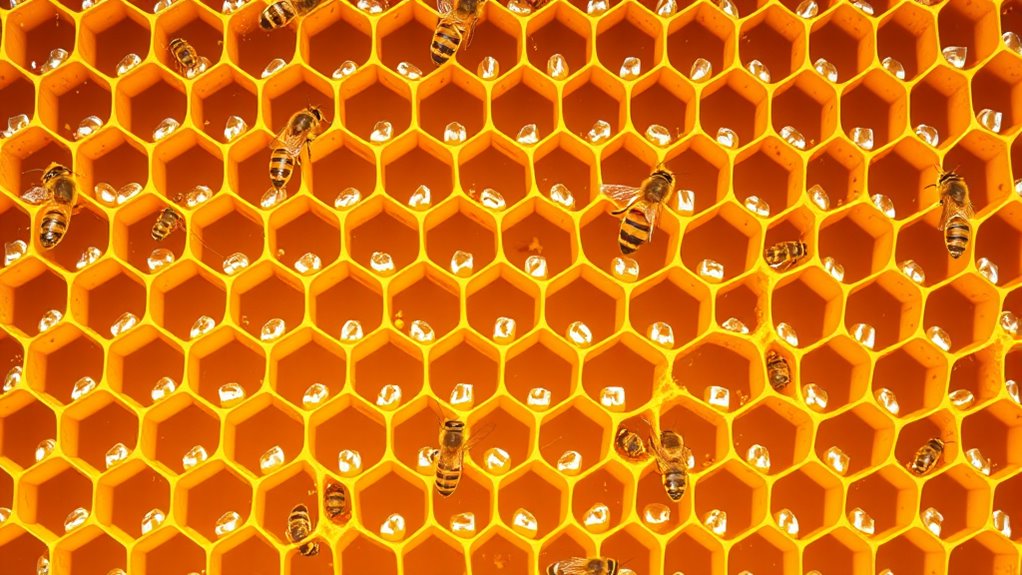

You’ll see that bees build honeycombs with perfect hexagons because this shape maximizes space, strength, and resource efficiency. Hexagons fit tightly together without gaps, saving wax and providing a stable structure that distributes weight evenly. This smart design helps the hive hold honey and support bee larvae. If you want to understand why this shape is so effective and how bees instinctively choose it, there’s more to discover behind this natural engineering marvel.
Key Takeaways
- Bees build hexagonal cells because this shape maximizes storage space while minimizing wax use.
- Hexagons evenly distribute weight, providing strength and stability to the honeycomb structure.
- The 120-degree angles of hexagons allow perfect, tight packing without gaps, optimizing space.
- The design efficiently balances resource conservation with structural support, ensuring colony sustainability.
- Honeycombs exemplify natural engineering, showcasing evolution’s role in developing the most effective shape.
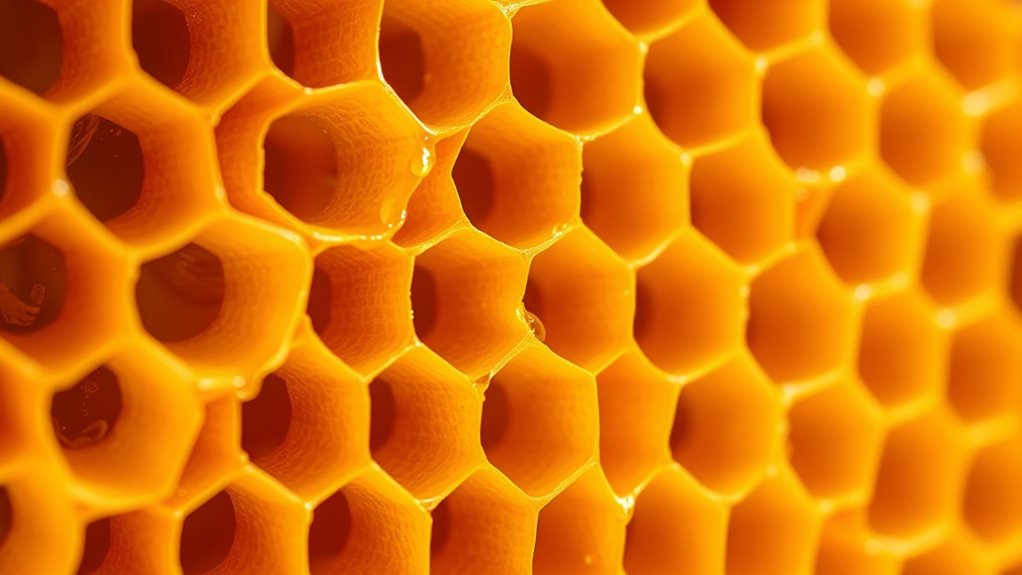
Honeycombs are a fascinating example of nature’s efficiency, showcasing how hexagons are used to maximize space and strength. When you observe a honeycomb, you see a perfect pattern of tightly packed cells, each one fitting seamlessly into the next. This isn’t a coincidence; it’s the result of bees’ engineering and their innate understanding of geometric principles. Bees have evolved to build with hexagons because this shape offers the best way to use resources while creating a sturdy, functional structure. The choice of hexagon efficiency isn’t just about aesthetics—it’s about practicality and optimization. Bees instinctively craft these shapes because they provide a way to store maximum honey and house the colony with minimal wax.
Honeycombs showcase nature’s ingenuity, maximizing space and strength with perfectly fitted hexagonal cells.
The strength of hexagons also plays an essential role. When you look at the structure, you notice how the shape distributes weight evenly, making the honeycomb incredibly resilient. This means the comb can hold a lot of honey, bee larvae, and withstand external pressures without collapsing. The engineering behind this shape is so effective that it minimizes the amount of wax needed while maintaining structural integrity. This efficiency is fundamental because producing wax is energy-intensive for bees. By building with hexagons, bees conserve resources and maximize storage capacity at the same time. Additionally, the geometric precision of hexagons allows for tighter packing and better resource management.
Furthermore, honeycombs demonstrate how nature’s design often mirrors mathematical efficiency. The hexagon’s angles are precisely 120 degrees, which allows the cells to fit together perfectly without gaps. This tight packing reduces wasted space, ensuring every part of the comb contributes to the colony’s survival. As a result, bees’ engineering skills have created a structure that’s both economical and durable. It’s a perfect example of how evolution favors shapes that optimize function, especially when resources are limited.
In essence, the hexagon efficiency of honeycombs highlights the brilliance of natural engineering. Bees have discovered a way to build structures that are strong, efficient, and resource-conscious—all driven by instinct and necessity. The hexagon pattern is a testament to how nature employs simple geometric principles to solve complex problems. When you understand the reasoning behind honeycombs’ design, you gain a new appreciation for the intricate, intelligent world of bees and their remarkable ability to turn basic shapes into masterpieces of engineering. Exploring other innovative designs in nature can deepen our understanding of how form and function are intertwined.
Frequently Asked Questions
How Do Bees Construct Hexagonal Cells so Efficiently?
You might wonder how bees construct hexagonal cells so efficiently. They instinctively use hexagonal geometry, which minimizes material while maximizing storage space. As they build, the bees adjust their wax to create perfect hexagons through natural, collective behavior. This process showcases their incredible construction efficiency, as hexagonal shapes require less wax and fit together seamlessly, demonstrating evolution’s smart design for ideal storage and strength in their honeycombs.
Are There Any Other Animals That Use Hexagonal Patterns?
You might be surprised, but other animals also use hexagonal patterns in their natural architecture. For example, certain wasps and ants create hexagonal nest chambers, optimizing space and strength. These natural pattern formations showcase how evolution favors efficiency, much like bees do. You can see this geometric design in the intricate structures of some spider webs and even in the scales of fish. Hexagons truly are the architecture of nature’s ingenuity.
Why Are Honeycomb Patterns Not Perfect Hexagons Everywhere?
You notice honeycomb patterns aren’t perfect hexagons everywhere because honeycomb irregularities and cell shape variation happen naturally. Bees optimize their wax to fill irregularities, but slight imperfections occur due to environmental factors, wax consistency, and construction challenges. This variation helps the hive maintain strength and flexibility, even if some cells aren’t perfect hexagons. So, these tiny imperfections are a natural part of how bees build efficient, resilient honeycombs.
Can Humans Replicate Honeycomb Structures in Engineering?
Yes, you can replicate honeycomb structures in engineering. By exploring biomimicry applications, you can develop lightweight, strong, and efficient designs inspired by bees’ hexagonal patterns. These structures influence architectural innovations, allowing you to create space-efficient buildings, durable panels, and energy-efficient materials. Emulating nature’s perfect shapes helps you optimize resources and enhance structural integrity, making honeycomb-inspired designs a valuable asset in modern engineering and architecture.
Do Honeybees Prefer Hexagons Over Other Shapes Naturally?
You might wonder if bees prefer hexagons naturally. Bees’ shape preference actually drives honeycomb efficiency, as hexagons require less wax and maximize storage space. This shape fits perfectly with their needs, making it the most practical choice. Bees instinctively build hexagonal cells because it’s the best way to create strong, efficient honeycomb structures that optimize their resources and storage.
Conclusion
So next time you see a honeycomb, remember you’re gazing at nature’s masterpiece—an elegant example of perfect engineering. The hexagon’s genius isn’t just in its shape, but in how it unites strength, efficiency, and harmony in one tiny cell. Isn’t it incredible how bees, without tools or plans, craft a structure that outshines even human design? Truly, honeycombs remind us that sometimes, the simplest shapes hold the greatest secrets.