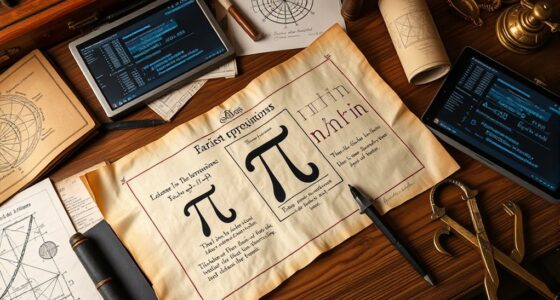
Pi is the most famous circle constant, representing the ratio of a circle’s circumference to its diameter. Its origins date back to ancient civilizations like the Egyptians and Babylonians, with Greek mathematicians like Archimedes refining its approximation. The symbol π was popularized by Euler in the 18th century, making it essential in geometry, physics, and engineering. If you explore further, you’ll uncover more about how pi connects math, science, and our understanding of the universe.
Key Takeaways
- Pi (π) is the ratio of a circle’s circumference to its diameter, approximately equal to 3.14159.
- It has been recognized since ancient civilizations like Egyptians and Babylonians.
- The symbol π was popularized by Leonhard Euler in the 18th century to represent this constant.
- Pi is fundamental in formulas for calculating circle area and circumference, and appears in many branches of mathematics.
- As a universal constant, pi symbolizes human curiosity and the pursuit of understanding the universe through mathematics.
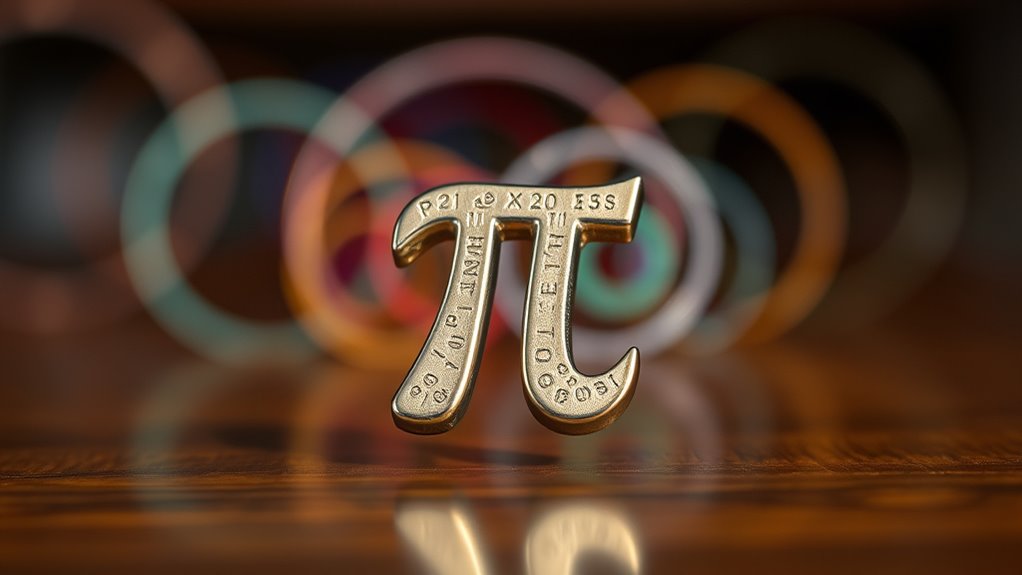
Have you ever wondered why circles are so fundamental to mathematics? It turns out that the answer lies in the deep-rooted history and the universal math symbolism associated with these perfect shapes. The symbol we now associate with pi (π) has a rich historical origin, stretching back thousands of years. Ancient civilizations, including the Egyptians and Babylonians, recognized the relationship between a circle’s circumference and its diameter long before the formal development of geometry. They used rough approximations, but it was the Greeks who truly formalized the concept. Mathematicians like Archimedes devised methods to approximate pi, laying the groundwork for its mathematical significance. The historical origins of pi highlight humanity’s enduring fascination with understanding the properties of circles and the quest for precision in measurement. Interestingly, this ongoing curiosity demonstrates how mathematical constants serve as bridges between abstract ideas and practical applications.
As you explore the world of math symbolism, you’ll notice that pi’s symbol (π) itself was popularized in the 18th century by Welsh mathematician Leonhard Euler. The Greek letter pi was chosen because it’s the first letter of the Greek word “perimeter” (periphēría), emphasizing its link to the circle’s boundary. This simple yet elegant symbol became a universal notation, allowing mathematicians across different cultures to communicate complex ideas about circles efficiently. The adoption of π as a standard symbol marked a milestone, making it easier to incorporate the constant into equations, calculations, and scientific theories.
Understanding why pi is so central to mathematics involves recognizing its role as a fundamental constant. It appears in formulas across geometry, trigonometry, calculus, and even physics. When you see pi in equations like the area of a circle (A = πr²) or the circumference (C = 2πr), you grasp its importance in describing the world around you. Its presence in wave functions, statistics, and probability underscores its versatility. Pi’s math symbolism embodies the idea that a simple ratio can reveal complex relationships, bridging the gap between abstract theory and real-world applications.
In essence, the history behind pi’s origins and its symbolic representation reveals a shared human effort to comprehend the universe through simple, elegant concepts. As you continue to study mathematics, you’ll see that pi isn’t just a number—it’s a symbol of our curiosity, ingenuity, and the timeless pursuit of understanding the fundamental nature of circles and the world they shape.
Frequently Asked Questions
How Is Pi Used in Modern Technology Applications?
You use pi daily in modern technology applications like digital signal processing, where it helps analyze and filter signals for clearer audio and images. It also plays a vital role in cryptographic algorithms, ensuring secure data transmission. Pi’s mathematical properties enable precise calculations in algorithms and hardware design, helping maintain system accuracy. So, without pi, your smartphones, computers, and digital communications wouldn’t be as reliable or secure as they are today.
Are There Any Cultural or Historical Myths About Pi?
You might think pi’s origins are purely mathematical, but myths about its mythical origins and cultural significance have persisted. Some believe ancient civilizations discovered pi through mystical means or divine inspiration, fueling stories that it has sacred or mystical powers. These cultural myths highlight how pi’s significance extends beyond math, symbolizing infinity and the universe’s harmony. While these stories are charming, modern understanding roots pi firmly in scientific discovery, not myth.
How Do Mathematicians Calculate Pi to Billions of Digits?
You can calculate pi to billions of digits by using advanced computational algorithms that efficiently perform digit expansion. Algorithms like the Bailey-Borwein-Plouffe (BBP) and the Chudnovsky formula enable you to generate precise decimal places rapidly. These methods break down the process into manageable steps, allowing you to harness powerful computers to extend pi’s digit sequence far beyond basic calculations, making ultra-precise approximations achievable today.
What Are Some Interesting Pi-Related Mathematical Properties?
You’ll find that pi has fascinating properties like its irrationality, meaning it can’t be expressed as a simple fraction, and its normality, which suggests its digits are uniformly distributed. Pi approximations using infinite series, like the Leibniz series, reveal how mathematicians compute it with increasing precision. Additionally, pi appears unexpectedly in formulas across geometry, calculus, and even probability, highlighting its fundamental role in various mathematical areas.
Is There an Official Day Dedicated to Celebrating Pi?
Yes, there’s an official day dedicated to celebrating pi—Pi Day, observed on March 14th. You’ll find many pi celebrations happening worldwide, from math events to themed activities. It’s a fun way for you to honor this fascinating constant, share your love for math, and indulge in pi-themed treats like pie. So mark your calendar and join in the festivities to appreciate the wonder of pi!
Conclusion
So, next time you marvel at a circle, remember that pi has been guiding us for centuries—like the wise old alchemist of mathematics. Whether you’re solving a problem or just enjoying a slice of pie, this constant connects us to a timeless world of discovery. Even if you’re not a mathematician, you can appreciate pi’s charm, just like discovering a secret message from the ancient Greeks. It’s truly a circle that keeps on giving!