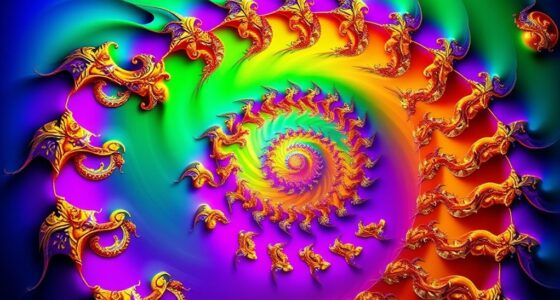

The golden angle, about 137.5 degrees, is a natural constant that guides how seeds, leaves, and other plant parts are arranged for maximum efficiency and beauty. It helps plants optimize space, sunlight, and growth by creating spiral patterns known as phyllotaxis. This angle is rooted in the Fibonacci sequence and the golden ratio, making plant structures both functional and visually appealing. If you want to explore how this remarkable pattern influences nature’s design, keep exploring.
Key Takeaways
- The golden angle approximates 137.5°, facilitating optimal seed and leaf arrangement in plants.
- It results from dividing a circle based on the golden ratio, creating efficient, space-maximizing patterns.
- The pattern underpins spiral phyllotaxis, forming overlapping spirals that enhance growth and visual appeal.
- Nature consistently uses the golden angle to maximize sunlight exposure and reduce competition among plant parts.
- Its prevalence is linked to Fibonacci sequences and the golden ratio, reflecting evolutionary optimization for efficiency.

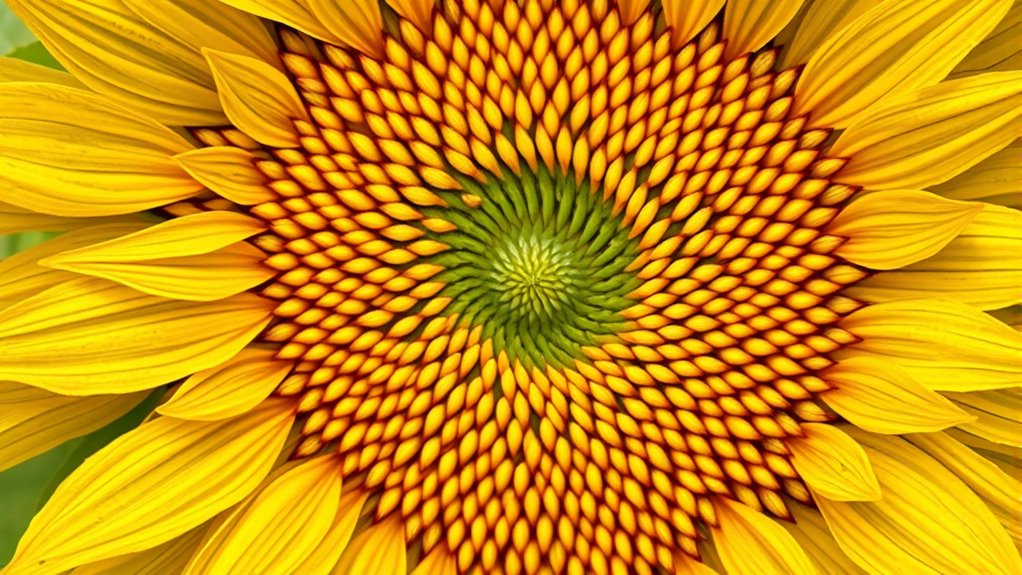
Have you ever wondered why sunflower seeds or pinecones arrange themselves so beautifully? It turns out, nature favors a specific angle—known as the golden angle—that creates these stunning, efficient patterns. When you look closely at sunflower seeds, you’ll notice they’re not randomly scattered but packed in a precise way called spiral phyllotaxis. This term describes how plant parts, like leaves, seeds, or scales, are arranged in spirals that grow outward from a central point. The key to this pattern lies in the golden angle, approximately 137.5 degrees, which plants use to space their seeds or leaves ideally.
The reason sunflower seeds follow this pattern is that it allows for the densest packing possible without any gaps or overlaps. Each seed is positioned at a specific angle relative to the previous one, and that angle is the golden angle. Because of this, the seeds form overlapping spirals that radiate outward in two directions—often called parastichies—creating a mesmerizing and efficient spiral pattern. The beauty of spiral phyllotaxis is that it maximizes sun exposure and space, giving each seed or leaf the best chance to grow without competing with its neighbors.
Furthermore, this optimal arrangement is an example of how natural systems optimize space utilization to promote growth and survival. This pattern isn’t accidental. Nature adopts the golden angle because it relates to the Fibonacci sequence, which is renowned for its appearance in natural growth patterns. The Fibonacci sequence involves numbers where each is the sum of the two before it—like 1, 1, 2, 3, 5, 8, 13, and so on. When the ratio of consecutive Fibonacci numbers approaches the golden ratio, about 1.618, the golden angle emerges naturally as the most advantageous divergence angle for packing. That’s why sunflower seeds, pinecones, and even pine needles follow this rule—nature uses the golden angle to create structures that are both beautiful and highly efficient.
Frequently Asked Questions
How Is the Golden Angle Related to Fibonacci Numbers?
You’ll find that the golden angle relates to Fibonacci numbers through Fibonacci relationships in nature’s spiral patterns. When you observe sunflower seeds, pinecones, or galaxies, their spiral patterns often follow angles close to 137.5 degrees, which is derived from dividing 360 degrees by Fibonacci-related ratios. This connection helps explain why these patterns appear so frequently, as Fibonacci relationships optimize packing and growth, creating the beautiful spirals you see in nature.
Do All Plants Use the Golden Angle in Their Growth?
Not all plants use the golden angle in their growth, but many do because it optimizes seed dispersal and leaf arrangement. You might notice plant mutations that deviate from this pattern, which can affect their efficiency. The golden angle helps maximize sunlight exposure and space, proving its evolutionary advantage. While some plants don’t follow it precisely, its influence on plant architecture remains significant for growth and seed dispersal strategies.
Can the Golden Angle Be Found in Non-Biological Structures?
Imagine a cosmic dance where mathematical constants like the golden angle choreograph patterns beyond plants. Yes, you’ll find this angle in non-biological structures, like spiral galaxies and seashells, revealing nature’s preference for harmony. These physical phenomena showcase the golden angle’s universal appeal, acting as a blueprint for efficient packing and growth. Its presence underscores how mathematical constants transcend life, shaping the universe’s elegant design in both organic and inorganic worlds.
Why Does the Golden Angle Produce Optimal Packing?
You see, the golden angle creates ideal packing because it maximizes phyllotaxis efficiency by spacing elements in spiral arrangements that avoid overlap. This angle ensures each new element fits without crowding, promoting uniform distribution. As a result, plants and other structures benefit from improved light exposure and resource use. The spiral arrangements driven by the golden angle are naturally efficient, making it a preferred pattern in both biological and non-biological contexts.
How Does the Golden Angle Influence Aesthetic Design?
The golden angle acts like a secret recipe for visual harmony, guiding your eye effortlessly through a design. By using mathematical proportions rooted in this angle, you create compositions that feel naturally balanced and pleasing. It influences aesthetic design by fostering a sense of order and elegance, making your work more mesmerizing. Embracing the golden angle helps you craft visuals that resonate deeply, echoing the beauty found in nature’s own blueprint.
Conclusion
As you observe the golden angle, remember it’s nature’s whisper of perfect harmony, a secret code woven into life’s design. Like a master painter’s brushstroke, it guides the dance of petals and seeds, shaping beauty from simplicity. Embrace this universal rhythm, knowing it connects everything in a silent symphony. The golden angle isn’t just math; it’s a timeless poetry, reminding you that even in chaos, there’s an elegant, hidden order waiting to be discovered.