
To find the volume of a cylinder, first measure the diameter accurately and divide by two to get the radius. Then, multiply the radius by itself and by pi (about 3.14159) to find the area of the base. Next, multiply this base area by the height of the cylinder. If you follow these steps, you’ll understand how each measurement contributes, and if you keep going, you’ll learn more about precise calculations.
Key Takeaways
- Measure the diameter of the cylinder’s base accurately using a ruler or tape.
- Divide the diameter by two to find the radius (r).
- Confirm or record the height (h) of the cylinder.
- Use the formula V = πr²h, where π ≈ 3.14159.
- Calculate the volume by squaring the radius, multiplying by π, then by the height.

Calculating the volume of a cylinder is a straightforward process that involves understanding its basic measurements. To do this, you need to know the cylinder dimensions—specifically, the height and the radius of the circular base. Once you have these measurements, you can easily determine the volume using the appropriate volume formulas. The key is to grasp how these dimensions interact and how they influence the calculation.
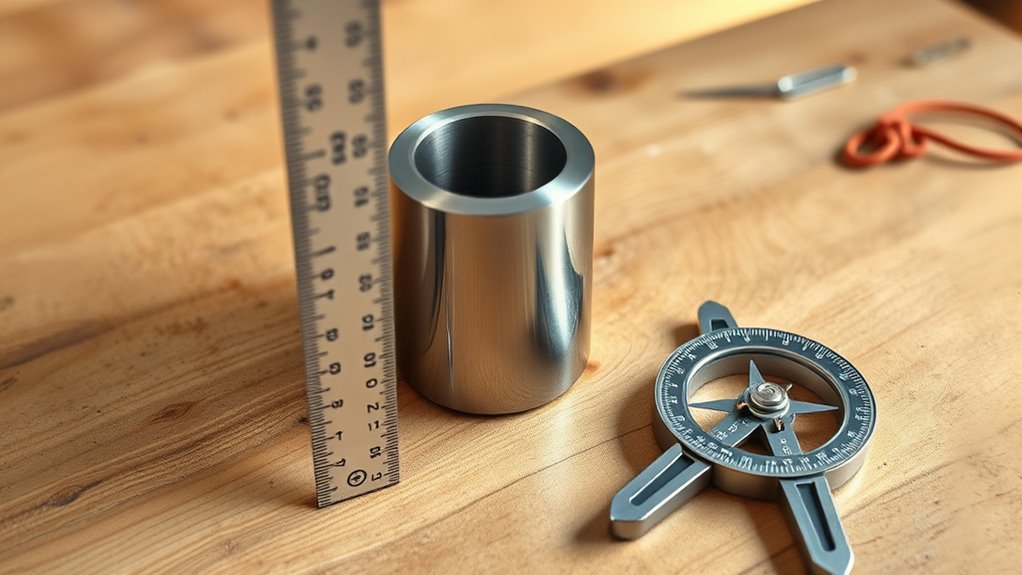
First, measure the diameter of the cylinder’s base, and then divide it by two to find the radius. The radius is essential because it’s used in the volume formulas. Make sure your measurements are accurate—using a ruler or measuring tape—so your final volume calculation is precise. The height is usually straightforward to measure, often given or marked on the object. Once you have both the radius and height, you’re ready to plug these into the volume formulas.
The most common formula for calculating the volume of a cylinder is V = πr²h. Here, V stands for volume, π (pi) is approximately 3.14159, r is the radius, and h is the height. This formula is derived from the fact that a cylinder can be thought of as a stack of many circular disks, each with an area of πr², stacked to a height h. By multiplying the area of the base by the height, you get the total volume.
To perform the calculation, square the radius (multiply it by itself), then multiply that result by π. Next, multiply the product by the height. For example, if your cylinder has a radius of 3 inches and a height of 10 inches, you first square the radius to get 9 (since 3² = 9). Multiply 9 by π to get approximately 28.274, then multiply that by 10 to find the volume, which is roughly 282.74 cubic inches. Understanding geometric principles can help clarify why the formula works.
Frequently Asked Questions
Can the Formula Change for Irregularly Shaped Cylinders?
No, the standard cylinder formulas don’t change for irregular shapes. However, if you’re dealing with irregular cylinders, you’ll need to use approximation methods like water displacement or calculus-based integration. These techniques help you find the volume when traditional formulas for perfect cylinders don’t apply. So, while the basic formulas stay the same, handling irregular shapes requires more advanced methods to accurately determine their volume.
How Do I Calculate Volume if the Cylinder Is Tilted?
Imagine pouring water into a tilted cylinder—gravity still pulls it down, but the shape’s tilt complicates your measurements. To find the volume, you need to account for the tilt by measuring the filled height and radius accurately, then adjusting for measurement errors caused by the angle. You can also use calculus or software tools to get precise results, ensuring your calculations reflect the true volume despite the tilt’s challenge.
What Is the Impact of Measurement Errors on Volume Accuracy?
Measurement inaccuracies can substantially affect your volume calculations by introducing errors that propagate through the process. When your measurements of radius or height are off, even slightly, those inaccuracies compound, leading to less precise volume results. To minimize impact, use precise instruments, double-check your measurements, and understand how errors can accumulate, ensuring you get the most accurate volume estimate possible.
How Do I Find the Volume of a Hollow Cylinder?
To find the volume of a hollow cylinder, you need to perform a volume calculation by subtracting the inner cylinder’s volume from the outer cylinder’s volume. Measure the outer radius, inner radius, and height. Use the formula: (π × outer radius² × height) minus (π × inner radius² × height). This gives you the volume of the hollow space inside the cylinder, which is essential for accurate measurements.
Can I Use the Same Formula for Non-Uniform Cylinders?
Imagine a non-uniform cylinder as a twisting river, its width and shape changing along its length. You can’t use the same formula for uniform cylinders because non-uniform ones have varying radii or heights. To find their volume, you need to contemplate material density variations and divide the shape into smaller, uniform sections, then sum their volumes. This approach captures the complexity beyond simple, uniform cylinders.
Conclusion
So, now that you know how to calculate a cylinder’s volume, you’re practically a math wizard. Who knew that multiplying the base area by height could be so exciting? Just remember, all those measurements might seem tricky, but with a little practice, you’ll be impressing everyone with your newfound skill. Just don’t get too carried away—after all, it’s just a simple formula, not rocket science. Or is it?