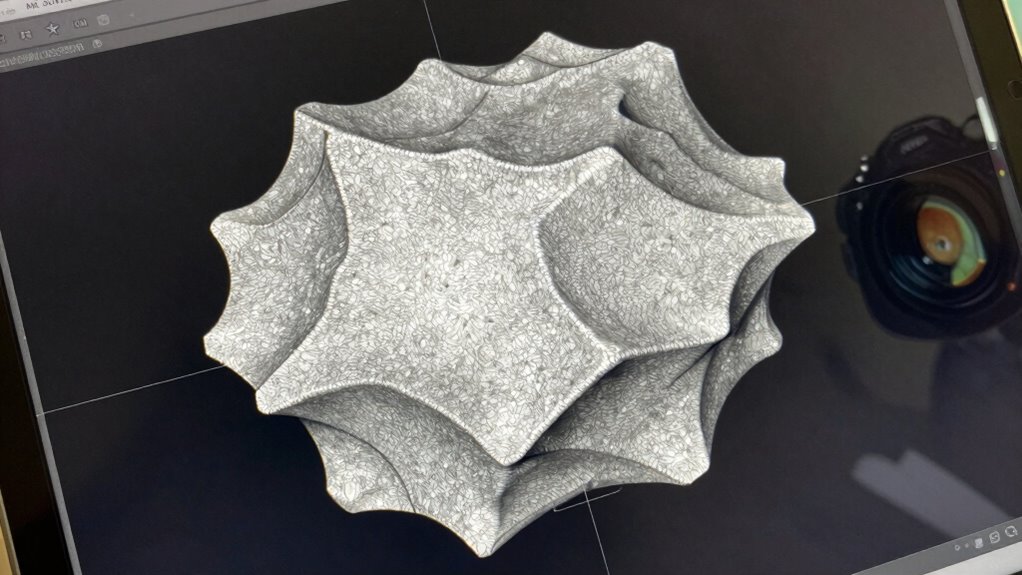

Noisy 3D scans often result from poor calibration, environmental interference, or surface properties like reflectivity and roughness. Inaccurate calibration, vibrations, and external disturbances can cause artifacts and graininess. Surface reflectivity or absorption impacts data quality, while hardware limits like resolution affect detail. Controlling lighting, stabilizing the environment, and proper setup help reduce noise. Using post-processing filters and smoothing can improve clarity—continue exploring these techniques to achieve cleaner, more precise models.

Prime made for students and young adults
- Fast, free delivery for dorm and study essentials
- Prime Video and Amazon Music included
- Member-only deals
Key Takeaways
- Ensure proper scanner calibration and environmental stability to reduce artifacts and misalignments.
- Use diffuse lighting, surface treatments, and control reflectivity to minimize noise from reflective surfaces.
- Capture multiple angles and maintain consistent distances for comprehensive, accurate data collection.
- Apply noise filtering and mesh smoothing during post-processing to improve scan clarity.
- Address hardware limitations by upgrading sensors and adjusting settings based on surface properties and environment.
As an affiliate, we earn on qualifying purchases.
Why Are My 3D Scans Noisy?
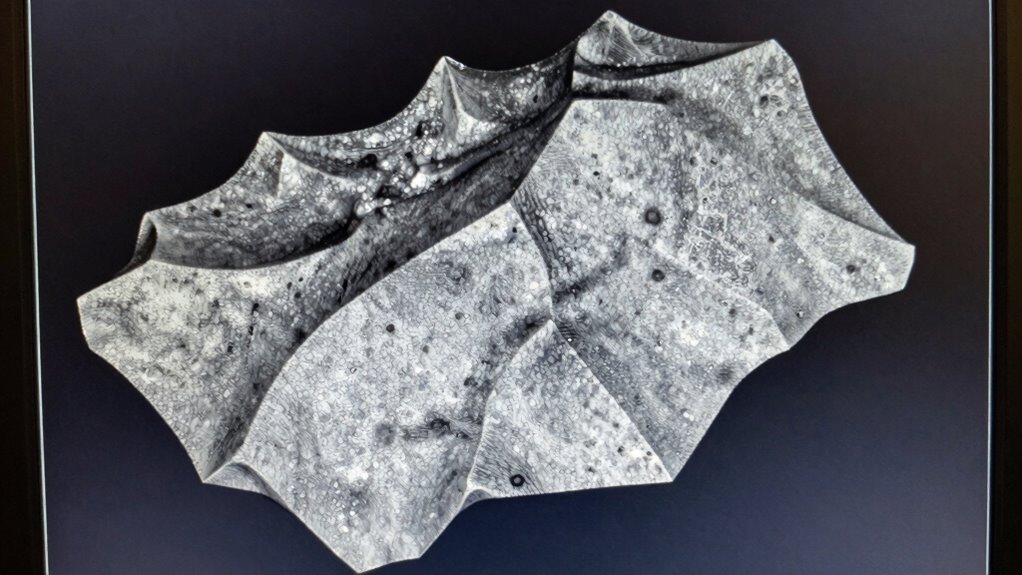
Have you ever wondered why your 3D scans often appear noisy or grainy? One common reason is poor scan calibration, which affects how accurately your scanner captures details. If the calibration isn’t precise, the data resolution drops, resulting in less detailed and noisier scans. When the scanner isn’t correctly calibrated, it struggles to distinguish fine features, leading to artifacts and graininess. Additionally, low data resolution can cause the scan to miss small surface variations, amplifying noise. Ensuring proper calibration helps your scanner interpret the environment accurately, improving data resolution and reducing graininess. Regularly checking and fine-tuning your scanner’s calibration settings is essential for clearer, more detailed 3D models. Proper calibration directly impacts scan quality, making your results more precise and less noisy. Moreover, understanding how sensor technology influences data capture can help optimize your scanning setup for better results.
3D scanning noise reduction filters
As an affiliate, we earn on qualifying purchases.
As an affiliate, we earn on qualifying purchases.
What Causes Graininess in 3D Scans?
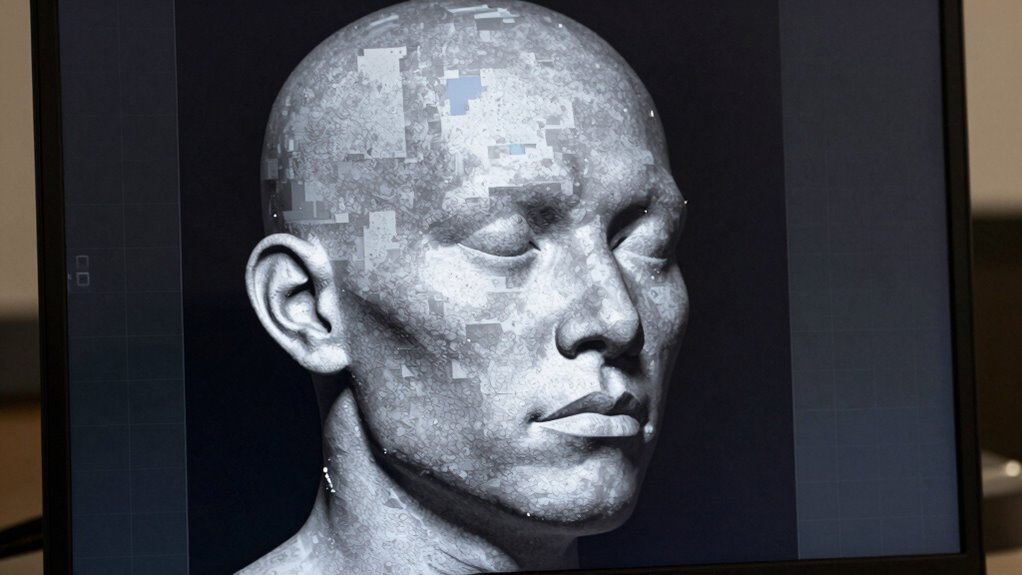
Graininess in your 3D scans often stems from the scanner’s resolution limits or surface reflectivity issues. When the resolution isn’t high enough, details get blurred, creating a grainy appearance. Similarly, reflective surfaces can cause scattered data, leading to unwanted noise in your scans. Incorporating Free Floating techniques can help reduce noise by allowing more flexible positioning of the scanner and optimizing data capture. Additionally, utilizing advanced calibration methods can further improve scan accuracy and reduce graininess caused by equipment limitations. Ensuring proper environmental conditions can also minimize interference and enhance scan quality.
Scanner Resolution Limits
Scanner resolution limits directly impact the level of detail captured in your 3D scans, often resulting in a grainy appearance. Your scanner’s resolution determines how finely it can capture surface features. When resolution is too low, the scan misses small details, creating a blocky or pixelated look. Hardware limitations, such as sensor size and data processing speed, restrict the maximum resolution you can achieve. Higher resolution scans require more data, which can slow down processing or demand more powerful equipment. If your scanner’s hardware can’t support finer detail, your scans will inevitably look noisy or grainy. To improve this, consider upgrading your scanner or adjusting settings to optimize resolution within your hardware’s capabilities. Understanding these limits helps you produce cleaner, more detailed 3D models.
Surface Reflectivity Issues
Surface reflectivity issues often cause graininess in your 3D scans because shiny or glossy surfaces reflect scanner signals unpredictably. This unpredictable reflection leads to inconsistent data, resulting in grainy textures. Material absorption also plays a role; surfaces that absorb scanner signals can cause incomplete or noisy scans. To reduce these issues, consider adjusting your scanning environment or settings. Using a passive voice detector can help identify and correct passive constructions that may weaken your writing. Additionally, understanding surface reflectivity and how it impacts signal behavior allows you to better anticipate and mitigate these problems. – Use matte finishes or apply a temporary coating to reduce reflectivity – Change the scanning angle to minimize direct reflections – Increase exposure or scanner sensitivity for better signal capture – Use polarized lighting or filters to manage surface reflections
Understanding how surface reflectivity and material absorption affect your scan quality helps you implement effective fixes, producing cleaner, more accurate 3D models.
As an affiliate, we earn on qualifying purchases.
How Hardware Limits Affect Scan Quality

Hardware limitations directly impact the quality of your 3D scans, often setting practical boundaries on detail, accuracy, and noise levels. Your scanner’s hardware, especially sensor resolution, determines how finely it captures surface features. Low-resolution sensors can’t detect small details, resulting in less precise models with increased noise. Additionally, hardware limitations like limited processing power or slow data transfer can cause data gaps and artifacts. These constraints mean you might see rough textures or missing details, regardless of your scanning technique. Upgrading to higher-resolution sensors or more capable hardware can markedly improve scan quality. Understanding hardware limits also helps you tailor your scanning approach to optimize results, especially when considering sensor capabilities and other hardware factors. However, understanding these limits helps you set realistic expectations and troubleshoot issues effectively, ensuring you get the best possible results within your hardware’s capabilities.
3D scanner stabilization equipment
As an affiliate, we earn on qualifying purchases.
As an affiliate, we earn on qualifying purchases.
Environmental Factors That Create Scan Artifacts
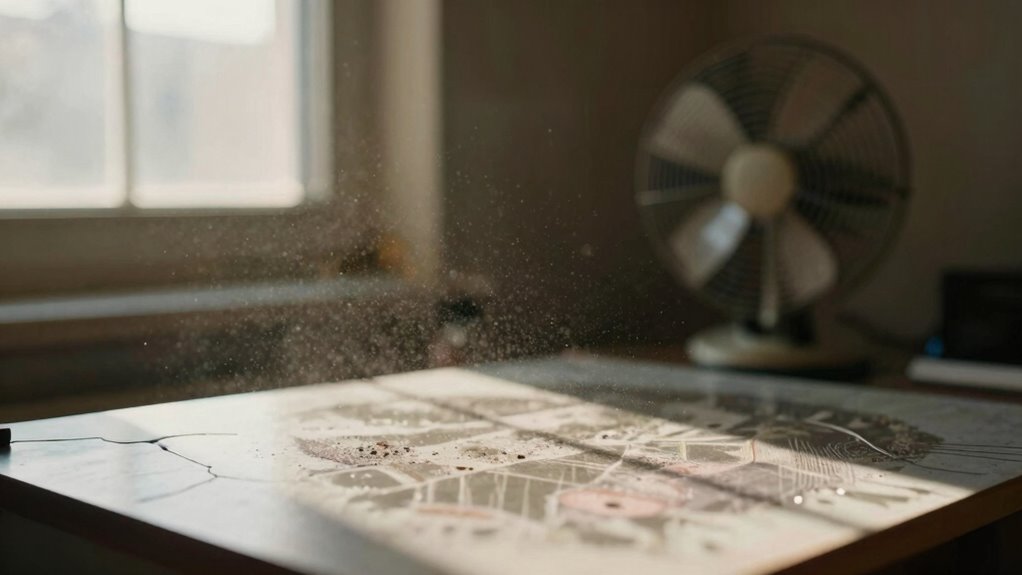
Environmental factors can substantially affect your scan quality. Poor lighting, reflective surfaces, and vibrations can introduce artifacts that distort your results. Understanding these influences helps you take steps to minimize their impact. For instance, ensuring proper air purifier maintenance can improve the overall environment and reduce airborne particles that may interfere with scans. Additionally, controlling ambient temperature and humidity levels can further stabilize the environment, preventing scan artifacts caused by fluctuating conditions. Regularly inspecting your workspace for electromagnetic interference can also help maintain accurate scanning results.
Lighting Conditions Impact
Lighting conditions can considerably affect the quality of your 3D scans, often causing artifacts or distortions that compromise accuracy. Variations in lighting, known as lighting variability, can lead to inconsistent data collection. Shadow casting from uneven light sources can obscure surface details, creating gaps or false edges in your scan. You might notice noisiness or distortions in areas affected by changing light angles. To improve results, consider these points:
- Use diffuse, uniform lighting to minimize shadows
- Avoid direct sunlight or harsh spotlights
- Keep lighting consistent throughout the scan
- Reduce environmental light fluctuations during capturing
Controlling lighting conditions helps ensure your scans are cleaner, more precise, and free of artifacts caused by inconsistent illumination.
Reflective Surface Challenges
Have you noticed how shiny or glossy surfaces can cause problems during your 3D scans? This happens because material properties like reflectivity and surface textures influence how light interacts with an object. Highly reflective materials can bounce laser or structured light beams unpredictably, creating scan artifacts and noise. Smooth, glossy surfaces tend to mirror the environment, confusing the scanner’s sensors and resulting in inaccurate data. To address this, you can apply matte sprays or powders to reduce reflectivity, or reposition the object to minimize reflections. Understanding surface textures helps you anticipate these issues. Managing surface properties and adjusting scanning angles can help you improve scan quality, ensuring cleaner, more accurate 3D models free from noise caused by reflective surfaces.
Environmental Vibrations Interference
Surface reflectivity issues can often be mitigated by adjusting the scanning environment. Environmental vibrations are a major source of scan noise, causing artifacts and inaccuracies. To reduce this, focus on vibration mitigation and stabilization techniques. Place your setup on a sturdy, vibration-dampening surface, away from heavy machinery or foot traffic. Use tripods with rubber feet or specialized mounts to absorb vibrations. Keep the scanner and object stable by avoiding sudden movements during scans. Additionally, consider environmental controls like isolating the workspace from external disturbances. These steps guarantee minimal vibration interference. Remember, even subtle vibrations can distort your data, so paying attention to environmental factors is essential for accurate, clean 3D scans.
- Use vibration damping pads
- Isolate scanner from external sources
- Secure all equipment firmly
- Perform scans in a stable environment
Settings and Techniques That Introduce Noise
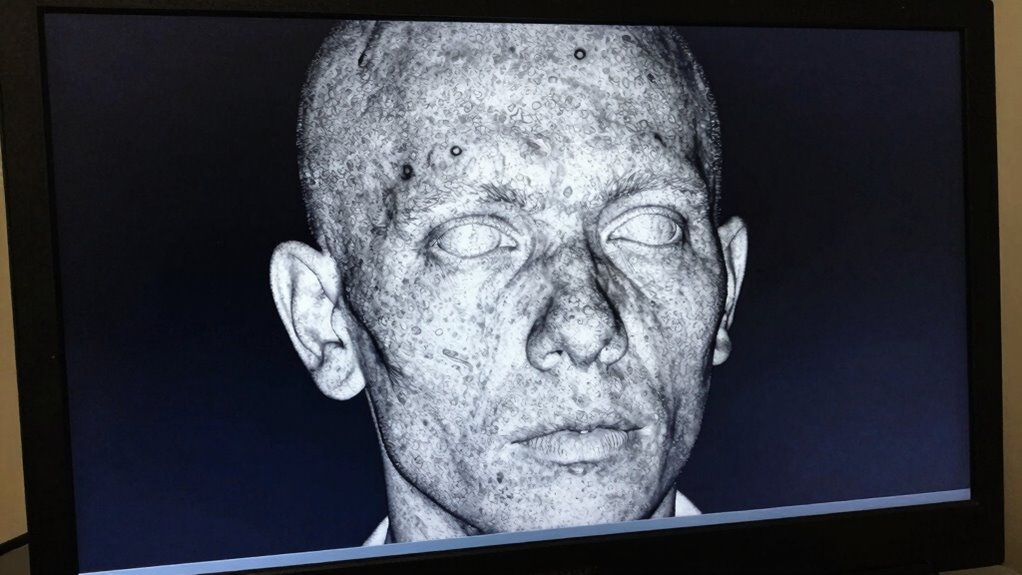
Certain settings and techniques during the scanning process can unintentionally introduce noise into your 3D scans. Poor lighting adjustments can cause reflections or shadows that confuse your scanner, resulting in inaccurate data. Making sure consistent, diffuse lighting helps minimize these issues. Additionally, neglecting proper scanner calibration can lead to misaligned data and increased noise. Take the time to calibrate your device regularly, following manufacturer guidelines, to guarantee maximum accuracy. Using improper settings, such as too high or too low resolution, can also amplify noise levels. Always double-check your scanner’s settings before starting a scan, and aim for stable, controlled conditions. These steps help produce cleaner, more precise scans and reduce the need for extensive post-processing. Moreover, understanding Rhythm Failure can inspire you to optimize your scanning process for better results. Proper environmental conditions are essential for minimizing interference and achieving clearer scan data. Also, being aware of ambient interference sources like electromagnetic noise can significantly improve scan quality.
Tips for Capturing Cleaner 3D Scans in the Field
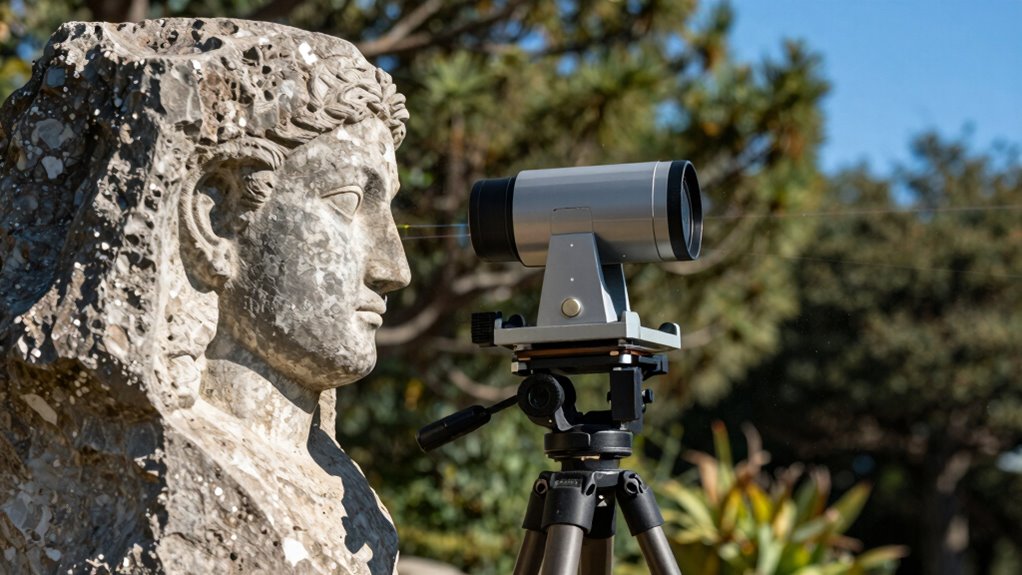
What strategies can you use to guarantee your 3D scans are cleaner when working in the field? First, assure proper scan calibration before starting; accurate calibration minimizes errors that cause noise. Maintain consistent distances and angles to improve data redundancy, which strengthens the scan’s reliability. Keep your environment stable—avoid movement and vibrations that can distort data. Use multiple scans from different angles to capture comprehensive coverage, then combine them for better accuracy. Regularly verify your equipment’s calibration and re-calibrate if necessary. Additionally, understanding the specifications of your equipment, such as the power output of your device, can help you better plan your scanning activities for optimal results. Ensuring you are familiar with your scanner’s operating parameters allows for adjustments tailored to different field conditions, further reducing noise. Being aware of the material properties of scanned objects can also influence scan quality, as reflective or transparent surfaces often require special handling.
Post-Processing Methods to Reduce Scan Noise
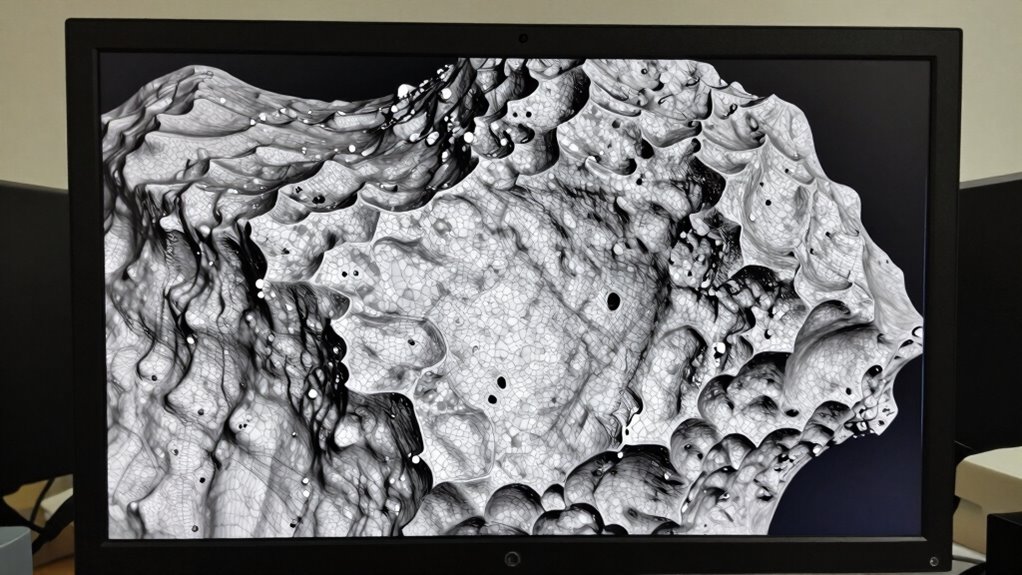
Post-processing offers effective ways to clean up your 3D scans by using noise filtering techniques that remove unwanted data points. Mesh smoothing strategies help refine surface details and improve overall accuracy, while advanced tools provide more precise control over noise reduction. Applying these methods guarantees your scan results are cleaner, more reliable, and ready for further use. Incorporating adaptive filtering techniques can further enhance the quality of your scans by dynamically adjusting to different noise levels. Additionally, understanding simple, practical solutions can make the post-processing process more accessible and manageable for users at various skill levels, especially when combined with specialized software designed for efficient noise reduction.
Noise Filtering Techniques
Noise filtering techniques play a crucial role in enhancing the quality of 3D scans by reducing unwanted artifacts and irregularities. They help you clean up noisy data, making your models smoother and more accurate. Effective noise filtering targets artifact reduction without losing important details. You can apply various methods, such as statistical filters, median filters, or bilateral filters, to smooth out rough areas. These techniques help eliminate random noise while preserving sharp features. Keep in mind that overly aggressive filtering may blur details, so strike a balance. The goal is to improve clarity without sacrificing fidelity. Proper noise filtering ensures your 3D models look cleaner, more professional, and easier to work with in further processing. Use these methods thoughtfully for maximum results in your scan post-processing workflow.
Mesh Smoothing Strategies
Mesh smoothing strategies are essential tools in reducing scan noise after capturing your 3D data, helping you refine your models for better accuracy and visual quality. By applying techniques like Laplacian smoothing or Taubin filtering, you can achieve effective surface optimization, minimizing roughness and irregularities. Mesh refinement focuses on adjusting vertex positions to create a cleaner, more uniform surface, which enhances the overall model integrity. These methods remove unwanted noise without compromising important details, resulting in a smoother, more polished mesh. Proper surface optimization improves the visual appeal and accuracy of your 3D scan, making it ready for further processing or presentation. Using these strategies ensures your models are not only cleaner but also more reliable for subsequent applications. Additionally, understanding the importance of sources and documentation can significantly improve your mesh processing results.
Advanced Post-Processing Tools
Building on mesh smoothing techniques, advanced post-processing tools offer powerful ways to further diminish scan noise and enhance your 3D models. These tools often include features like software calibration, which improves data accuracy and consistency. By fine-tuning calibration settings, you can minimize errors introduced during scanning. Additionally, specialized software can apply noise reduction algorithms that target residual imperfections without sacrificing detail. Using these tools, you can refine your models for cleaner, more precise results. Keep in mind:
- Calibration adjustments ensure better data accuracy
- Noise reduction algorithms target specific imperfections
- Non-destructive editing preserves original detail
- Manual corrections complement automatic processes
Together, these methods enable you to achieve cleaner scans with higher fidelity, making your 3D models more reliable for analysis or manufacturing.
When Should You Use Filtering and Smoothing Tools?

You should consider using filtering and smoothing tools whenever your 3D scan contains unwanted artifacts or irregularities that hinder its accuracy. Recognizing the filtering necessity helps determine when noise reduction is essential—particularly if your scan shows jagged edges, extraneous points, or rough surfaces. Filtering is most effective during the initial processing stages, where it can eliminate outliers and reduce the overall noise level. Smoothing timing matters too; employ smoothing after filtering to refine the surface without losing detail. Use these tools when the noise obscures important features or degrades the model’s clarity. Timing is vital: applying filters first clears out major artifacts, then smoothing enhances surface quality, ensuring your final model is cleaner and more precise. Understanding how filtering improves your 3D scan’s accuracy can help you achieve better results.
Best Practices for Achieving Clearer 3D Models
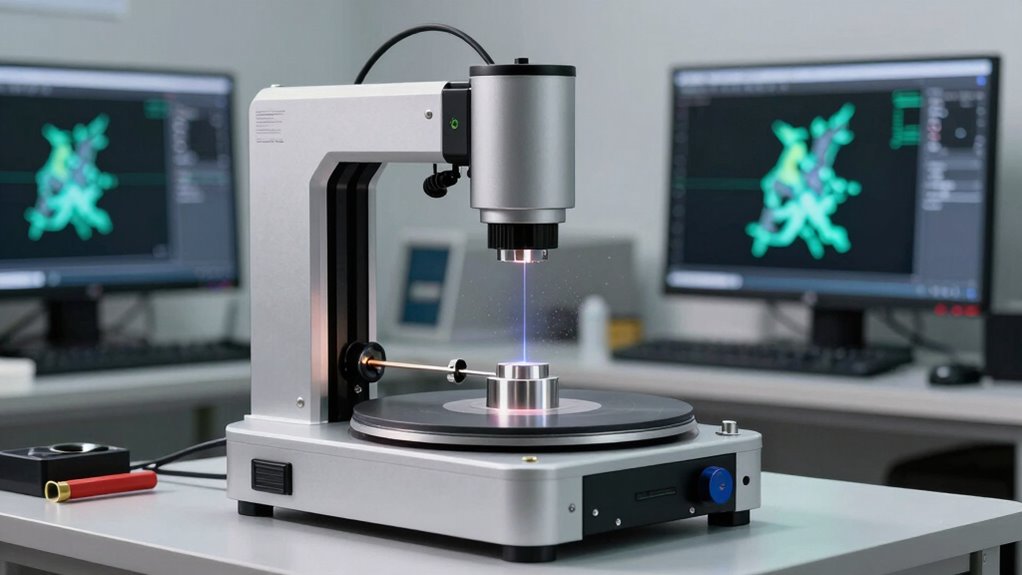
Achieving clearer 3D models requires a strategic approach that combines proper scanning techniques with effective post-processing. Start by ensuring your scanner is well-calibrated; scan calibration is essential for accurate data capture. Incorporate data redundancy by capturing multiple scans from different angles—this helps fill in gaps and reduces noise. Consistently maintain stable lighting and minimize movement during scans to prevent distortions. Additionally, verify your scanner’s settings and environment to optimize data quality. To enhance clarity, consider using software tools designed for noise reduction and mesh refinement, but always start with high-quality raw data. Remember, good results depend on both precise setup and thorough data collection, making your final 3D models considerably clearer and more detailed. Proper scanner calibration and a controlled environment are key factors that influence the quality of your scans. Furthermore, understanding the noise sources can help you troubleshoot and improve your scanning process more effectively.
Troubleshooting Persistent Noise in Your 3D Scans

Persistent noise in your 3D scans can be frustrating, but pinpointing its cause is the first step toward fixing it. Material properties play a significant role; rough or reflective surfaces often cause scattered data and noise. Consider applying surface treatments or choosing materials that absorb or diffuse laser or light signals better. Software calibration is equally vital—ensure your scanner is properly calibrated to align sensors and optimize accuracy. Regularly update calibration settings based on environmental conditions and equipment specifications. If noise persists, revisit your setup to confirm your scanner’s settings match the material and environment. Adjusting these factors helps reduce persistent noise, leading to cleaner, more accurate 3D models. Proper attention to material properties and calibration can make all the difference in troubleshooting ongoing scan issues.
Frequently Asked Questions
How Does the Choice of 3D Scanning Software Impact Noise Levels?
Choosing the right 3D scanning software directly impacts noise levels by affecting software compatibility and ease of use. If your software isn’t compatible with your scanner, it may introduce artifacts and noise. A user-friendly interface helps you focus on capturing quality data, reducing errors and noise. Opt for software that integrates well with your hardware and offers advanced filtering tools, ensuring cleaner, more accurate scans with less noise.
Can Specific Object Materials Increase Scan Noise?
Imagine your scan as a camera capturing a mirror’s reflection—material properties and surface reflectivity are the ripples distorting the image. Shiny or reflective objects reflect laser or light signals unpredictably, creating noise in your scan. High reflectivity surfaces bounce signals erratically, making your data grainy. To improve, matte finishes or adjusting scanner settings can reduce these disruptions, helping you achieve cleaner, more accurate 3D models.
What Role Does Scanner Calibration Play in Reducing Noise?
Scanner calibration plays a vital role in reducing noise by ensuring calibration accuracy and proper sensor alignment. When you calibrate your scanner correctly, it aligns sensors precisely, minimizing measurement errors that cause noise. Regular calibration checks help maintain this accuracy, preventing drift over time. By focusing on calibration accuracy and sensor alignment, you greatly improve scan quality, resulting in cleaner, more detailed 3D models with less noise.
Are There Optimal Environmental Conditions for Indoor Scanning?
You should keep your indoor environment as controlled as possible, because the devil’s in the details. Ideal lighting conditions mean soft, diffuse light to prevent shadows and glare, while minimizing ambient vibrations ensures scanner stability. Turn off nearby machinery and avoid high traffic areas. Maintaining a steady environment helps your scans come out clearer and reduces noise, so you get the best results without having to chase shadows or shake the camera.
How Do Different 3D Scanning Techniques Compare in Noise Reduction?
Different 3D scanning techniques vary in noise reduction, mainly due to sensor resolution and data processing. Laser scanners often offer higher sensor resolution, capturing detailed data that reduces noise, while structured light scanners excel with sophisticated data processing algorithms to filter out noise. Photogrammetry may produce noisier results unless enhanced with advanced data processing. Choosing the right method depends on your required accuracy and environmental conditions.
Conclusion
To transform your noisy scans into crisp, clear models, you need to understand the root causes and apply the right fixes—like tuning your hardware, optimizing settings, and using post-processing tools wisely. Think of your scan as a rough gemstone; with patience and the right techniques, you can polish it into a dazzling masterpiece. Remember, every detail counts—so keep refining until your 3D world shines with clarity and precision.
Halloween Picks
halloween
As an affiliate, we earn on qualifying purchases.