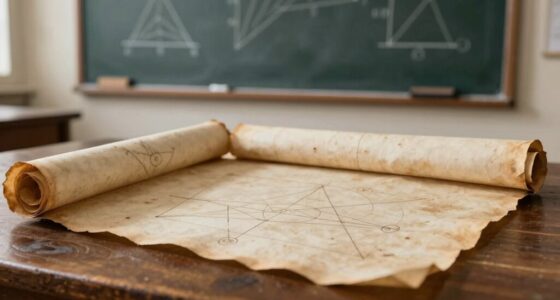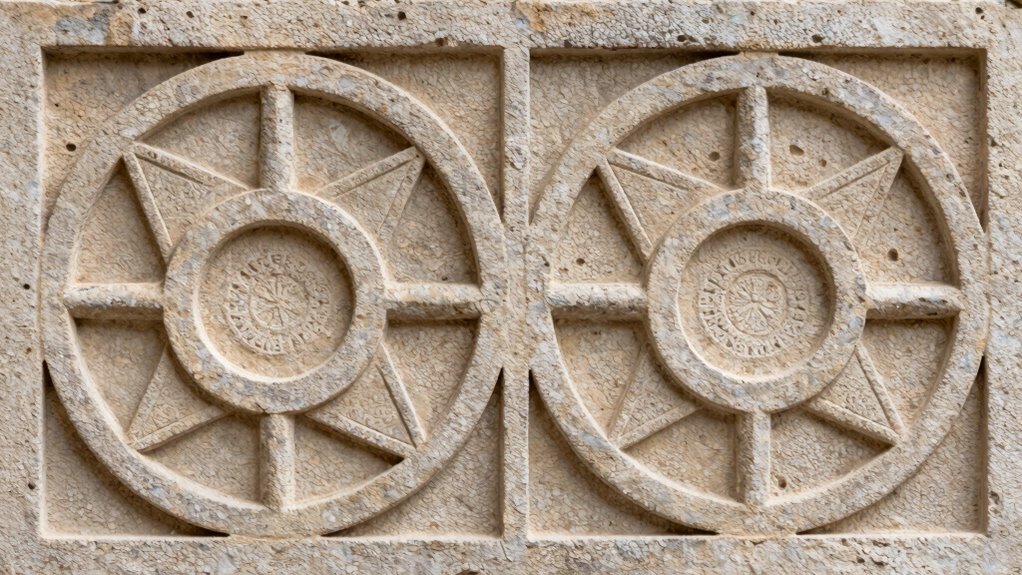

Medieval builders knew plenty about geometry, relying on simple tools like compasses, straightedges, and grids to transfer complex designs from sketches to structures. They understood how shapes like triangles, squares, and circles contributed to stability, using ratios like the golden ratio for aesthetic harmony. They also mastered how to align vaults and arches accurately, ensuring stability and strength. If you want to explore how they combined these principles to create iconic structures, there’s more to discover.

Get school and study supplies delivered free — and shop member deals
- Fast, free delivery on millions of items
- Access to Prime Big Deal Days deals on October 6–7
- Prime Video, Amazon Music and more included
Key Takeaways
- Medieval builders used compasses, straightedges, and proportional dividers for precise measurements and transferring complex designs.
- They understood how geometric shapes like triangles and circles contributed to structural stability and aesthetic harmony.
- Builders applied geometric ratios, including the golden ratio, to ensure proportionate and visually pleasing structures.
- Construction relied on careful ground plans, layouts, and geometric reasoning to accurately transfer designs from sketches to physical form.
- Knowledge of angles, symmetry, and proportionality was essential for aligning vaults, arches, and ensuring structural integrity.
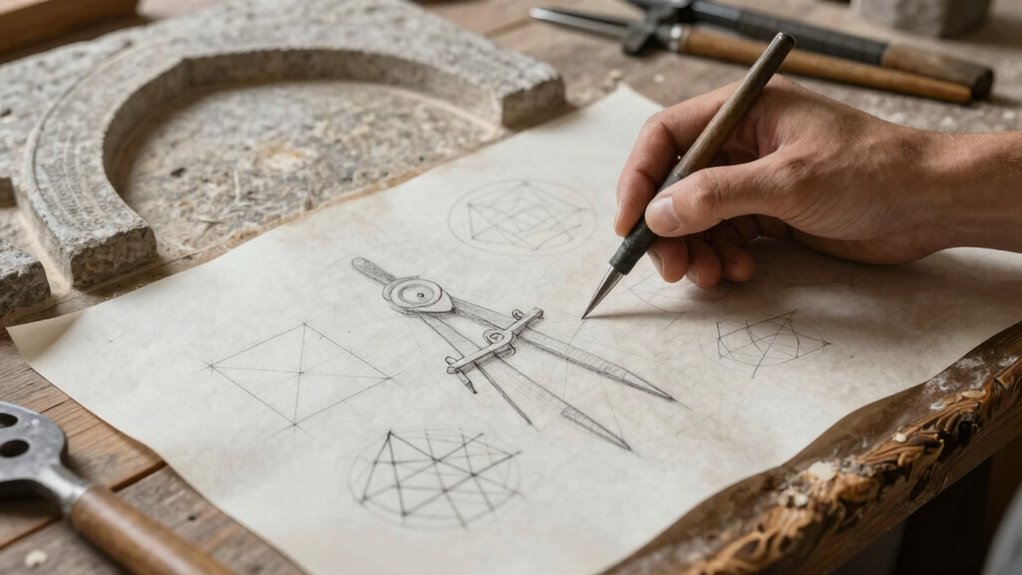
During the Middle Ages, builders relied heavily on geometry to design and construct impressive structures like cathedrals, castles, and bridges. You might think they didn’t have access to modern software or precise measuring tools, but they understood the significance of ancient construction techniques rooted in geometric principles. These principles formed the backbone of their work, guiding every step from laying foundations to finishing intricate facades. Without digital aids, they used simple tools like compasses, straightedges, and basic measurements, yet achieved remarkable accuracy through their mastery of geometric concepts.
Medieval builders used simple tools and geometric principles to create precise, enduring structures without modern technology.
You’d find that medieval builders had a deep knowledge of basic geometric shapes and how to manipulate them. They understood that triangles, squares, and circles could be combined to create stable, balanced structures. For example, the pointed arches of Gothic cathedrals rely on the principles of triangles to distribute weight efficiently. They also used geometric ratios to determine proportions, making sure that structures were not only strong but also aesthetically pleasing. The use of the golden ratio, even if not named as such back then, influenced many design choices, giving medieval architecture its harmonious appearance.
Ancient construction methods played a significant role in their approach. Builders inherited techniques from earlier civilizations, adapting and refining them over time. They learned to construct precise grids and layouts, often marking out plans directly on the ground with basic tools. This process involved careful calculations and an intuitive understanding of geometric principles, which allowed them to transfer complex designs from paper or sketches into physical structures with remarkable precision. Their geometric reasoning was essential to ensuring the stability and elegance of their creations. Additionally, their methods often incorporated principles of symmetry and proportion, which further enhanced structural integrity and visual harmony.
You’d notice that the process of constructing large-scale buildings depended heavily on geometric reasoning. For instance, the builders had to ensure that the angles of the vaults and arches aligned perfectly to avoid structural failure. To do this, they relied on proportional dividers and sighting techniques, which helped them transfer measurements accurately from plans to the actual site. Their understanding of how to divide space into equal parts, calculate angles, and create symmetrical designs was essential to the stability and beauty of their work.
In essence, medieval builders mastered the art of using simple geometric principles to solve complex construction problems. Their knowledge of ancient construction techniques, combined with an intuitive grasp of geometry, allowed them to create enduring monuments that still inspire today. Without modern software, their skill lay in the ability to visualize, measure, and execute designs with precision—an impressive demonstration of their understanding of geometry and engineering.
medieval geometry compass and straightedge set
As an affiliate, we earn on qualifying purchases.
As an affiliate, we earn on qualifying purchases.
Frequently Asked Questions
How Did Medieval Builders Teach Apprentices Geometric Skills?
During medieval apprenticeship, builders taught apprentices geometric skills through hands-on practice and observation, emphasizing geometric symbolism in their work. You’d learn by copying diagrams, using simple tools like rulers and compasses, and understanding proportions. Apprentices also studied the symbolic meaning behind geometric shapes, which reinforced their practical skills and spiritual insights. This method helped them internalize complex concepts, ensuring precise construction without modern software.
Were There Specific Symbols Used in Medieval Geometric Diagrams?
You’d be surprised—medieval diagrams used more medieval symbolism than a knight’s shield. They employed simple geometric notation and symbols like circles, squares, and intersecting lines, often adorned with mystical or religious signs to communicate complex ideas. These symbols weren’t just doodles; they encoded geometric relationships, helping builders visualize structures. So, medieval notation was as much about symbolism as it was about precise geometry, blending art and science seamlessly.
How Did Builders Ensure Precision Without Modern Tools?
You guaranteed precision in ancient construction by relying on careful measurement techniques and understanding architectural symbolism. Builders used tools like the compass and straightedge to draw precise lines and circles, aligning structures with geometric principles. They often employed proportional systems to maintain accuracy, demonstrating their deep knowledge of geometry. This mastery allowed them to create complex, harmonious designs without modern software, proving their skill in translating architectural symbolism into tangible, enduring structures.
Did Medieval Architects Have Access to Geometric Treatises?
You’d be surprised, but medieval architects did have access to geometric treatises, which guided their work. They studied these texts to master geometric construction techniques and understand medieval architectural symbolism deeply. These treatises served as their blueprint, helping them create precise structures. While they didn’t have modern software, they relied on this knowledge, combined with practical experience, to bring complex designs to life—proving that necessity is the mother of invention.
How Was Geometry Applied to Decorative Arts in the Middle Ages?
You see that medieval artisans used geometry to craft intricate ornamental patterns, often inspired by religious symbolism. They applied geometric principles to create harmonious designs on illuminated manuscripts, stained glass, and stone carvings, ensuring symmetry and balance. By understanding proportions and shapes, they conveyed spiritual meanings and divine order. Their mastery of geometric techniques allowed them to produce visually stunning, meaningful decorative arts that still inspire today.
architectural proportional dividers
As an affiliate, we earn on qualifying purchases.
As an affiliate, we earn on qualifying purchases.
Conclusion
You stand in awe of medieval builders, who, like Da Vinci’s sketches in the dark, grasped geometry’s secrets without modern tools. Their hands, guided by intuition and ancient wisdom, built wonders that still echo through time. As if whispering secrets from a forgotten age, they showed us that mastery isn’t just in the tools we wield but in the understanding we nurture. In their silent language, geometry became a timeless song, forever etched in stone and spirit.
As an affiliate, we earn on qualifying purchases.
historical construction measurement tools
As an affiliate, we earn on qualifying purchases.
As an affiliate, we earn on qualifying purchases.
Halloween Picks
halloween
As an affiliate, we earn on qualifying purchases.