
You can solve the impossible by using precise origami folds that rely on geometric principles like symmetry, angles, and proportions. By mastering basic techniques such as valley and mountain folds, along with advanced methods like squash or reverse folds, you can transform a simple sheet of paper into complex structures. Consistent practice and understanding of math behind folding allow you to create extraordinary models. If you continue exploring, you’ll discover how science and creativity come together in incredible paper constructions.
Key Takeaways
- Mastering geometric principles and symmetry enables precise folds to create complex origami structures that seem impossible.
- Techniques like squash, petal, and reverse folds transform basic shapes into intricate, stable models.
- Understanding angles and proportions is essential for solving challenging designs and achieving accurate, balanced results.
- Applying mathematical concepts allows for the creation of advanced models such as tessellations and three-dimensional figures.
- Practice and problem-solving in origami unlock the ability to craft seemingly impossible forms through deliberate folding.
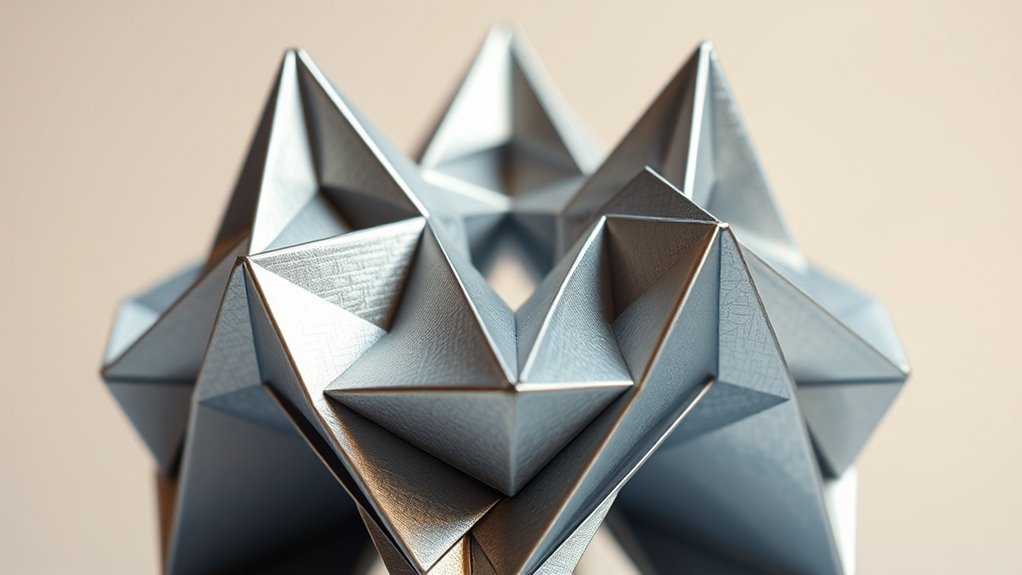
Have you ever wondered how simple folds can transform a piece of paper into intricate structures? The magic of origami lies in the way basic folds, when combined with an understanding of mathematical principles, can create complex, seemingly impossible designs. It’s not just about folding randomly; it’s about applying precise techniques rooted in geometry, symmetry, and spatial reasoning. These mathematical principles serve as the foundation for constructing models that maintain their shape and stability, even when they look delicate or elaborate. By mastering these concepts, you can predict how each fold will influence the final form, turning a flat sheet into a three-dimensional masterpiece.
Creative techniques in origami involve more than just following diagrams—they require you to think critically about how each fold interacts with the others. For instance, valley and mountain folds aren’t just simple creases; they are fundamental building blocks that enable you to manipulate the paper’s surface into different angles and layers. Using symmetry, you can replicate patterns effortlessly, ensuring your model is balanced and aesthetically pleasing. Additionally, techniques like squash folds, petal folds, and reverse folds expand your ability to add detail and complexity. These methods allow you to transform a basic square into intricate animals, flowers, or geometric shapes with precision and elegance.
As you explore these techniques, you’ll realize that origami is as much about problem-solving as it is about art. Each project presents unique challenges, compelling you to think about how to best employ mathematical principles to achieve the desired outcome. For example, understanding angles and proportions helps in making accurate folds that align perfectly, especially when working on symmetrical models. Recognizing the importance of geometric principles can significantly improve your folding accuracy and model stability. The creative techniques you develop through practice enable you to adapt and innovate, pushing the boundaries of what’s possible with a simple sheet of paper.
Ultimately, mastering the interplay between mathematical principles and creative techniques empowers you to solve the impossible. You’ll find yourself able to craft complex structures that seem to defy logic, all through careful, deliberate folds. Whether you’re folding a delicate crane or a geometric tessellation, the core idea remains the same: with patience, precision, and a solid grasp of these principles, you can turn a humble piece of paper into a stunning piece of art, showcasing the beauty of both science and creativity in harmony.
Frequently Asked Questions
Can Origami Constructions Be Used to Model Real-World Engineering Structures?
Yes, you can use origami constructions to model real-world engineering structures. By applying advanced folding techniques, you can create lightweight, efficient models that demonstrate complex concepts like deployability and flexibility. These models help you analyze structural stability, ensuring the design can withstand forces and stresses. Origami-inspired engineering allows you to innovate with materials and mechanisms, making it a valuable tool for developing practical solutions in fields like aerospace and architecture.
What Are the Most Advanced Mathematical Tools Used in Origami Problem-Solving?
You rely on advanced mathematical tools like mathematical modeling and geometric analysis to solve complex origami problems. These tools help you understand fold patterns, angles, and surface properties, enabling precise design of intricate structures. By applying mathematical modeling, you can predict how paper will fold under specific conditions, while geometric analysis allows you to analyze shapes and spatial relationships, making seemingly impossible origami constructions achievable and accurate.
How Does Origami Contribute to Innovations in Space Engineering?
Origami helps you innovate in space engineering by enabling compact designs for space habitats and solar panel deployment. You can fold structures to fit into small launch vehicles, then unfold them in space, making large habitats or solar arrays feasible. This technique reduces launch costs and complexity while ensuring reliable deployment, advancing space exploration and satellite technology. Your understanding of origami’s principles directly supports creating more efficient, adaptable space systems.
Are There Digital or Software Tools That Assist in Complex Origami Designs?
Like a painter with a palette, you can use digital software to help craft complex origami designs. These tools, featuring folding algorithms, streamline intricate patterns and enable precise visualization before folding. Programs like TreeMaker and Origami Simulator let you experiment with folds and structures, making it easier to innovate and perfect designs. So, yes, digital tools are essential companions for anyone tackling advanced origami projects.
What Is the History of Origami in Different Cultures Beyond Japan?
You’ll find that origami’s history extends beyond Japan, influenced by various cultures’ artistic traditions and unique materials. In China, paper folding dates back centuries, with intricate designs reflecting spiritual beliefs. In Europe, paper folding evolved into decorative arts during the Renaissance. These cultural influences shape origami’s diverse styles, blending traditional techniques with modern creativity, highlighting how different societies have contributed to its rich, global history.
Conclusion
So, next time you think a paper crane is just a simple fold, remember you’re holding the power to create what seems impossible. With a few clever folds, you’ve turned paper into art, engineering, and magic—all without a single screw or nail. It’s amusing how something so delicate can challenge the limits of what you thought was possible. Maybe, just maybe, the real impossible is what you believed couldn’t be done with a sheet of paper.