
With a compass and straightedge, you can perform classic geometry constructions like bisecting angles and drawing tangent lines to circles. These techniques involve careful steps such as creating arcs, drawing perpendiculars, and connecting points without measuring. They rely on simple tools to produce precise results, showcasing the beauty of geometric logic. Mastering these methods allows you to solve complex problems effortlessly—if you continue exploring, you’ll uncover even more fascinating constructions.
Key Takeaways
- Classical constructions use only a compass and straightedge to create precise geometric figures without measurements.
- Constructing angle bisectors involves arcs and lines that divide angles into two equal parts.
- Tangent lines to circles are drawn by constructing perpendiculars from external points to the circle’s radius.
- These techniques rely on fundamental properties like equal distances, perpendicularity, and circle tangency.
- Mastering these methods builds a strong foundation for solving complex geometric problems and proofs.
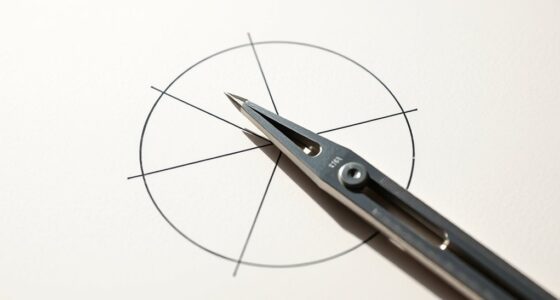
Have you ever wondered how mathematicians construct perfect geometric figures using only a compass and straightedge? It’s a fascinating process that relies on precise, logical steps to create angles, lines, and shapes without the need for measurements. One fundamental technique involves constructing angle bisectors, which are lines that divide an angle into two equal parts. To do this, you start by drawing the angle you want to bisect. Then, you open your compass to a convenient radius and place its point at the vertex of the angle. Swing an arc that intersects both sides of the angle, creating two points on each side. Without changing the compass width, place the compass point on one of these intersection points and draw a small arc inside the angle. Repeat this process from the other intersection point, ensuring the arcs intersect inside the angle. The intersection of these two small arcs marks a point through which you draw a straight line from the vertex, bisecting the angle perfectly. This method works because it creates equal distances on both sides, ensuring the line divides the angle into two congruent parts. Additionally, understanding the properties of circles and their tangents is crucial for solving many classical geometry problems. Circle tangents are another essential aspect of classical geometry constructions, often used in problems involving circles and lines. To construct a tangent to a circle from a point outside it, you start by drawing the circle with your compass. Then, locate the external point and connect it with the circle’s center, forming a secant line. To find the tangent point, you use the fact that the radius to the tangent point is perpendicular to the tangent line. You can construct this by drawing a line from the circle’s center to the external point and then constructing the perpendicular bisector of the segment connecting the circle’s center to the external point. This perpendicular bisector will intersect the circle at exactly one point, which is the tangent point. From there, you can draw the tangent line through that point, ensuring it touches the circle at exactly one point without crossing it. This technique highlights the elegance of classical constructions, relying solely on the properties of circles and perpendicular lines. Mastering these constructions—angle bisectors and circle tangents—demonstrates the power of simple tools to solve complex geometric problems. With patience and precision, you can create perfect angles and tangent lines that form the foundation of more intricate shapes and proofs. These methods show that, even without modern technology, the principles of classical geometry allow you to explore and understand the beautiful relationships between lines, angles, and curves. The compass and straightedge remain timeless tools, empowering you to craft and analyze the geometric universe with clarity and exactness. Understanding the precision of geometric tools enhances your ability to perform accurate constructions and appreciate the elegance of classical methods.

FOUR E'S SCIENTIFIC Lab Scale 500g x 0.001g Accuracy - High Precision Laboratory Analytical Balance with Windshield Digital Scientific Scale Jewelry/Kitchen Scale
0.001 g High Precision: This lab scale is equip with high precision strain gauge sensor to strengthen the...
As an affiliate, we earn on qualifying purchases.
Frequently Asked Questions
Can Compass and Straightedge Constructions Create All Geometric Figures?
You can’t create all geometric figures with just a compass and straightedge. While you can construct angle bisectors, circles, tangents, and many polygons, some shapes like certain regular polygons are impossible to build exactly. These tools excel at precise constructions involving angles and circles, but they’re limited by mathematical constraints. So, you can’t generate every figure, but you’re well-equipped for many classic constructions involving angle bisectors and circle tangents.
What Are the Historical Origins of Compass and Straightedge Techniques?
You should know that compass and straightedge techniques originate from ancient Greek, particularly Euclidean geometry. These methods date back to around 300 BCE, when Greek mathematicians like Euclid formalized geometric principles. They developed precise tools and methods to construct figures, which became fundamental in mathematics. Over centuries, this approach influenced many cultures and laid the groundwork for modern geometric constructions, emphasizing logical reasoning and accuracy.
Are There Modern Tools That Replicate Classical Construction Methods?
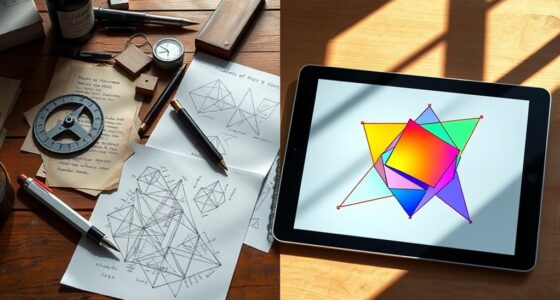
Yes, modern digital tools and educational applications replicate classical construction methods. You can use geometry software like GeoGebra or dynamic geometry apps on tablets and computers to perform compass and straightedge constructions accurately. These tools let you explore geometric principles interactively, deepening your understanding. They’re especially useful for students and educators, making traditional techniques accessible and engaging in a digital format that enhances learning and experimentation.
How Do Compass and Straightedge Constructions Relate to Algebraic Solutions?
You can see that compass and straightedge constructions relate to algebraic solutions because they focus on algebraic equivalence and constructible numbers. When you perform a construction, you’re fundamentally solving for these numbers, which are solutions to certain polynomial equations. If a number is constructible, it’s algebraically obtainable through these techniques. This connection highlights how geometric methods can represent algebraic solutions, linking classical constructions to modern algebraic concepts.
What Are the Limitations of Compass and Straightedge Constructions?
You quickly realize that compass and straightedge constructions have limits, like trying to reach the moon with a slingshot. Impossibility proofs show you can’t construct certain numbers, such as cube roots or trisect angles, using only these tools. Construction accuracy also matters—tiny errors can throw off your results. These fundamental restrictions demonstrate that some geometric problems are unsolvable with classical methods, highlighting the fascinating boundaries of geometric possibilities.

Bonvoisin Triple Beam Scale 2610g x 0.1g, Mechanical Lab Scale with Stainless Steel Platform, Balance Scale Pan Balance for Classroom
Solid Metal Base: Triple beam scale features solid cast metal base so it guarantees excellent stability. The stainless...
As an affiliate, we earn on qualifying purchases.
Conclusion
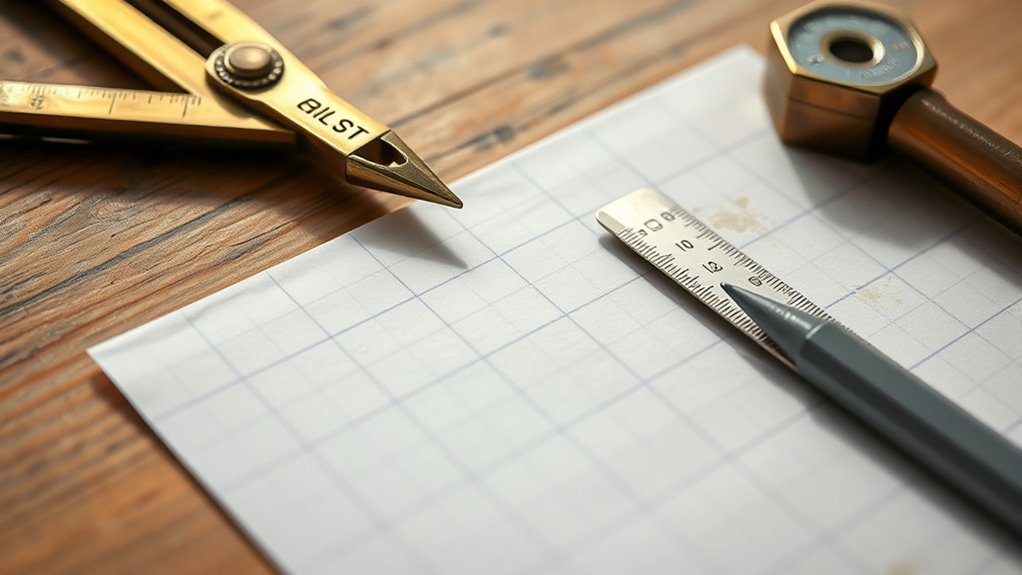
You hold the compass and straightedge, tools rooted in ancient tradition, yet they create modern marvels. While these simple instruments seem humble, they reveal complex geometries and profound truths. Like the balance between simplicity and complexity, your precise constructions bridge the gap between basic tools and intricate ideas. Embrace this timeless dance—using humble tools to achieve extraordinary results—reminding you that sometimes, the simplest methods lead to the deepest understanding.

QWORK Balance Scale, 200g / 0.2g, Mini Laboratory Triple Beam Balance Beam Scale for Teaching Tool
Material: Sturdy materials providing safety, durability, and long service life.
As an affiliate, we earn on qualifying purchases.

QWORK Balance Scale, 100g / 0.1g, Laboratory Triple Beam Balance Beam Scale for Teaching Tool
100% brand new and high quality, good performance and long term service.
As an affiliate, we earn on qualifying purchases.