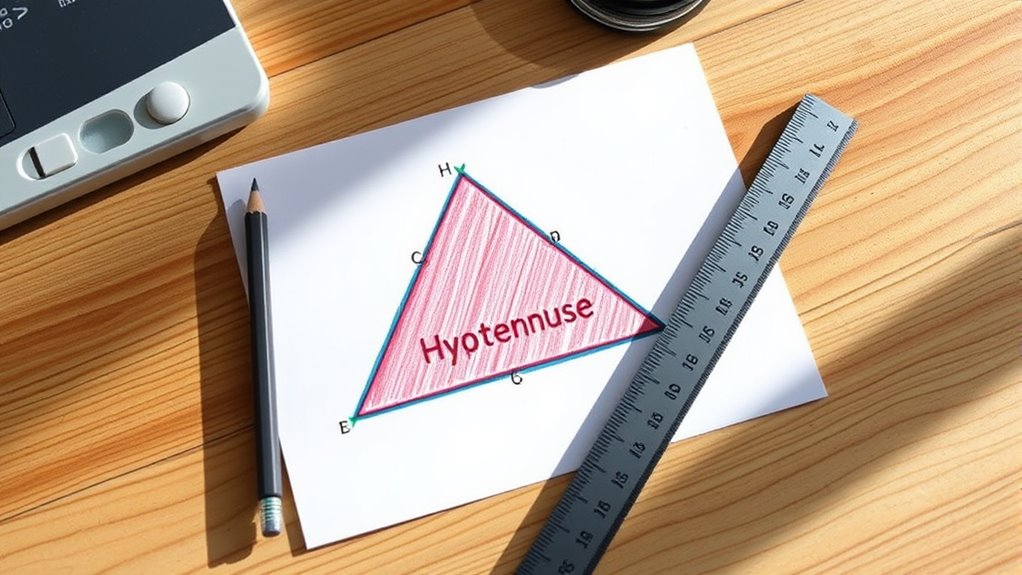

In geometry, understanding the Pythagorean Theorem is key to working with right triangles. It states that the square of the hypotenuse (the longest side) equals the sum of the squares of the other two sides (legs). This rule helps you find missing side lengths and solve real-world problems like construction and navigation. If you want to learn how to apply this theorem to different situations, keep exploring — there’s more to discover!
Key Takeaways
- The Pythagorean theorem relates the lengths of the sides in a right triangle using the formula a² + b² = c².
- It applies only to right triangles, where one angle measures 90 degrees.
- The theorem helps calculate an unknown side if the other two sides are known.
- The hypotenuse is the longest side, opposite the right angle, and is denoted as ‘c’.
- Understanding this theorem is essential for solving practical problems in construction, navigation, and design.
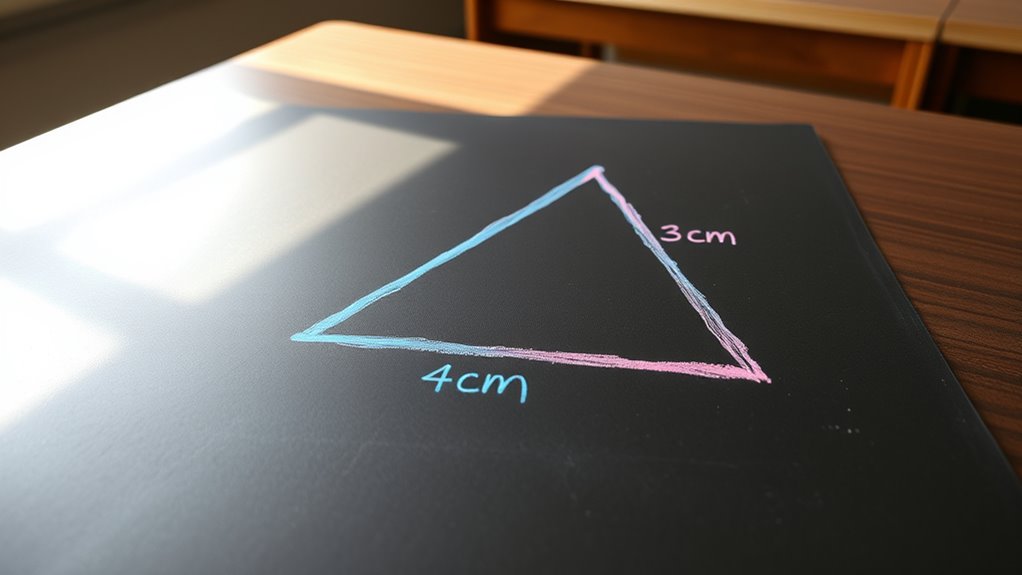
Have you ever wondered what shapes and sizes make up the world around you? It’s fascinating to realize that many objects and structures can be broken down into simple geometric forms, like triangles. One of the most important and useful shapes in geometry is the right triangle, which features a 90-degree angle. These triangles are everywhere—on rooftops, in staircases, and even in the way we measure distances. Understanding right triangles is key to applying the Pythagorean theorem, a fundamental principle that helps you find missing side lengths and solve real-world problems seamlessly.
Discover how simple right triangles unlock real-world solutions and everyday problem-solving skills.
When working with right triangles, you’ll notice they have three sides: two legs that meet at the right angle and the hypotenuse, which is the longest side opposite the right angle. The Pythagorean theorem states that the square of the hypotenuse’s length equals the sum of the squares of the legs’ lengths. Mathematically, it’s expressed as a² + b² = c², with ‘c’ representing the hypotenuse. This simple yet powerful formula allows you to determine an unknown side when you know the other two, making it invaluable in fields like construction, navigation, and engineering.
The beauty of theorem applications like this is that they’re straightforward once you grasp the concept. If you’re designing a ramp for accessibility, you can use the theorem to ensure the incline is safe and accurate. When you’re trying to find the distance between two points on a map, the theorem helps you calculate the straight-line distance by forming a right triangle with the difference in coordinates. Even in sports, understanding right triangles and the theorem can improve your strategies, such as calculating the shortest path or determining angles for optimal performance.
Practicing with right triangles and theorem applications helps you build a solid foundation in geometry. It sharpens your problem-solving skills and enables you to approach everyday situations with confidence. Whether you’re measuring for a new bookshelf, planning a garden, or figuring out the height of a tall building using just a measuring tape and a protractor, knowing how to work with right triangles and apply this theorem makes everything easier. The key is to recognize right triangles when they appear and to remember the formula: a² + b² = c².
In short, understanding right triangles and the theorem applications tied to them opens up a world of possibilities. These concepts aren’t just academic—they’re practical tools that help you navigate and shape the physical world with precision. So next time you see a corner, a staircase, or even a ladder, remember that a simple right triangle and the Pythagorean theorem are behind many of the measurements and designs you encounter every day. Mastering geometric principles enables you to solve complex problems with confidence and creativity.
Frequently Asked Questions
How Is the Pythagorean Theorem Applied in Real-World Engineering Projects?
You use the Pythagorean theorem in real-world engineering projects to perform structural analysis and improve construction planning. It helps you calculate distances and load distributions in buildings, bridges, and other structures, ensuring stability and safety. By applying this theorem, you can determine the correct angles and measurements, optimize material use, and prevent structural failures. It’s an essential tool that makes your engineering designs precise and reliable.
What Are Common Mistakes Students Make When Using the Pythagorean Theorem?
You often make common misconceptions when using the Pythagorean theorem, like confusing the legs and hypotenuse or forgetting to square the numbers. Calculation errors happen if you miscalculate squares or add incorrectly, leading to wrong results. To avoid these mistakes, double-check which side is the hypotenuse, carefully square each number, and verify your addition. Practice these steps to improve accuracy and understanding.
Can the Pythagorean Theorem Be Used in Non-Euclidean Geometries?
They say “know the rules before bending them,” and with the Pythagorean theorem, it’s no different. You can’t directly use it in non-Euclidean geometries because of their curved spaces, which change the relationships between sides. Theorem limitations mean it works only in flat, Euclidean contexts. For non-Euclidean applications, you need different tools, like hyperbolic or spherical geometry formulas, to accurately analyze the shapes.
How Does the Pythagorean Theorem Relate to the Distance Formula in Coordinate Geometry?
In coordinate geometry, the Pythagorean theorem helps you with distance calculation between two points. When you find the distance, you subtract the x-coordinates and y-coordinates to get the differences, then square those differences. By adding the squared differences and taking the square root, you directly apply the Pythagorean theorem. This method makes calculating the straight-line distance between points simple and precise in coordinate geometry.
Are There Alternative Methods to Prove the Pythagorean Theorem?
Imagine you’re in ancient Greece, but today, you can explore alternative ways to prove the Pythagorean theorem. You can use geometric proofs, like rearranging shapes, or algebraic derivations, involving coordinate geometry and algebraic manipulation. These methods offer fresh perspectives beyond traditional proofs, helping you understand the theorem’s elegance. So, yes, numerous proofs exist, and exploring them can deepen your appreciation for this fundamental principle.
Conclusion
Now that you understand the Pythagorean theorem, it’s funny how often right triangles appear in everyday life—whether you’re designing a ramp or figuring out the distance across a field. It’s almost like the universe nudges us to notice these patterns. Keep an eye out, and you’ll start seeing right triangles everywhere. Who knew that mastering a simple formula could reveal so many hidden connections around you? Geometry isn’t just theory—it’s part of your world.