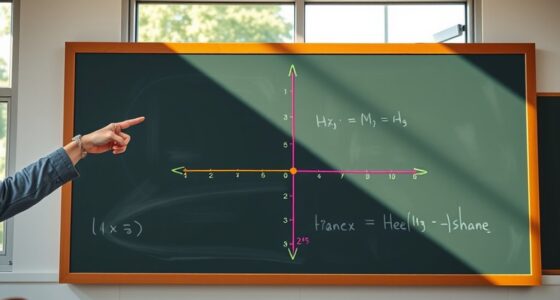

Understanding basic geometric terms is key to visualizing space. A point is a location with no size, represented by a dot and labeled with a capital letter. Lines extend infinitely in both directions, while line segments have two endpoints. Planes are flat surfaces extending endlessly in all directions, defined by three points. Recognizing how these elements relate and differ helps clarify geometric concepts; exploring further reveals even more about their fascinating connections.
Key Takeaways
- Points are location markers with no size, used to define positions in space and form the basis for lines and planes.
- Lines extend infinitely in both directions, while line segments have fixed endpoints; both are fundamental in geometric constructions.
- Planes are flat, two-dimensional surfaces extending infinitely, defined by at least three non-collinear points.
- Collinear points lie on the same straight line, essential for understanding relationships and geometric proofs.
- Visual aids and coordinate systems help clarify the properties and relationships of points, lines, and planes in geometry.
What Is a Point in Geometry?

Have you ever wondered what a point is in geometry? A point is a fundamental building block that indicates a specific location in space. It has no size, width, or height, only position. In coordinate systems, points are represented by ordered pairs or triplets, like (x, y) or (x, y, z), which help us locate them precisely. Points are essential in geometric proofs, serving as anchors for constructing lines, angles, and shapes. They define the corners of polygons or intersections of lines. Understanding points helps you grasp the basics of geometry, enabling you to analyze spatial relationships accurately. Without points, concepts like lines and planes would lack reference, making it impossible to describe or measure geometric figures effectively. Recognizing the importance of points is crucial in understanding geometric relationships and their role in spatial reasoning.
Understanding Lines and Line Segments
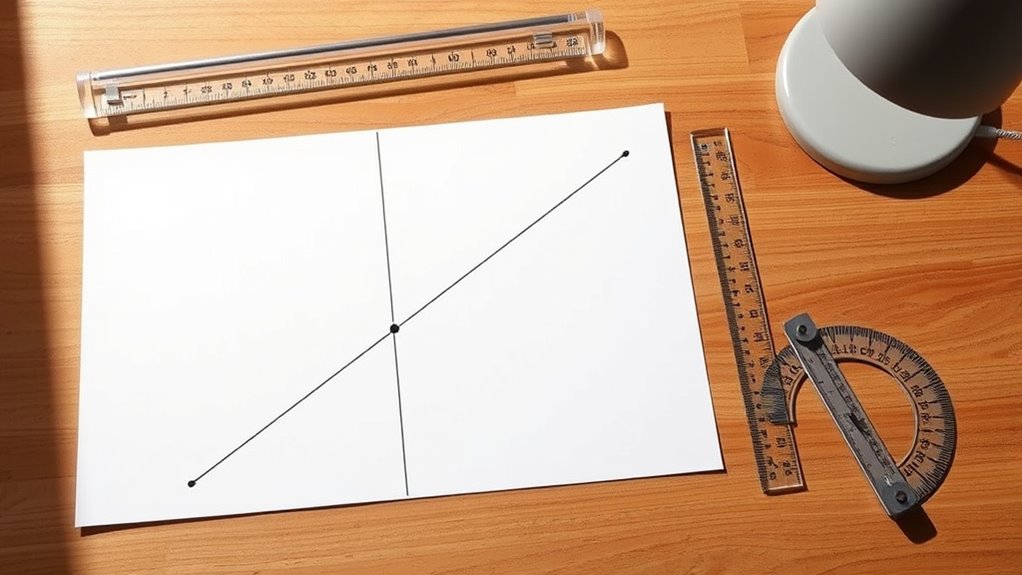
You’ll notice that lines extend endlessly in both directions, while line segments have definite start and end points. Visualizing these differences with diagrams helps clarify how each is used in geometry. Understanding these distinctions makes it easier to interpret geometric figures accurately. Recognizing the importance of high contrast ratios can also improve how images are perceived in various visual applications.
Differences Between Lines and Line Segments
While lines and line segments are both fundamental concepts in geometry, they have distinct differences that are important to understand. A line extends infinitely in both directions, meaning it has no endpoints, while a line segment has two defined endpoints. When it comes to angle measurement, lines can help us understand angles formed with other lines, but line segments only form angles at their endpoints. Line naming conventions often use lowercase letters or two points on the line, emphasizing its infinite nature. In contrast, line segments are named by their endpoints, highlighting their finite length. Recognizing these differences helps you understand geometric relationships better and avoids confusion when analyzing shapes and angles.
Visualizing With Geometric Diagrams
How can you clearly distinguish between lines and line segments when viewing geometric diagrams? First, look for the endpoints; line segments have definite endpoints, while lines extend beyond the diagram’s edges. Understanding how coordinate systems help locate points on diagrams makes it easier to see these differences. Geometric transformations, like translations or rotations, can also reveal how lines and segments behave differently under movement. Additionally, recognizing the implications of AI in Education can inform teaching methods for explaining these concepts effectively.
Exploring the Concept of Planes

A plane in geometry is a flat, two-dimensional surface that extends infinitely in all directions. Its orientation determines how it sits in space, whether horizontal, vertical, or tilted. Understanding plane orientation helps you visualize how different planes relate to each other. When two planes intersect, they form a line called the line of intersection. This line is always straight and extends infinitely within both planes. Recognizing plane intersections is key to understanding how multiple planes interact in space. Sometimes, planes are parallel and never meet, while other times they intersect along a line. Visualizing these relationships helps you grasp the spatial aspects of geometry, making it easier to analyze more complex figures and their properties. Exploring the concept of planes in geometry allows for a deeper understanding of their interactions and properties.
The Relationship Between Points, Lines, and Planes

Points, lines, and planes are fundamental elements in geometry that define the structure of space. They relate closely in various ways, especially when using coordinate systems to locate them precisely. You can think of points as coordinates, lines as connections between points, and planes as flat surfaces containing multiple points and lines. When performing geometric transformations, such as translations or rotations, understanding their relationships helps you visualize how these elements move or change position. Recognizing the properties of different geometric elements is essential for understanding their interactions within a space.
- Visualize how points move along lines or across planes in a coordinate system
- Understand how lines intersect or run parallel within a plane
- Recognize how transformations preserve or alter these relationships
Visualizing Geometric Elements With Examples

Using visual aids can make understanding points much easier. For example, diagrams or models help you see where a point is located. Real-life examples, like a dot on a map, make these concepts more tangible. Additionally, understanding how tuning modifications can influence vehicle performance can further deepen your grasp of geometric arrangements in vehicle design.
Visual Aids for Clarity
Ever wondered how visual aids can make geometric concepts easier to understand? Using tools like interactive diagrams and digital illustrations helps clarify complex ideas. These aids allow you to manipulate points, lines, and planes, making abstract ideas tangible. For example, you can rotate or zoom in on diagrams to see different perspectives, enhancing comprehension. Visual aids also help you identify relationships between elements more easily. Incorporating visual learning techniques can further improve your grasp of geometric principles.
Real-Life Geometric Examples
Visualizing geometric elements through real-life examples can greatly enhance your understanding of abstract concepts. In urban architecture, buildings often feature geometric shapes like rectangles, triangles, and circles, illustrating points, lines, and planes in a tangible way. For instance, the grid layout of city streets demonstrates the intersection of lines and the use of planes to define spaces. Celestial navigation relies heavily on geometric principles; sailors use the positions of stars (points) and the angles between them (lines) to determine their location. Recognizing these everyday applications helps you see how points, lines, and planes are not just theoretical ideas but practical tools used in designing cities and navigating the world. These examples bridge the gap between abstract geometry and real-world experience.
Common Mistakes and Clarifications in Geometric Terms

Understanding common mistakes in geometric terms is essential for improving your grasp of the subject. Many people confuse basic concepts like points, lines, and planes, leading to misconceptions. Clarifying terminology helps prevent these errors and deepens your understanding.
Mastering geometric terminology prevents misconceptions and strengthens your understanding of points, lines, and planes.
Here are some common misconceptions you should watch out for:
- Thinking a line has thickness; remember, lines are infinitely thin.
- Believing a plane is a flat surface you can see entirely; it’s an undefined, 2D space extending infinitely.
- Confusing collinear points with points lying on different lines, which affects understanding of geometric relationships.
Frequently Asked Questions
How Do Points, Lines, and Planes Relate in Three-Dimensional Space?
You’re exploring how points, lines, and planes relate in three-dimensional space. These elements form the foundation of spatial relationships and dimensional interactions. Points mark specific locations, lines extend infinitely through points, and planes stretch out in two dimensions, intersecting with lines and other planes. Understanding their relationships helps you visualize and analyze 3D objects, recognizing how they connect, intersect, or remain parallel within the space around you.
What Are the Real-World Applications of Basic Geometric Terms?
Imagine you’re living in a world before GPS, relying on basic geometric terms to navigate. In architectural design, you use points, lines, and planes to create accurate structures, while in computer graphics, these concepts help render realistic 3D images. These fundamental ideas guide construction, animation, and even virtual reality experiences, proving their importance beyond the classroom. You’re constantly applying these simple yet powerful tools in everyday technology and design.
Can a Point Exist Without a Location in Space?
You might wonder if a point can exist without a location in space. In abstract concepts and theoretical models, a point is defined as having no size or dimension, representing a specific location. However, in practical terms, a point only exists as a mental idea or symbol, not as a physical object. So, while it can be thought of as existing without a physical presence, practically, it always relates to a specific place.
How Do Geometric Terms Help in Advanced Mathematics?
You might wonder how geometric terms help in advanced math. They provide a clear framework for understanding complex concepts, especially when working with coordinate systems and geometric proofs. By using precise language, you can accurately describe shapes, positions, and relationships. This clarity makes solving problems easier and more reliable, enabling you to build on foundational ideas and explore higher-level mathematics with confidence and consistency.
Are There Any Exceptions or Special Cases in Geometric Definitions?
Imagine a world where rules bend—exceptions to definitions or special cases in geometry. You might find that certain shapes, like a perfect circle, challenge the idea of a straight line or flat plane. These special cases highlight that while definitions guide most, geometry sometimes stretches or adapts, revealing unique scenarios. So, yes, there are exceptions and special cases, reminding you that geometry’s beauty lies in its flexibility and nuance.
Conclusion
Understanding points, lines, and planes is key to grasping geometry’s fundamentals. Did you know that in Euclidean space, a plane extends infinitely in all directions, containing countless points and lines? Mastering these basic terms helps you visualize complex shapes and solve geometric problems more confidently. Keep practicing, and you’ll find that these simple concepts become powerful tools for exploring the fascinating world of geometry.