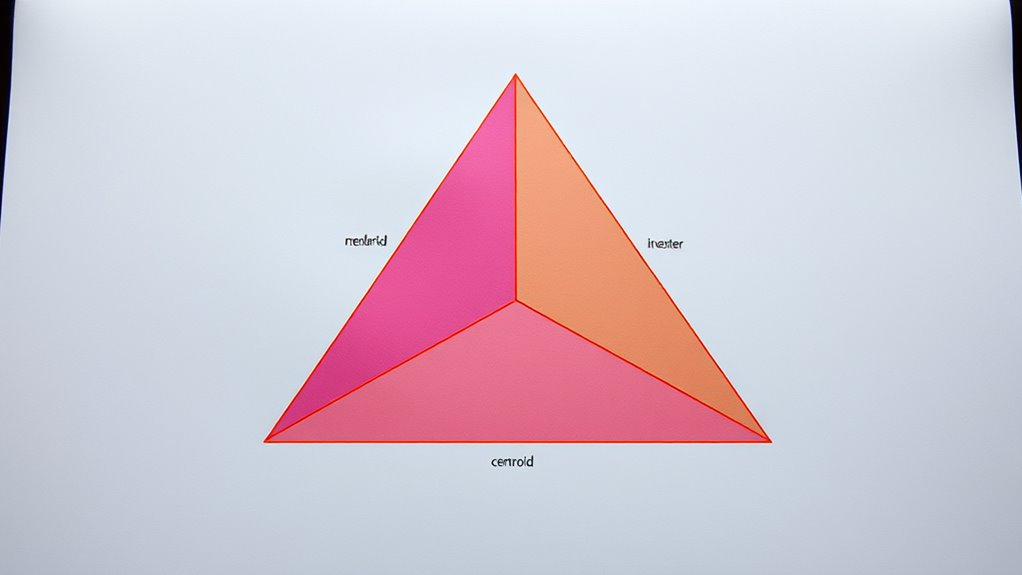

Triangle centers—such as the centroid, circumcenter, incenter, and orthocenter—are key points inside a triangle that reveal its geometric properties. The centroid is where the medians meet; it balances the triangle. The circumcenter is where perpendicular bisectors intersect, equidistant from vertices. The incenter, where angle bisectors meet, is the triangle’s center of inscribed circle. The orthocenter, the intersection of altitudes, varies with triangle shape. Exploring these centers helps you understand triangle relationships better.
Key Takeaways
- The centroid is the intersection of medians, dividing each in a 2:1 ratio, and always lies inside the triangle.
- The circumcenter is the intersection of perpendicular bisectors, equidistant from all vertices, and can be inside or outside the triangle.
- The incenter is the intersection of angle bisectors, equidistant from all sides, and always lies inside the triangle.
- The orthocenter is the intersection of altitudes, with its position varying depending on the triangle’s shape; it can be inside or outside.
- The centroid, circumcenter, and orthocenter are collinear along the Euler line, linking key triangle centers.

Triangle centers are special points within a triangle that reveal important geometric properties and relationships. One useful way to understand these centers is by looking at the medial triangle, which is formed by connecting the midpoints of each side. The medial triangle shares many properties with the original triangle, such as having parallel sides and being similar to the larger triangle. Notably, the centroid, circumcenter, and orthocenter all lie on a single straight line called the Euler line, which runs through the triangle’s interior. This line helps you see how these centers relate to each other and to the triangle’s overall structure.
The medial triangle acts as a helpful reference point because it simplifies many complex relationships. For example, the centroid, which is the point where all three medians intersect, always lies inside the triangle and is located at the intersection of the medians connecting each vertex to the midpoint of the opposite side. When you draw the medial triangle, you’ll notice that the centroid of the original triangle is also the centroid of the medial triangle, emphasizing its central role. The Euler line, passing through the centroid, orthocenter, and circumcenter, connects these key centers and reveals symmetries in the triangle. You’ll find that the centroid divides the Euler line into segments with a ratio of 2:1, with the centroid closer to the orthocenter than the circumcenter.
Understanding the Euler line can give you a clearer picture of the triangle’s internal harmony. The circumcenter, the point where the perpendicular bisectors of the sides intersect, is equidistant from all three vertices. It often lies outside the triangle if the triangle is obtuse but remains inside for acute triangles. The orthocenter, where the altitudes intersect, can be inside or outside depending on the triangle’s shape. All three centers—centroid, circumcenter, and orthocenter—are collinear along the Euler line, and their positions depend on the triangle’s angles and side lengths. Recognizing this line helps you see how these centers coordinate and how the medial triangle plays a role in understanding their relationships. Additionally, triangle centers are fundamental in various geometric constructions and proofs, making their study essential for a deeper comprehension of triangle properties.

Mr. Pen Geometry Set with 6 Inch Swing Arm Protractor, Divider, Set Squares, Ruler, Compasses and Protractor, 15 Piece Set
Geometry Set For All Levels Designed in USA
As an affiliate, we earn on qualifying purchases.
As an affiliate, we earn on qualifying purchases.
Frequently Asked Questions
How Do Triangle Centers Relate to Real-World Navigation?
You use triangle centers in real-world navigation through triangulation techniques. For example, the circumcenter helps determine your position by intersecting signals from three known points. The centroid guides you in balancing or optimizing routes, while the incenter aids in pinpointing precise locations within a triangular area. By understanding these centers, you improve accuracy and efficiency in geographical navigation, making travel and mapping more reliable and straightforward.
Can Triangle Centers Be Used in Architecture Design?
Yes, triangle center applications are valuable in architectural geometry. You can use the centroid to find the ideal center of mass for balance, the circumcenter for designing structures with equidistant support points, and the incenter for creating aesthetically pleasing, symmetrical layouts. These centers help optimize stability, symmetry, and aesthetics, making them essential tools in architecture. Understanding triangle centers allows you to design more precise and harmonious structures.
Are Triangle Centers Applicable in Non-Euclidean Geometries?
Yes, triangle centers are applicable in non-Euclidean geometries like hyperbolic geometry. In non-Euclidean models, you can define analogous centers, but their properties differ from Euclidean ones. You’ll find that concepts such as centroid, circumcenter, incenter, and orthocenter adapt to hyperbolic geometry, helping you analyze triangles within these models. Understanding these centers in hyperbolic geometry can deepen your insight into the structure of non-Euclidean spaces.
How Do Triangle Centers Change With Triangle Transformations?
Imagine your triangle as clay you’re shaping. When you perform medial transformations, the triangle’s centers, like the centroid, shift smoothly, like a compass needle moving with each twist. As the triangle changes—stretching or shrinking—the centroid shifts accordingly, always staying at the intersection of medians. These transformations show how triangle centers adapt, highlighting their dynamic nature in response to your shaping, helping you visualize geometric harmony in motion.
What Are the Historical Origins of Studying Triangle Centers?
You explore the historical development of triangle centers by looking at mathematicians’ contributions from ancient Greece through the Middle Ages. Pythagoras and Euclid laid early groundwork, while Renaissance scholars like Apollonius advanced understanding of triangle properties. In the 19th and 20th centuries, mathematicians like Feuerbach and Kimberling expanded the study, formalizing concepts and discovering new centers. Their work continues to influence geometry today.
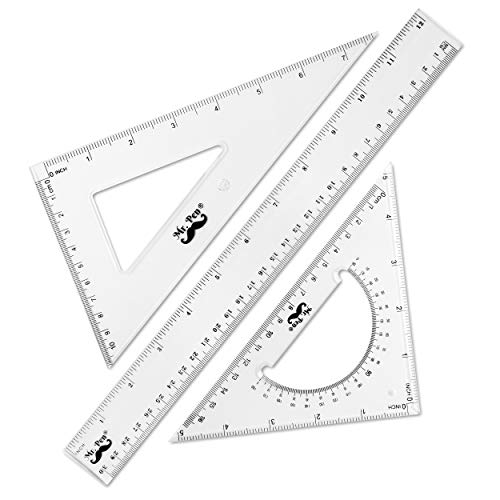
Mr. Pen Triangle Ruler, Protractor, Math Set – 3 Pack, Square Ruler, Protractor for Geometry
Package Includes: One 12-Inch Straight Ruler, One 45 Degree Set Square, And One 30/60 Set Square
As an affiliate, we earn on qualifying purchases.
As an affiliate, we earn on qualifying purchases.
Conclusion
Understanding triangle centers helps you see the geometry behind everyday shapes. Did you know that the centroid, where medians meet, divides each median in a 2:1 ratio? This shows how the center balances the triangle perfectly. By grasping these concepts, you gain a new perspective on shapes around you. So, next time you see a triangle, remember there’s more than meets the eye—you’re exploring the heart of geometry itself!
Mr. Pen Geometry Set with 6 Inch Swing Arm Protractor, Divider, Set Squares, Ruler, Compasses and Protractor, 15 Piece Set
Geometry Set For All Levels Designed in USA
As an affiliate, we earn on qualifying purchases.
As an affiliate, we earn on qualifying purchases.

Compass Geometry Tool, 13PCS Compass and Protractors Set Math Geometry Drawing Tool Precision Set Graphic Compasses Triangle Rulers Pencils Protractor with Storage Case (Brown)
【13-piece Math Compass Kit】You will get 13 pieces of compass geometry tool in the package, which includes 3…
As an affiliate, we earn on qualifying purchases.
As an affiliate, we earn on qualifying purchases.