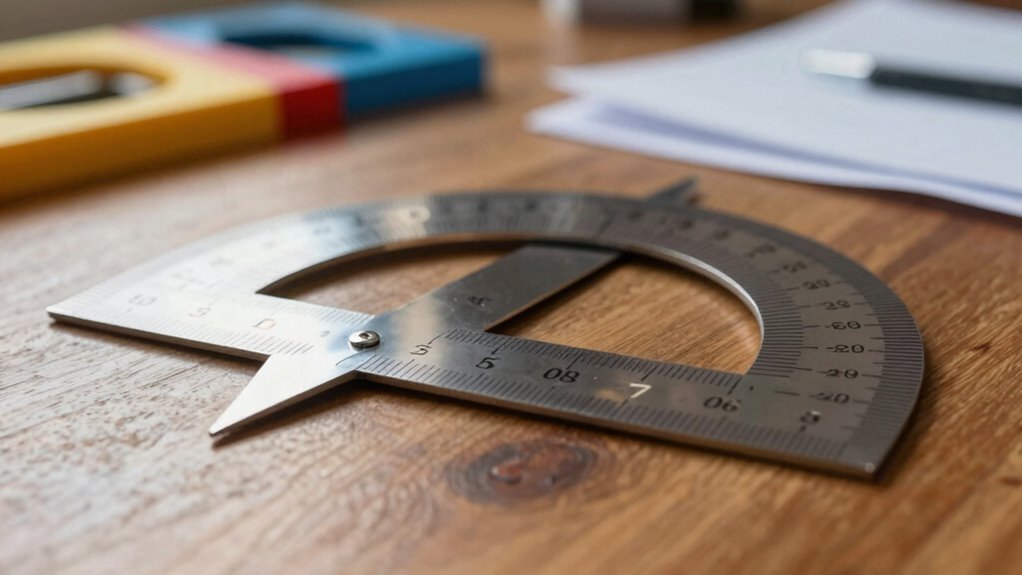

Understanding how angle pairs work together helps you see relationships and solve problems easily in real-life situations. Instead of just memorizing names, focusing on the connections between angles allows you to interpret structures and objects around you more intuitively. This approach improves your spatial awareness and decision-making, making tasks like designing, troubleshooting, or steering much simpler. If you keep exploring, you’ll discover even more ways to use these ideas practically and confidently.

Prime made for students and young adults
- Fast, free delivery for dorm and study essentials
- Prime Video and Amazon Music included
- Member-only deals
Key Takeaways
- Understanding angle pairs reveals how angles relate in real-world structures, enhancing practical problem-solving skills.
- Recognizing angle relationships promotes intuitive grasp of geometry, reducing reliance on memorization.
- Angle pairs help interpret everyday objects and signals, improving quick decision-making and safety awareness.
- Focusing on relationships fosters deeper comprehension of geometric concepts used in architecture and engineering.
- Learning angle interactions enhances spatial awareness and practical application, making geometry more relevant and meaningful.
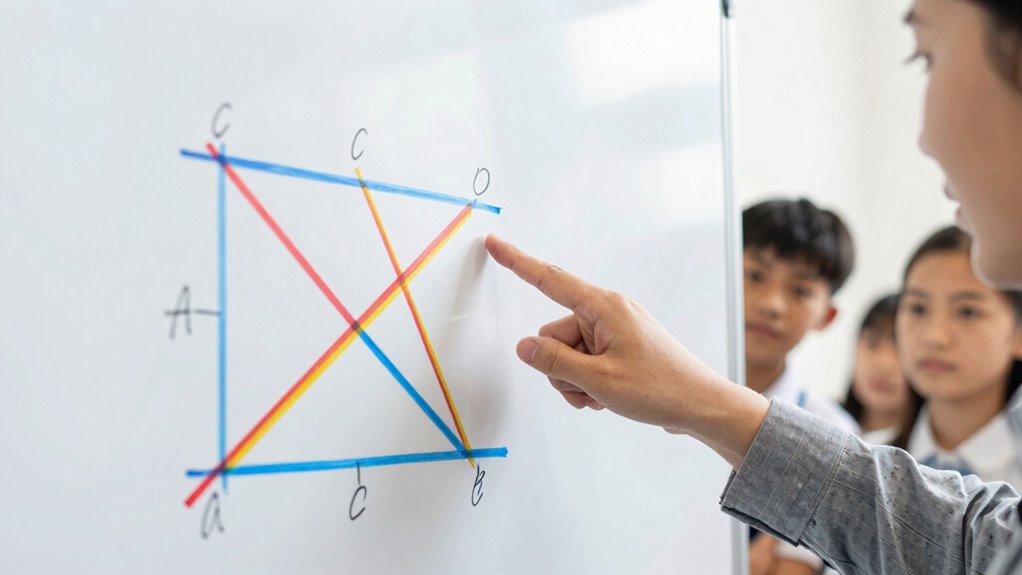
Understanding angle pairs is essential because they reveal the relationships between different angles in geometric figures. When you recognize how angles relate to each other, you can better interpret and analyze the shapes and structures you encounter every day. Instead of simply memorizing names like complementary or supplementary, focusing on how these angles work together helps you see their significance in real-world applications. For example, in architecture, understanding how angles pair up can help you grasp why certain structures are stable or how they fit together. When designing a roof or a bridge, knowing the relationships between angles ensures safety and precision. This practical insight is far more valuable than rote memorization because it allows you to apply concepts directly to tangible situations.
Recognizing how angles relate helps us understand structures and solve real-world problems more effectively.
The importance of visual understanding becomes clear when you look at how we interact with our environment. Think about a traffic light or a stop sign—angles are everywhere, guiding movement and safety. Recognizing how angles pair in these objects helps you interpret signals quickly and accurately. Similarly, in everyday tasks like assembling furniture or decorating a room, understanding the relationships between angles makes the process smoother. You don’t need to recall complicated names; instead, you observe how angles complement or oppose each other, leading to better decisions and more accurate results. This visual approach empowers you to connect geometric principles to practical situations, making learning more intuitive and meaningful. Recognizing angle relationships enhances your ability to analyze and solve real-world problems efficiently.
In geometry, angle pairs such as vertical angles or adjacent angles aren’t just abstract ideas—they’re tools you can use to solve problems efficiently. When you see two angles forming a straight line, you intuitively understand they are supplementary, and knowing this helps you quickly calculate unknown angles without memorizing their names. This practical understanding is especially useful in fields like engineering, art, or even navigation, where geometric relationships are constantly at play. Recognizing how these angle pairs function together in different contexts deepens your understanding of spatial relationships and improves your problem-solving skills. Recognizing how angles in real-world applications interact sharpens your spatial awareness and enhances your problem-solving skills. It’s more than just knowing the names of angle pairs; it’s about understanding how they function together in real life. Developing this visual understanding can improve your ability to interpret and manipulate various structures and designs around you. Additionally, understanding these relationships can also deepen your appreciation for the fundamental principles of geometry, which underpin many practical and theoretical applications.
Ultimately, focusing on the relationships between angles rather than their labels allows you to develop a deeper, more practical grasp of geometry. This perspective helps you see connections, make predictions, and solve problems confidently. When you prioritize visual understanding and real-world applications of angle pairs, you transform geometry from a set of memorized facts into a powerful tool for everyday life. You’ll find it easier to interpret structures, design solutions, and appreciate the geometry that surrounds you, making your learning both relevant and impactful.
geometry angle measurement tools
As an affiliate, we earn on qualifying purchases.
As an affiliate, we earn on qualifying purchases.
Frequently Asked Questions
How Do Angle Pairs Relate to Real-World Problem Solving?
You see angle pairs applications in everyday problem solving, like designing structures or analyzing motion. When you understand how complementary, supplementary, or vertical angles work, you can quickly identify solutions and make accurate calculations. Recognizing these angle relationships helps you solve practical problems more efficiently, whether in engineering, architecture, or even navigation. Mastering angle pairs boosts your ability to approach real-world challenges confidently and precisely.
Can Understanding Angle Pairs Improve Overall Geometry Skills?
Yes, understanding angle pair applications and practicing angle pair visualization can considerably improve your overall geometry skills. When you grasp how angles relate and interact, you can analyze shapes more effectively, solve problems faster, and see geometric concepts clearly. This practical knowledge helps you recognize patterns and connections in real-world situations, making geometry more intuitive and boosting your confidence in applying concepts to new challenges.
Are Some Angle Pairs More Useful Than Others?
Some angle pairs are more useful because they have broader applications in real-world problems. For instance, complementary and supplementary angles often come up in construction and design, making them essential. By understanding angle pair misconceptions, you can avoid errors and recognize their practical uses. Knowing which pairs matter most helps you focus your effort where it counts, turning theory into action and making geometry truly relevant to everyday life.
How Do Angle Pairs Connect to Other Geometric Concepts?
Angle pairs directly connect to other geometric relationships, helping you understand figures better. For instance, supplementary and complementary angles relate to parallel lines and transversals, revealing properties like congruence and similarity. Recognizing these angle pairs allows you to prove theorems and solve problems more efficiently, as they serve as building blocks for understanding complex geometric concepts. Mastering angle pairs enhances your overall grasp of geometry, making it easier to see how different shapes and lines interact.
What Are Common Mistakes When Identifying Angle Pairs?
Think of identifying angle pairs like sorting puzzle pieces—if you’re not careful, you may make angle misconceptions or identification errors. Common mistakes include confusing complementary with supplementary angles, or mixing up adjacent and vertical angles. Always double-check the angle’s position and relationship, rather than relying solely on memorized names. This careful approach helps avoid misconceptions and guarantees you correctly identify and understand each angle pair.
As an affiliate, we earn on qualifying purchases.
Conclusion
Remember, understanding why angle pairs matter often reveals their true beauty — it’s like discovering a secret code in the world around you. The names are just labels, but the connections you make deepen your insight. Sometimes, it’s the moments when you realize the relationships between angles mirror the connections in life that truly matter. So, don’t just memorize; see the patterns and let them remind you that understanding often leads to the greatest discoveries.
As an affiliate, we earn on qualifying purchases.
As an affiliate, we earn on qualifying purchases.
Halloween Picks
halloween
As an affiliate, we earn on qualifying purchases.