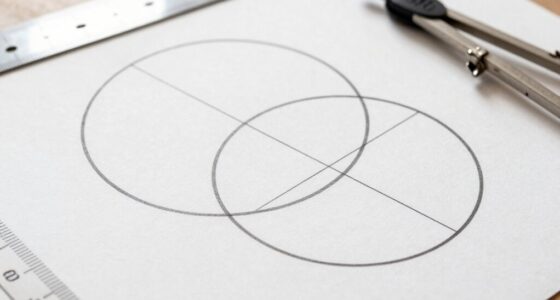

When you look at similar figures, you’re seeing how scale ratios show proportional relationships that help you understand size differences in real-world objects. These ratios reveal how parts relate to the whole, whether in maps, models, or blueprints. Recognizing these patterns allows you to compare and analyze sizes accurately. By exploring these connections, you’ll discover how scale shapes many aspects of design, engineering, and nature, encouraging you to explore further for a deeper understanding.

Prime made for students and young adults
- Fast, free delivery for dorm and study essentials
- Prime Video and Amazon Music included
- Member-only deals
Key Takeaways
- Similar figures demonstrate how scale ratios relate different sizes while preserving shape, enabling accurate real-world comparisons.
- Recognizing proportional relationships in similar figures helps interpret distances, sizes, and measurements in maps and blueprints.
- Scale factors reveal how physical features or structures can be enlarged or reduced while maintaining their geometric integrity.
- Understanding similarity aids in designing models, ensuring proportions are accurate for real-world applications.
- Analyzing similar figures allows for predictive insights into how changes in size affect other dimensions and properties.

When working with similar figures, understanding how their sizes relate through scale is fundamental, especially in real-world applications. Similar figures are shapes that have the same form but differ in size, and recognizing this similarity allows you to compare and analyze objects effectively. To do this, you need to grasp the concept of scale, which is the ratio of corresponding sides in similar figures. This ratio forms the basis of proportional reasoning, a core skill that helps you understand how measurements change in different contexts. When you analyze similar figures, you’re primarily examining how geometric transformations—such as dilation—affect size while preserving shape. These transformations stretch or shrink figures proportionally, maintaining angles and the shape’s overall structure. Recognizing this connection helps you see that scale is not just about size but about how figures relate to each other through these transformations. Additionally, understanding the concept of dilation enhances your ability to interpret how figures change size while maintaining their shape. In everyday life, understanding scale and similar figures enables you to interpret maps, models, and blueprints more accurately. For example, when you look at a scaled map, you’re applying proportional reasoning to determine real-world distances from the map’s measurements. The scale ratio acts as a bridge between the map’s size and actual distances, allowing you to convert measurements seamlessly. Similarly, in architecture or engineering, blueprints are scaled representations of real structures. Recognizing how the blueprint’s figures are similar to the actual building helps you visualize the project and verify measurements are correct. This practical application of geometric transformations and proportional reasoning underscores how these concepts are indispensable beyond math class. Furthermore, when working with similar figures, you develop a keen eye for relationships and ratios that extend to more complex problems. You learn to identify corresponding angles and sides, understand how they change under dilation, and use ratios to solve real-world problems. This skill becomes especially valuable in fields like design, manufacturing, and even art, where scaling objects accurately is paramount. The key insight is that similar figures reveal the consistent relationships between parts and whole, regardless of size. By mastering the principles of geometric transformations and proportional reasoning, you gain a powerful toolkit to interpret, compare, and manipulate scaled objects confidently. Recognizing the importance of accurate measurement and how it relates to scale helps you apply these concepts effectively in practical situations. Developing a strong understanding of scale factors can also improve your ability to work with complex models and design projects. For instance, understanding how to adjust scale models accurately can significantly impact the precision of your work. Moreover, understanding how these ratios influence the perception of size can also aid in environmental conservation efforts, where precise scaling is essential to modeling ecosystems or habitats. Ultimately, understanding similar figures helps you see the world through a mathematical lens—recognizing that size differences often follow predictable, proportional patterns that reflect the underlying shape and structure of the objects around you.
As an affiliate, we earn on qualifying purchases.
Frequently Asked Questions
How Do Similar Figures Help in Architectural Design?
Similar figures help you achieve design accuracy in architectural projects by using proportional relationships. They allow you to create scaled models or plans that accurately reflect the real structure’s dimensions. This way, you can visualize and adjust designs before construction, guaranteeing everything fits perfectly. By understanding these relationships, you guarantee your architectural plans are precise, reducing errors and making your project more efficient and visually consistent.
Can Similar Figures Be Used in Digital Modeling?
Yes, similar figures can be used in digital modeling through proportional scaling, like a painter’s brush strokes blending seamlessly. You can easily create accurate digital renderings by resizing models while maintaining their proportions. This technique helps you visualize designs realistically, ensuring that every element stays true to the original. Using similar figures in digital modeling makes it easier to experiment with different sizes, making your creative process both flexible and precise.
What Are Common Mistakes When Using Similar Figures for Scaling?
When using similar figures for scaling, you often make mistakes that affect scale accuracy. Common errors include misreading measurements, which lead to measurement errors, and failing to keep proportions consistent. You might also forget to double-check your scale factors, causing inaccuracies in your scaled model. To avoid these mistakes, always verify measurements carefully, maintain proportionality, and use precise tools to guarantee your scaled figures reflect real-world sizes accurately.
How Does Scale Affect Measurements in Cartography?
Scale directly impacts measurements in cartography by maintaining ratio consistency, which guarantees distances are proportionally accurate. However, you should be aware of map distortion, which occurs when the scale isn’t applied correctly or the map projection alters the true proportions. This distortion can make measurements seem inaccurate, so always check that the scale is consistent and appropriate for the map’s purpose to get reliable measurements.
Are Similar Figures Applicable in Biological Growth Comparisons?
Yes, similar figures are applicable in biological growth comparisons. They help you understand biological scaling and growth patterns across different sizes, like comparing the size of animals or plants at various stages. By analyzing similar figures, you can see how proportions stay consistent despite size differences. This insight allows you to predict growth trends, understand developmental processes, and compare organisms effectively, emphasizing the importance of scale in biology.
As an affiliate, we earn on qualifying purchases.
Conclusion
Understanding similar figures helps you see how scale transforms tiny models into colossal structures. When you grasp this concept, you reveal the secret to designing everything from miniature maps to skyscrapers that scrape the sky. It’s like holding the universe’s blueprint in your hands—nothing is too big or small to understand with the right scale. So, next time you see a tiny toy or a towering building, remember: they’re both the same shape, just scaled up or down like magic!
As an affiliate, we earn on qualifying purchases.
As an affiliate, we earn on qualifying purchases.
Fall Picks
fall essentials
As an affiliate, we earn on qualifying purchases.