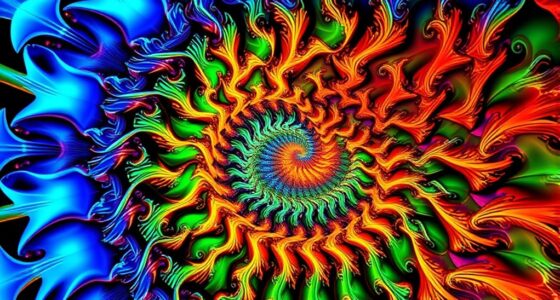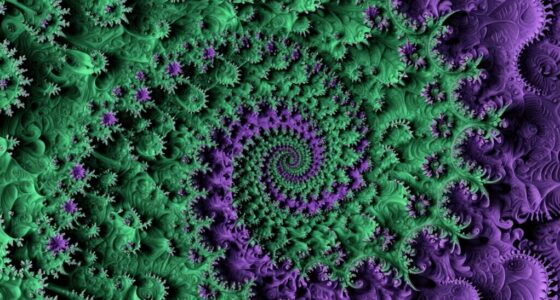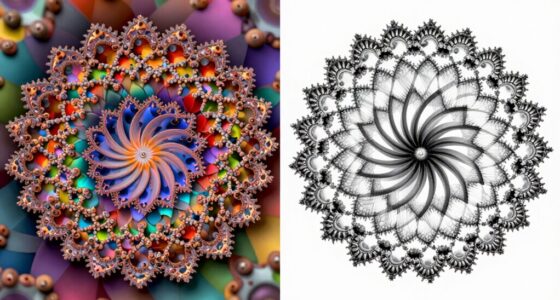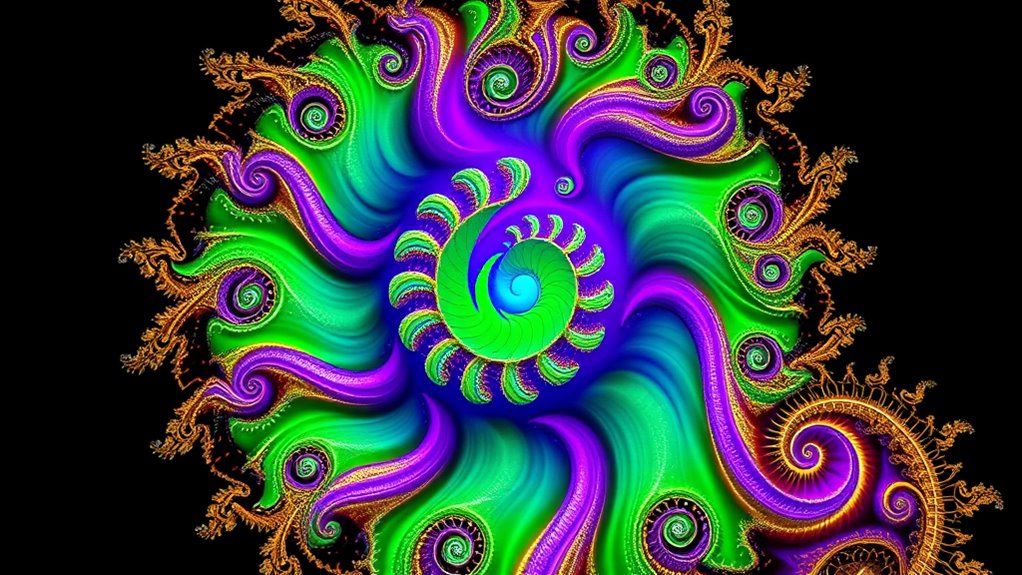

Fractals show how simple rules can create endless complexity, shaping patterns in nature, art, and science. By using recursive algorithms and self-similarity, you can generate intricate structures like coastlines, clouds, and trees. These patterns repeat at every scale, revealing infinite detail from straightforward instructions. If you’re curious about how these patterns form and their applications, exploring more will uncover the fascinating ways simple rules craft complexity.

Prime made for students and young adults
- Fast, free delivery for dorm and study essentials
- Prime Video and Amazon Music included
- Member-only deals
Key Takeaways
- Fractals exhibit infinite complexity emerging from simple recursive rules and algorithms.
- Self-similar patterns repeat at various scales, creating detailed and intricate structures.
- Mathematical models like the Mandelbrot set demonstrate how simple equations generate complex forms.
- Natural phenomena such as coastlines and mountain ranges are examples of fractal self-similarity.
- Fractal geometry reveals that simple iterative processes can produce endlessly complex patterns.
fractal geometry educational kit
As an affiliate, we earn on qualifying purchases.
As an affiliate, we earn on qualifying purchases.
The Origins and Discovery of Fractals
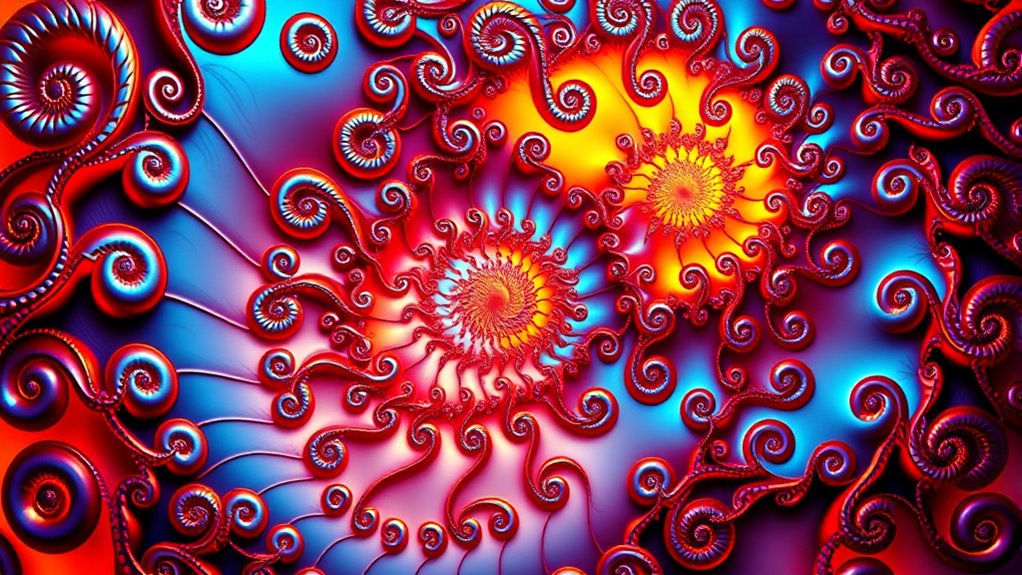
Have you ever wondered how the concept of fractals came to be? It all started with mathematicians noticing intriguing recursive patterns in nature and art. Early pioneers like Benoît B. Mandelbrot explored these patterns, revealing how simple rules could generate complex, self-similar structures. Fractal aesthetics emerged from this discovery, showcasing how repetitive, recursive patterns create visually stunning designs. Mandelbrot’s work demonstrated that fractals aren’t just mathematical curiosities—they reflect patterns found in coastlines, mountains, and clouds. This realization shifted perspectives on geometry, emphasizing infinite complexity arising from straightforward rules. The study of fractals opened new avenues for understanding natural forms and artistic expression, laying the foundation for the modern fascination with these endlessly intricate, recursive patterns. Mathematical concepts play a crucial role in understanding the underlying principles behind fractal formation.
As an affiliate, we earn on qualifying purchases.
Fundamental Principles Behind Fractal Geometry
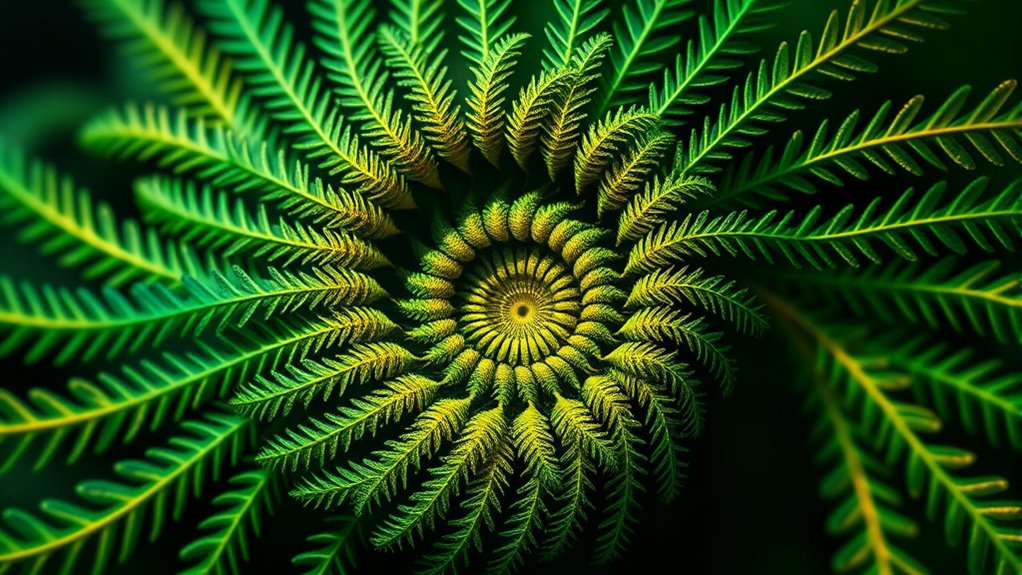
You’ll notice that fractals are characterized by self-similarity, meaning their patterns repeat at different scales. These structures are created through iterative processes that build complexity step by step. Understanding how scaling and recursion work is key to grasping the fundamental principles of fractal geometry. High resolution visuals can help in visualizing the intricate details and recursive nature of fractals.
Self-Similarity Patterns
What makes fractals truly fascinating is their self-similarity, a property where patterns repeat at different scales. This trait results from recursive growth, creating self-similar structures that look alike regardless of zoom level. These repeating patterns are fundamental to fractal geometry, giving fractals their infinite complexity. To better understand, consider:
- The way a coastline’s jagged edge resembles smaller sections of itself.
- The branching of trees or blood vessels, where each branch mimics the whole.
- The repeating motifs in the Mandelbrot set, showcasing intricate detail at every magnification.
- Essential oils for health, which exemplify how simple compounds can produce complex therapeutic effects.
This self-similarity pattern reveals that each part contains a miniature version of the whole, highlighting how simple rules can generate complex, endlessly repeating structures.
Iterative Construction Processes
How do fractals achieve their intricate patterns? Through iterative construction processes, you repeatedly apply simple rules to generate complex designs. Each step adds layers of pattern repetition, increasing the overall complexity. This process relies on the idea that small changes at each stage accumulate, creating fractals with astonishing detail. Additionally, understanding support hours for various entertainment venues can enhance your planning and experience. This iterative complexity enables fractals to develop their mesmerizing detail, proving that simple rules can lead to infinitely intricate forms.
Scaling and Recursion
Have you ever wondered what makes fractals so endlessly intricate? It’s all about scaling and recursion. Fractals use recursive functions, repeating patterns at every level, which creates infinite detail. This self-similarity means each part mirrors the whole, no matter how zoomed in. The key is understanding fractal dimensions, which measure complexity beyond traditional shapes. Here’s how it works:
- Recursive functions generate smaller copies of the original shape, maintaining detail at every scale.
- Scaling involves shrinking or enlarging parts, revealing endless patterns when you zoom in.
- Fractal dimensions quantify how detail increases as you zoom, often resulting in non-integer values that reflect their complexity.
- Effective visualization often requires specialized tools or safe applications to explore fractal structures interactively.
Together, these principles explain how simple rules produce infinitely complex structures.
As an affiliate, we earn on qualifying purchases.
Recursive Algorithms and Self-Similarity

Recursive algorithms are essential tools for generating fractals because they repeatedly apply a simple rule to create complex, self-similar patterns. By doing so, you produce recursive patterns that mimic the structure of the whole at smaller scales. This process reveals self similar structures, where each part resembles the entire fractal. When you implement recursion, you break down a problem into smaller versions of itself, allowing the pattern to grow infinitely. These algorithms are powerful because a simple initial rule can generate astonishing complexity. As you iterate, you see how the same pattern repeats at different levels, creating the mesmerizing beauty of fractals. Additionally, understanding the type of bicycle races can inspire new ways to approach challenges with strategic thinking and endurance. Ultimately, recursive algorithms showcase how simple rules can lead to infinitely intricate, self-replicating forms.
As an affiliate, we earn on qualifying purchases.
Famous Examples of Fractals in Nature
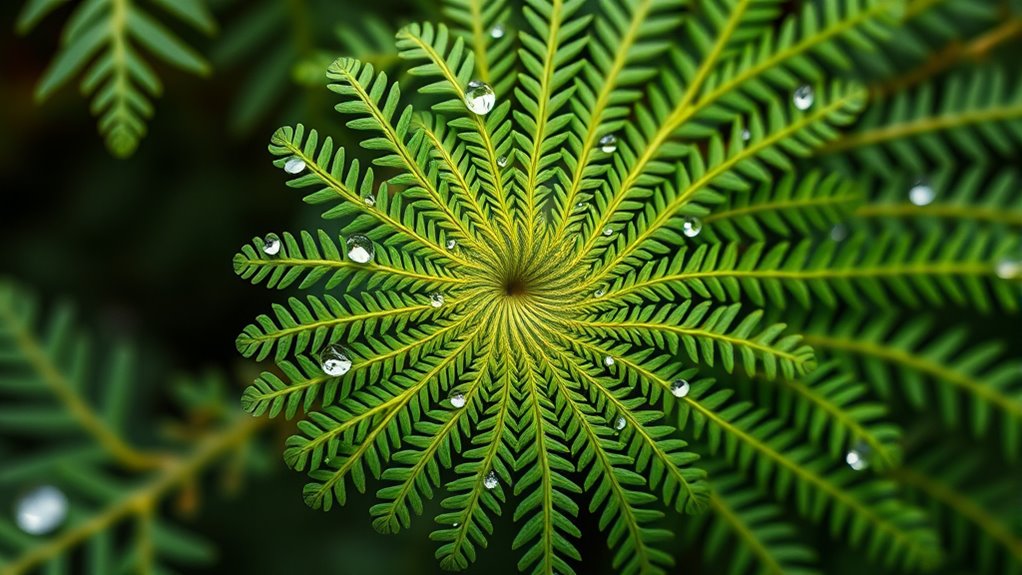
You can see fractals in nature through fern leaf patterns, where each smaller leaf mimics the whole. Coastlines also display fractal shapes, with jagged edges that look similar at different scales. These examples highlight how self-similarity appears in the world around you. Additionally, natural fractals can be observed in cloud formations and mountain ranges, further demonstrating the recurring patterns that characterize fractal geometry.
Fern Leaf Patterns
Fern leaf patterns are striking examples of fractals in nature, showcasing self-similarity at various scales. You can observe how each small frond resembles the entire leaf, demonstrating pattern replication. This natural fractal inspires fractal art, where artists mimic these repetitive structures to create intricate designs. Ferns exemplify how simple rules generate complex, repeating patterns that extend infinitely at different levels. Their fractal beauty highlights nature’s efficiency in design and growth. By studying fern leaf patterns, you gain insight into the underlying principles of fractals and how they manifest in real-world organisms. These patterns illustrate that complexity arises from simplicity, making ferns a perfect example of fractals in nature. Their fractal structure continues to fascinate scientists and artists alike. Additionally, understanding the cost and budgeting involved in related projects can help in planning and appreciating the intricate beauty of natural fractals.
Coastline Shapes
Have you ever noticed how coastlines seem to twist and turn with endless complexity? This coastline complexity results from shoreline irregularities that occur at every scale. When you zoom in, you’ll see tiny fjords, inlets, and coves that mirror larger features, demonstrating fractal behavior. These irregularities make coastlines appear jagged and unpredictable, reflecting natural processes like erosion and sediment deposition. Fractal geometry helps explain this pattern, showing that the more you examine a coastline, the more detail you discover. The self-similar patterns observed in coastlines are a classic example of fractal patterns in nature. Famous examples like the rugged coast of Norway or the intricate outlines of the Florida Keys highlight how natural fractals shape our world’s borders. Understanding these shoreline irregularities reveals the fascinating self-similarity that underpins many natural landscapes.
Mathematical Representations and Equations

How do mathematicians capture the intricate patterns of fractals? They use mathematical representations and equations to model their complex structures precisely. These equations define the rules that produce fractals through iterative processes. For example, the Mandelbrot set is described by a simple quadratic equation, yet it creates infinite complexity. To understand these, you should explore:
Mathematicians model fractals with equations that generate infinite complexity through iterative processes.
- Iterated function systems (IFS), which use recursive functions to generate self-similar patterns.
- Complex number equations, like ( z_{n+1} = z_n^2 + c ), which produce fractals such as the Mandelbrot set.
- Fractal dimension formulas, which quantify how detail scales at different magnifications.
- Tuning techniques in engineering that utilize fractal geometry to optimize structures and systems.
These mathematical tools allow you to translate the visual complexity of fractals into precise, manageable equations.
Visualizing Fractals: Techniques and Tools

You can explore fractals through various digital rendering techniques that generate detailed images quickly. Interactive visualization tools allow you to manipulate parameters and see changes in real time, enhancing understanding. Additionally, artists create stunning fractal designs that blend mathematical precision with creative expression, showcasing the beauty of these patterns. Exploring mathematical patterns through these methods can deepen appreciation for the intricate structures found in nature and art.
Digital Rendering Methods
Digital rendering methods have revolutionized the way we visualize fractals, making complex patterns accessible and mesmerizing. With advanced software, you can create stunning digital art that highlights recursive textures and intricate details. These tools allow you to experiment with algorithms and color schemes, enhancing both simplicity and complexity. Incorporating design principles can further refine the aesthetic appeal of fractal artworks. These methods make fractal visualization more engaging, enabling you to explore the beauty of mathematical patterns through digital art tools.
Interactive Visualization Tools
Interactive visualization tools have transformed the way you explore fractals by allowing real-time manipulation of parameters and instant feedback. Using interactive algorithms, you can adjust variables like zoom level, color schemes, and iteration depth, observing how these changes affect the fractal’s structure instantly. Visualization techniques such as fractal zooming and parameter sliders make complex patterns more accessible and engaging. These tools enable you to experiment freely, uncovering hidden details and understanding the fractal’s infinite complexity firsthand. They also help in learning and teaching, providing intuitive ways to grasp mathematical concepts behind fractals. Moreover, interactive visualization fosters a deeper appreciation for the power of imagination in exploring complex systems, highlighting how mental potential can be harnessed to uncover new patterns and insights. Overall, interactive visualization tools empower you to explore fractals dynamically, making the study of these intricate patterns both engaging and insightful.
Artistic Fractal Creations
Have you ever wondered how fractals can serve as stunning artistic expressions? You can harness various techniques to create mesmerizing fractal art. First, choosing vibrant color palettes enhances visual impact, highlighting intricate details. Second, experimenting with fractal animations brings movement and depth, making static images come alive. Third, software tools like Mandelbulb 3D or Apophysis allow you to customize parameters easily, producing unique designs. By blending these tools with your creativity, you can craft captivating visuals that showcase fractals’ infinite complexity. Whether for digital galleries or personal projects, these methods enable you to push the boundaries of traditional art with fractal patterns. Ultimately, mastering visualization techniques transforms simple mathematical rules into breathtaking artistic expressions. Understanding fractal geometry can deepen your appreciation and inspire innovative designs.
Applications of Fractal Concepts in Science and Technology

Fractal concepts have become essential tools across various fields of science and technology because they provide a framework for understanding complex, irregular patterns that traditional models struggle to describe. In science, fractals help explain natural phenomena like coastlines, mountain ranges, and blood vessel growth, making models more accurate. In technology, they enhance image compression and signal processing. Chaos theory, closely related to fractals, helps predict unpredictable systems, such as weather patterns. Fractal art also influences design and visualizations, showcasing the beauty of natural complexity. Furthermore, the study of vetted – Fin and Forage can inspire innovative solutions in resource management and sustainable practices. You can see how these concepts revolutionize our approach to problem-solving and creativity, bridging the gap between simplicity and complexity. By applying fractal ideas, scientists and engineers access new possibilities for innovation and understanding in many disciplines.
The Artistic Appeal of Fractal Patterns
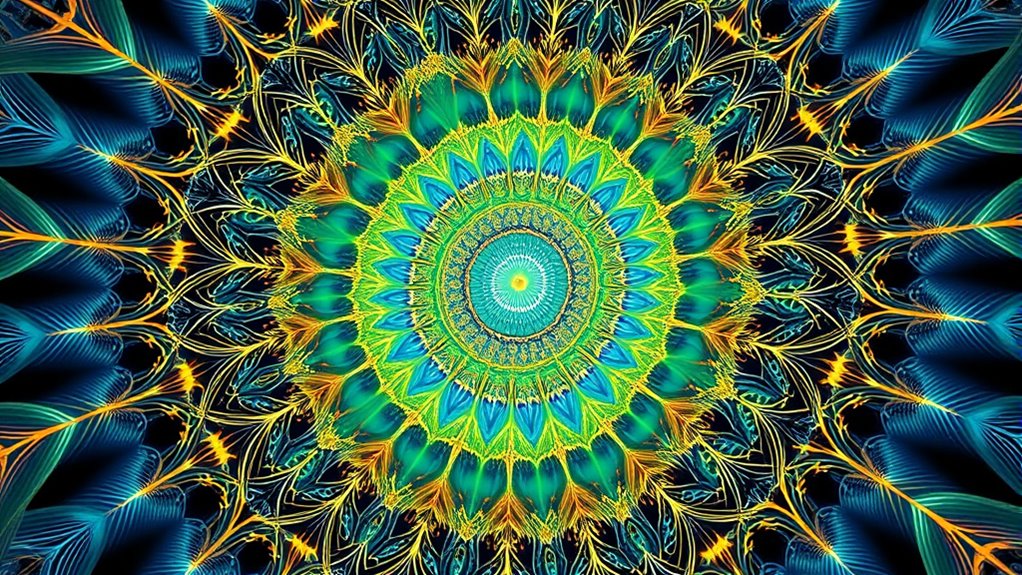
Because of their intricate and self-repeating structures, fractal patterns captivate the eye and evoke a sense of natural harmony. Their aesthetic appeal lies in how they blend complexity with simplicity, creating mesmerizing visuals. When you observe fractals, you notice their breathtaking visual complexity, which draws viewers into endless exploration. Here are three reasons why fractals appeal artistically: 1. They evoke a sense of wonder through infinite detail. 2. Their self-similarity offers harmony and unity in design. 3. The patterns inspire creativity across various art forms. Additionally, understanding the self-replicating nature of fractals enhances appreciation for their mathematical beauty. Whether in digital art, paintings, or architecture, fractal patterns generate a unique visual experience, making them irresistible to artists and audiences alike. Their natural harmony and complexity foster a profound aesthetic appeal, capturing the imagination.
Challenges and Open Questions in Fractal Research

Despite significant advances, fractal research faces numerous challenges that hinder a complete understanding of their properties and applications. One major obstacle is modeling complex fractal behaviors accurately, which limits their use in areas like fractals in music, where subtle variations impact sound quality. Additionally, integrating fractals into practical technologies remains difficult, especially in fractal-based encryption, where security and efficiency are still being optimized. Open questions about the mathematical foundations of certain fractals also persist, making it hard to fully predict their behavior. Furthermore, computational limitations restrict the real-time generation and manipulation of fractal patterns, slowing down innovation. Preppy Dog Names Overcoming these challenges requires interdisciplinary efforts, but until then, many exciting possibilities in fields like music and cryptography remain only partially realized.
The Future of Fractal Studies and Innovations
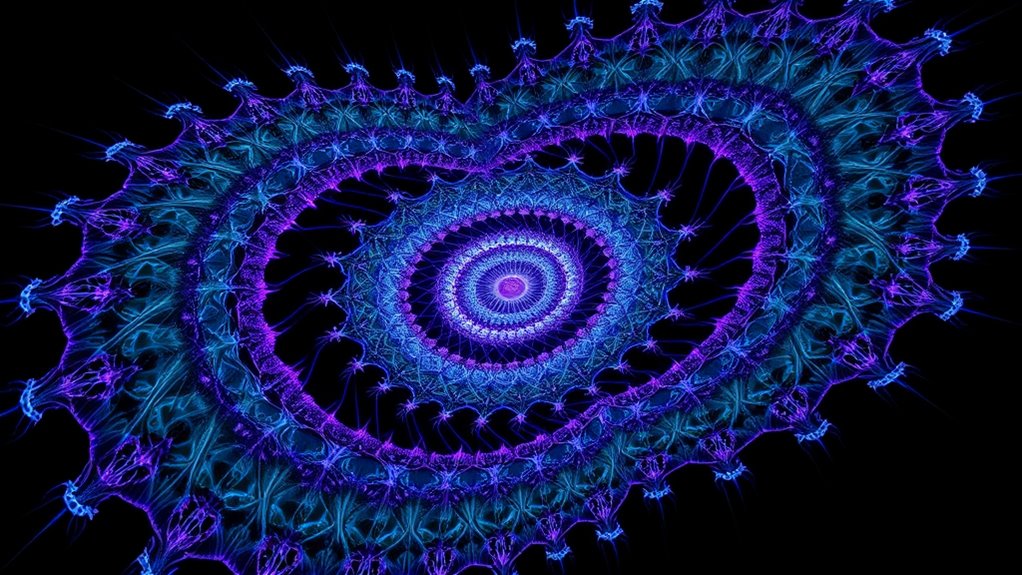
The future of fractal studies is poised for remarkable growth as advancements in technology and mathematics continue to unseal new possibilities. You’ll see exciting developments in fractal art, where artists harness fractal patterns for stunning visual creations, pushing creative boundaries. Mathematical modeling will also improve, allowing you to simulate complex natural phenomena more accurately, from coastlines to weather systems. Additionally, AI-powered content clusters will play a crucial role in organizing and disseminating fractal research, making it more accessible and fostering innovation across disciplines.
Here are three key innovations to watch:
- Enhanced computer algorithms enabling real-time fractal rendering and exploration.
- Integration of fractals into virtual reality, creating immersive experiences.
- New applications of fractal principles in science and engineering for better data analysis.
These innovations will deepen your understanding of fractals and open up fresh avenues for artistic and scientific breakthroughs.
Frequently Asked Questions
How Do Fractals Relate to Chaos Theory and Complex Systems?
You see, fractals relate to chaos theory and complex systems through chaos patterns and fractal self-similarity. They demonstrate how simple rules can create unpredictable, intricate structures. As you study fractals, you notice similar patterns repeat at various scales, revealing the underlying order in chaos. This connection helps you understand how complex systems evolve, showing that complexity often emerges from basic, deterministic processes.
Can Fractals Be Used to Model Financial Markets and Economic Data?
Imagine you’re a time traveler trying to predict market movements in the age of dial-up internet. Fractals can help you model financial markets and economic data by capturing market unpredictability through their self-similar patterns. These models reveal complex behaviors and trends, making them valuable tools for economic modeling. While not perfect, fractals provide insight into chaotic systems, helping you better understand and navigate the unpredictable world of finance.
Are There Biological Processes That Inherently Follow Fractal Patterns?
You might notice that biological patterns often follow fractal-like structures. Natural structures such as blood vessels, lung bronchi, and plant roots display self-similarity, which is a key feature of fractals. These processes are inherently fractal because they optimize resource distribution and growth. Recognizing these patterns helps you understand how complex biological systems operate efficiently, demonstrating that fractal geometry is fundamental to many natural structures.
How Do Fractals Influence Modern Computer Graphics and Animation?
Have you ever marveled at the realistic detail in digital landscapes? Fractals greatly influence modern computer graphics and animation by enabling techniques like fractal compression and texture mapping. These methods allow you to create complex, natural-looking textures efficiently. By mimicking the self-similar patterns found in nature, fractals help generate stunning visuals with less data, making your digital worlds more immersive and visually striking.
What Are the Limitations of Current Fractal Generation Algorithms?
You’ll find that current fractal generation algorithms face limitations due to computational constraints, which can slow down rendering times and reduce detail. Additionally, they often rely heavily on algorithmic randomness, making it challenging to produce consistent results or control over specific features. These issues restrict the complexity and precision of fractals, especially when trying to create highly detailed or real-time graphics, pushing developers to seek more efficient methods.
Conclusion
You can see how fractals reveal infinite complexity from simple rules, shaping everything from nature to technology. Some believe they hold the key to unraveling universal patterns, suggesting a deeper order behind chaos. While research continues, exploring fractals might just lead you to uncover hidden structures in the universe. Embrace their mystery, and you might discover that simplicity truly conceals extraordinary complexity waiting to be understood.
Fall Picks
fall essentials
As an affiliate, we earn on qualifying purchases.