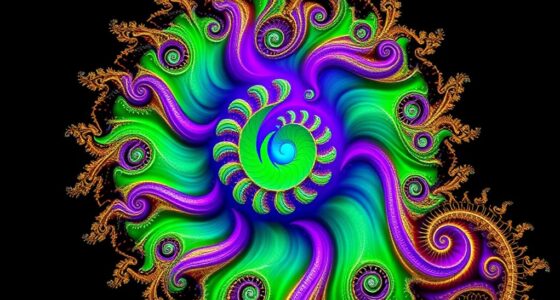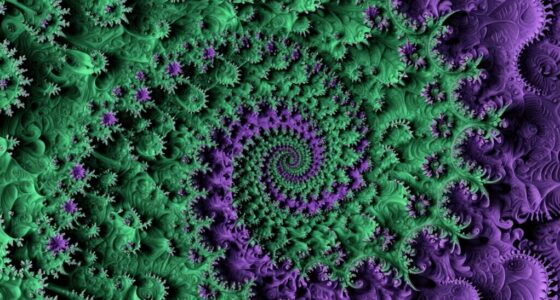
Pretty fractals focus on visual appeal, using simplified formulas and vibrant colors to create enthralling patterns that catch your eye, but often lack scientific accuracy. Useful fractal models, on the other hand, prioritize precision and real-world relevance, balancing complexity with mathematical rigor to represent natural systems accurately. While pretty fractals appeal to your sense of beauty, useful models serve practical purposes like predicting erosion or diagnosing diseases. If you want to understand how these differences impact their use, keep exploring further.

Prime made for students and young adults
- Fast, free delivery for dorm and study essentials
- Prime Video and Amazon Music included
- Member-only deals
Key Takeaways
- Pretty fractals focus on aesthetic appeal, emphasizing symmetry and vibrant visuals, while useful fractals prioritize accuracy and real-world applicability.
- Pretty fractals often use simplified formulas for visual effect, whereas useful models balance complexity with mathematical rigor.
- Visual appeal is central in pretty fractals, but usefulness in models is measured by their ability to accurately represent natural phenomena.
- Pretty fractals are designed for inspiration and visual delight, unlike useful models that serve scientific analysis and problem-solving.
- Developing useful fractal models involves advanced computational techniques to ensure precision, unlike the more straightforward design of pretty fractals.
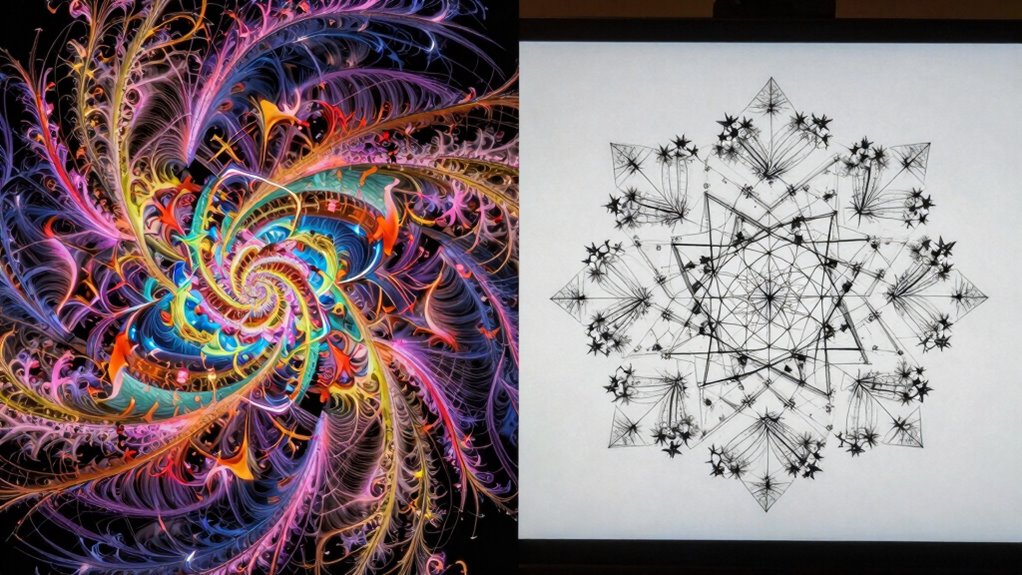
Fractals are often admired for their stunning, intricate patterns, which can appear almost magical in their complexity. But beneath their mesmerizing visual appeal lies a fundamental difference between a pretty fractal and a useful fractal model. While a pretty fractal might catch your eye with its captivating shapes and vibrant colors, it doesn’t necessarily serve a practical purpose. It’s primarily designed for aesthetic appeal, showcasing mathematical beauty without necessarily adhering to strict mathematical accuracy. These fractals tend to emphasize symmetry, color, and pattern, making them visually enthralling but often lacking in precise representation of natural phenomena or complex systems.
Pretty fractals captivate with their beauty, but lack the precision needed for practical scientific and real-world applications.
A useful fractal model, on the other hand, prioritizes mathematical accuracy and real-world applicability. It’s built with a clear goal: to accurately represent or simulate natural patterns, behaviors, or structures. These models might not always be as visually flashy as their pretty counterparts, but they’re invaluable for scientific analysis, data modeling, and problem-solving. For example, in geology, a fractal model of coastlines can help predict erosion patterns more reliably than a purely aesthetic fractal. In medicine, fractal analysis of blood vessels can aid in diagnosing diseases, relying on precise mathematical descriptions rather than visually appealing designs. The key difference is that a useful fractal is rooted in the principles of mathematics, ensuring that its complexity genuinely mirrors the complexity of the natural or theoretical system it aims to represent.
You’ll notice that pretty fractals often use simplified or stylized formulas, sometimes sacrificing accuracy to enhance visual appeal. They may exaggerate features or ignore subtle details that are critical in scientific contexts. Conversely, practical fractal models carefully balance complexity with mathematical rigor, ensuring that their structure aligns with empirical data or theoretical frameworks. This makes them more reliable tools in research and engineering, where accuracy can be more critical than visual beauty. Additionally, the development of mathematically rigorous fractal models often involves advanced computational techniques to handle their complexity effectively.
Ultimately, whether a fractal is pretty or useful depends on your goal. If you’re looking for inspiration or visual delight, a pretty fractal suffices. But if you need a model that accurately captures the complexity of a real-world system, you’ll want to focus on the fractal’s mathematical accuracy and its ability to provide meaningful insights. The most effective applications often combine both qualities, creating models that are not only accurate but also engaging enough to inspire further exploration.
As an affiliate, we earn on qualifying purchases.
Frequently Asked Questions
How Do I Choose the Best Fractal Model for My Project?
To choose the best fractal model for your project, consider your goals—whether you prioritize aesthetic appeal or need a model that captures visual complexity for analysis. If visual complexity matters most, select a fractal that accurately reflects the intricate patterns you’re studying. If aesthetics are key, opt for one with appealing, visually striking features. Match the fractal’s properties to your project’s purpose to guarantee the best fit.
Can Pretty Fractals Be Used for Practical Applications?
You might think pretty fractals are just eye candy, but they actually have surprising practical uses! Their aesthetic appeal and mesmerizing visual complexity can power innovative designs, art, and even signal processing. These fractals can help visualize data patterns or inspire architectural marvels. So, don’t dismiss their beauty—what seems like pure decoration could reveal groundbreaking solutions in technology, medicine, or environmental modeling, blending art with real-world utility.
What Tools Are Recommended for Building Useful Fractal Models?
You should consider using software like Apophysis or Mandelbulb 3D for building useful fractal models. These tools offer advanced fractal visualization features that help you analyze complex patterns and improve model accuracy. They allow you to tweak parameters precisely, ensuring your fractal reflects real-world data or desired outcomes. By focusing on detailed visualization and accuracy, you’ll create models that are not just pretty but also highly functional.
How Does Fractal Complexity Affect Real-World Utility?
Fractal complexity is like a tangled web—more intricate designs can boost aesthetic appeal, but they often reduce computational efficiency. When you increase complexity, you get richer details, making models more useful for real-world applications like terrain analysis or signal processing. However, overly complex fractals may slow calculations, so balancing detail with efficiency is key to maximizing their utility in practical projects.
Are There Industry Standards for Evaluating Fractal Usefulness?
Yes, industry standards for evaluating fractal usefulness focus on balancing artistic expression and visual appeal. You should consider how well a fractal’s complexity enhances clarity and communication in your field. Standards often include quantitative measures like the fractal dimension and qualitative assessments of aesthetic impact. By applying these, you guarantee your fractals are not only beautiful but also functional, helping you create visuals that are both appealing and meaningful.
As an affiliate, we earn on qualifying purchases.
Conclusion
So, next time you gaze at a pretty fractal, remember it’s like a beautiful painting—captivating but not always practical. The true power lies in the useful fractal model, where complexity meets clarity, guiding real-world solutions. Think of it as a lighthouse amid stormy seas—illuminating paths where others see only chaos. Embrace the difference, and you’ll harness fractals not just for beauty, but for brilliance in understanding our world.
As an affiliate, we earn on qualifying purchases.
As an affiliate, we earn on qualifying purchases.
Halloween Picks
halloween
As an affiliate, we earn on qualifying purchases.