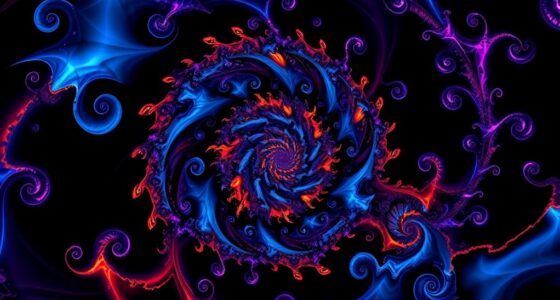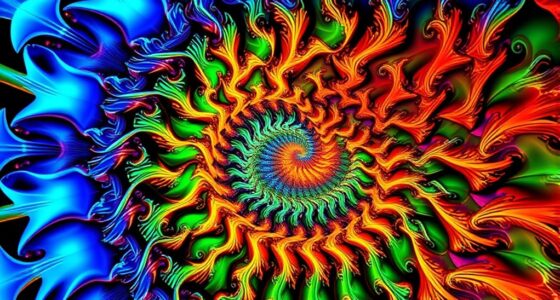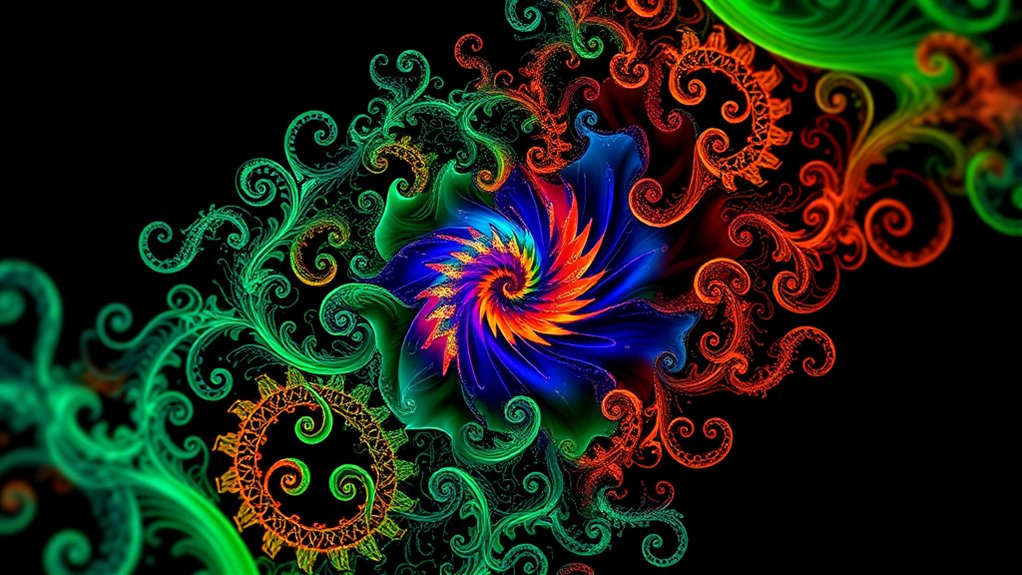

Julia sets, often called the beautiful cousins of the Mandelbrot set, showcase the stunning complexity that arises from simple mathematical rules. Each set reveals intricate patterns and shapes that change dramatically with tiny tweaks in parameters, highlighting chaos and order. You’ll see mesmerizing fractal designs that reflect the delicate balance between stability and chaos. If you keep exploring, you’ll uncover even more fascinating insights into their fascinating structures and mathematical significance.
Key Takeaways
- Julia sets are fractal patterns generated by iterating complex quadratic functions, closely related to the Mandelbrot set.
- Each Julia set corresponds to a specific parameter in the complex plane, revealing diverse, intricate shapes.
- The boundary of Julia sets is infinitely complex, exhibiting self-similarity and fractal detail at all scales.
- Julia sets serve as visual representations of chaos and stability in mathematical dynamical systems.
- They are considered the “beautiful cousins” of the Mandelbrot set for their interconnected nature and mesmerizing patterns.
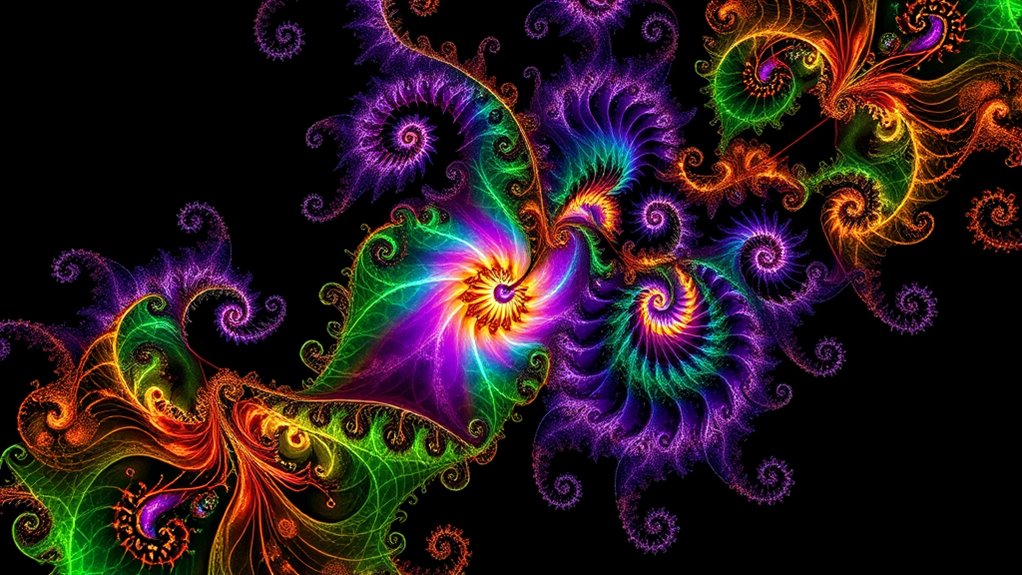
Have you ever wondered what makes certain patterns in complex numbers so fascinating? It’s the intricate beauty and complexity of Julia sets, which emerge from simple mathematical rules yet produce endlessly captivating images. These sets are closely related to the Mandelbrot set, but instead of viewing one overarching shape, you focus on the behavior of points under iteration for specific parameters. The key to understanding Julia sets lies in exploring their parameter space—an abstract domain where each point corresponds to a different function that generates a unique fractal pattern. As you move through this space, you discover a stunning variety of shapes, from connected, bulbous forms to totally disconnected, dust-like structures. The boundary between these regions is what mathematicians call a fractal boundary, and it’s where the magic truly happens. This boundary is infinitely complex; zooming in reveals never-ending detail and self-similarity. It’s a vivid illustration of fractal geometry in action, and it’s what gives Julia sets their mesmerizing quality.
When you study the parameter space of Julia sets, you see how tiny changes in the parameters produce drastically different fractal patterns. This sensitivity is one of the defining features of chaotic systems. For some parameters, the Julia set is connected and forms a continuous shape, often resembling a lacy, intricate web. For others, it breaks apart into scattered points, creating a totally disconnected fractal. The boundary between these two behaviors is fractal itself—irregular, infinitely detailed, and impossible to perfectly define with a simple equation. Exploring this boundary reveals the deep connection between dynamics and geometry. It’s here that you witness how simple quadratic functions can generate such astonishing complexity. The boundary’s fractal nature means that no matter how much you zoom in, you’ll find new detail, new self-similarity, and new surprises. Additionally, advances in AI security are helping mathematicians simulate and visualize these fractals with greater precision and depth.
Understanding the parameter space and its fractal boundary helps you appreciate why Julia sets are more than just pretty pictures—they’re a window into the chaotic underpinnings of mathematical systems. Each point in the parameter space encodes a different dynamic, and the boundary marks the delicate threshold where stability turns into chaos. As you investigate into this world, you realize that the beauty of Julia sets isn’t just visual; it’s rooted in the underlying mathematics that governs their formation. The endless complexity, the fractal boundary, and the rich variation across parameter space make Julia sets a fascinating subject, inviting you to explore the delicate balance between order and chaos in the universe of complex numbers.
Frequently Asked Questions
How Do Julia Sets Relate to Other Fractals?
You can see that Julia sets relate to other fractals through their complex iterative patterns and fractal similarities. They’re created by repeatedly applying mathematical functions, just like the Mandelbrot set and other fractals. These sets often display intricate, self-similar designs, revealing the beauty of infinite complexity. By exploring Julia sets, you observe how different parameters produce a wide variety of stunning, unique patterns, connecting them to the broader world of fractal geometry.
Can Julia Sets Be Used in Real-World Applications?
Yes, you can use Julia sets in real-world applications. They’re popular in fractal art, creating visually stunning images that showcase complex patterns. Scientists also use Julia sets in scientific modeling to simulate natural phenomena like fluid flow, weather patterns, and biological structures. Their intricate, self-similar patterns help analyze complex systems, making Julia sets valuable tools in both artistic and scientific fields.
What Determines the Shape of a Specific Julia Set?
You determine the shape of a specific Julia set mainly through the parameter you choose in its formula. The parameter impact directly influences the shape variation, causing the set to appear more intricate, connected, or fragmented. Small changes can dramatically alter the pattern, making some Julia sets look like delicate filigree while others resemble chaotic blobs. Your choice of parameter therefore controls the visual complexity and structure of the Julia set.
Are All Julia Sets Connected or Disconnected?
You’ll find that not all Julia sets are created equal—some are as seamlessly connected as a flowing river, while others are as eerily disconnected as shattered glass. It all depends on the parameter you choose. When the parameter’s value falls within certain bounds, the Julia set remains connected; outside those bounds, it becomes disconnected. So, the shape of a Julia set hinges on the parameter influence, shaping its connectivity.
How Does the Parameter C Influence the Julia Set’s Form?
You see, by varying the parameter c, you directly influence the form of the Julia set. Different c values cause the set to change from simple shapes to highly complex and intricate patterns. This parameter variation affects the set’s connectivity, making it either connected or disconnected, and increases its overall set complexity. Experimenting with different c values reveals a fascinating range of Julia set forms, from smooth to wildly detailed.
Conclusion
You now see how Julia sets, with their intricate patterns, mirror the Mandelbrot set’s complexity. Imagine exploring a virtual landscape where each tiny change in your initial point creates a new, stunning fractal. For instance, a mathematician might tweak a value and discover a breathtaking, self-similar pattern—showing how these sets reveal the endless beauty hidden within chaos. Julia sets remind you that even chaos can be wonderfully structured.