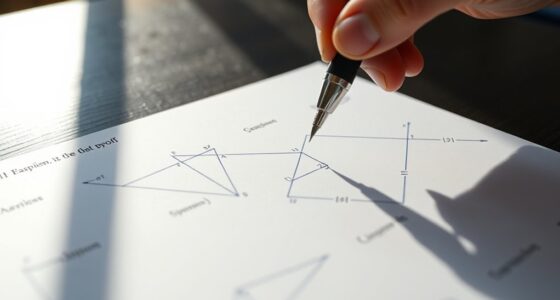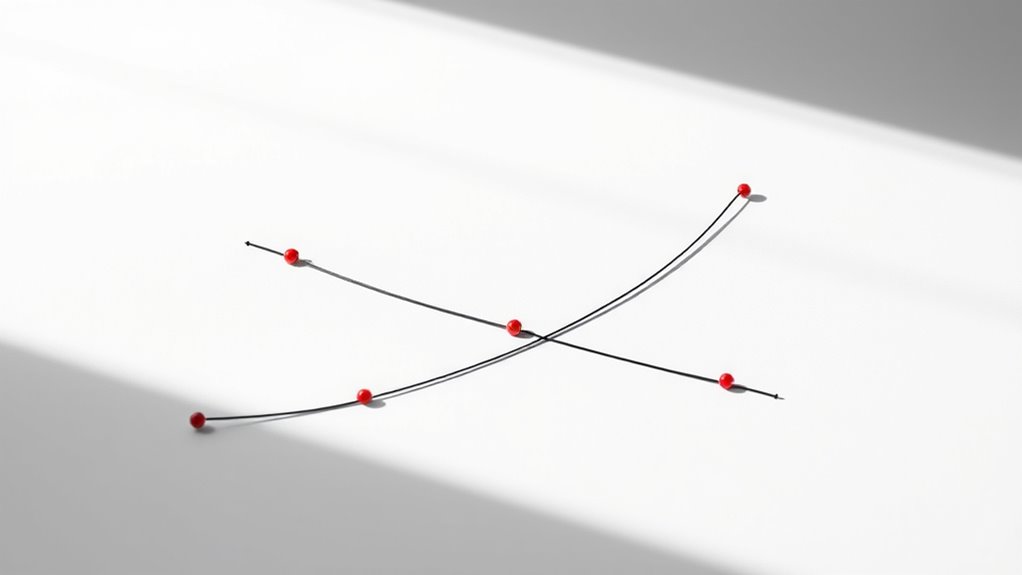

In geometry, you should understand that points, lines, and planes are the basic building blocks. Points mark exact locations in space but have no size. Lines extend infinitely in both directions and connect points. Planes are flat surfaces that stretch endlessly, containing many points and lines. Knowing how these elements interact helps you analyze shapes and spatial relationships. Keep exploring to discover how these fundamentals support more complex geometric ideas.

Prime made for students and young adults
- Fast, free delivery for dorm and study essentials
- Prime Video and Amazon Music included
- Member-only deals
Key Takeaways
- Points are precise locations in space with no size or dimension, serving as the basic units in geometry.
- Lines extend infinitely in both directions, consisting of an endless sequence of points, and are fundamental for angles and intersections.
- Planes are flat, two-dimensional surfaces that extend infinitely in all directions, containing numerous points and lines.
- These three elements—points, lines, and planes—form the foundation for understanding spatial relationships in geometry.
- Mastery of these concepts enables the analysis of geometric shapes, proofs, and the study of more complex structures.
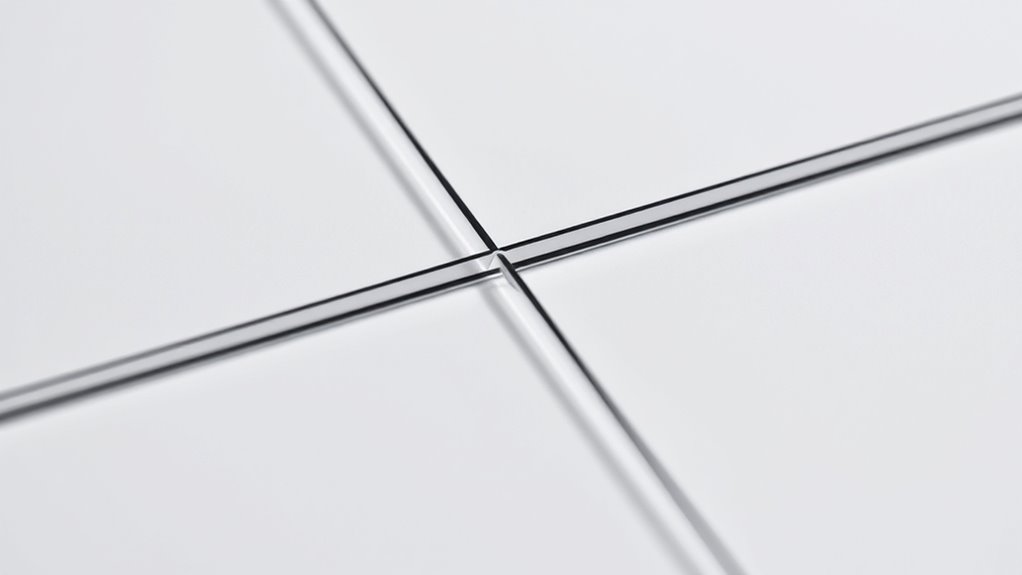
Geometry is a branch of mathematics that deals with shapes, sizes, and positions of objects. When you start exploring this field, you’ll quickly encounter fundamental terms like points, lines, and planes, which form the building blocks of geometric understanding. These concepts help you describe and analyze the spatial relationships between objects in space. Points are the most basic units; they have no size, shape, or dimension, but they serve as precise locations within a coordinate system. You can think of points as dots that mark specific positions on a graph or in space, and they are essential in creating geometric proofs, where establishing exact locations is critical. Lines extend infinitely in both directions and are made up of an endless number of points. They help illustrate relationships between points and form the basis for defining angles, intersections, and other geometric figures. When you work with lines, understanding properties like parallelism and perpendicularity becomes *indispensable*, especially in complex geometric proofs where you need to demonstrate specific relationships between lines and shapes.
Planes are flat surfaces that extend infinitely in all directions and contain an infinite number of points and lines. They are *indispensable* when visualizing larger geometric figures and understanding how shapes like triangles, rectangles, and circles sit within space. In coordinate systems, planes are represented as flat grids where you can plot points, lines, and shapes with precision. Using these coordinate systems makes it easier to analyze geometric figures mathematically and to perform accurate calculations. When you’re developing geometric proofs, understanding how points, lines, and planes interact helps you establish the validity of your arguments. For example, proving that two lines are parallel or that a point lies on a particular plane involves logical reasoning based on the properties of these fundamental elements. The ability to manipulate and interpret these concepts within coordinate systems allows you to translate visual ideas into formal, algebraic expressions, making your proofs more rigorous and convincing.
Ultimately, grasping these basic terms is essential in mastering geometry. By understanding points, lines, and planes, you’ll be able to describe complex shapes, analyze spatial relationships, and develop precise geometric proofs. These concepts also serve as the foundation for more advanced topics, such as three-dimensional geometry and trigonometry. Whether you’re plotting points on a graph or proving properties about shapes, knowing how to work with these fundamental elements will enhance your ability to think critically and reason logically about space and form. They are the language of geometry, enabling you to communicate ideas clearly and solve problems systematically.
As an affiliate, we earn on qualifying purchases.
Frequently Asked Questions
How Do Points, Lines, and Planes Relate in Three-Dimensional Space?
In three-dimensional space, points, lines, and planes interact through spatial relationships that define their positions and orientations. You can think of a point as a location, a line as a set of points extending in one direction, and a plane as a flat surface containing many lines and points. Using dimensional analysis, you realize that points are 0D, lines are 1D, and planes are 2D, creating a framework for understanding space.
What Are the Real-World Examples of Geometric Points, Lines, and Planes?
Your city’s skyline is like a giant canvas of geometric points, lines, and planes. In urban planning, points mark key locations like parks or buildings, while lines outline roads and pathways. Architectural design relies on planes for walls and floors, creating the structure’s form. These concepts shape the world around you, making everyday spaces functional and beautiful—proving geometry’s power in turning ideas into reality.
How Are Points, Lines, and Planes Used in Computer Graphics?
In computer graphics, you use points, lines, and planes to create realistic visuals through rendering techniques and 3D modeling. Points define object vertices, guiding shapes and textures. Lines form edges and wireframes, shaping models. Planes serve as surfaces for textures or backgrounds. You manipulate these elements to build detailed scenes, apply lighting, and produce lifelike images, making your digital creations more immersive and accurate.
Can a Plane Be Curved or Does It Have to Be Flat?
A plane is flat by definition, but in advanced math like non-Euclidean geometry, you can imagine curved planes that bend and twist like a roller coaster. These curved vs flat planes defy our everyday intuition, showing that the properties of non-Euclidean planes break the rules of flatness. So, while a classic plane stays flat, in complex math, you can explore beautifully curved, mind-bending surfaces that act like planes.
What Is the Significance of Points, Lines, and Planes in Advanced Geometry?
You see, points, lines, and planes are essential in advanced geometry because they form the foundation for coordinate systems and geometric transformations. These concepts help you understand how to map shapes, analyze spatial relationships, and perform operations like rotations or translations. Without them, working with complex shapes or 3D models becomes impossible. Their significance lies in enabling precise descriptions, calculations, and manipulations of geometric figures across various applications.
As an affiliate, we earn on qualifying purchases.
Conclusion
Understanding points, lines, and planes forms the foundation of geometry. Did you know that in Euclidean space, a single point can determine a line, and three non-collinear points define a plane? Mastering these basic terms helps you grasp more complex concepts. Keep exploring; it’s fascinating how these simple elements build the entire geometric world around us. The more you learn, the more you’ll see the beauty in everyday shapes and structures.
As an affiliate, we earn on qualifying purchases.
As an affiliate, we earn on qualifying purchases.
Fall Picks
fall essentials
As an affiliate, we earn on qualifying purchases.