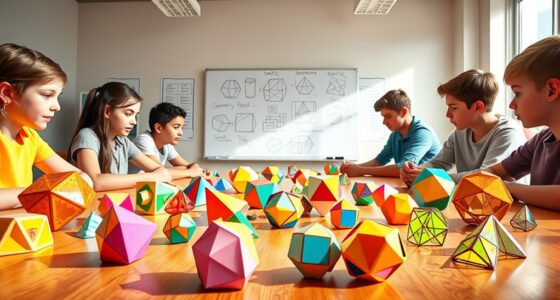

In a high-tech world, geometry remains essential because it helps you understand and design the digital and physical spaces around you. From navigation apps and virtual reality to robotics and AI, geometric principles enable innovation and precise problem-solving. Your ability to visualize, analyze, and manipulate shapes is indispensable for advancing technology. Embracing these concepts keeps you connected to the core skills driving modern progress—if you want to explore how this all fits together, keep going.
Key Takeaways
- Geometry provides the fundamental framework for designing and understanding complex modern technology systems like virtual reality and robotics.
- It enhances spatial reasoning skills essential for innovation, troubleshooting, and optimizing technological solutions.
- Geometric principles underpin the development of accurate digital models, navigation algorithms, and data visualizations.
- Mastery of geometry enables effective interaction with 3D environments, critical in augmented reality and immersive experiences.
- As technology advances, geometry remains vital for creating precise, reliable, and scalable high-tech applications.

Have you ever wondered why geometry remains essential in our high-tech world? It’s because at its core, geometry forms the mathematical foundations that enable us to understand and manipulate the space around us. Whether you’re designing a new smartphone app, developing virtual reality environments, or constructing skyscrapers, geometry provides the tools you need to visualize, analyze, and innovate. This branch of mathematics isn’t just about shapes and angles; it’s about building a framework for thinking about the world in a precise, logical way. Your ability to grasp spatial reasoning—the mental skill of visualizing and manipulating objects in space—relies heavily on geometric principles. Without it, advances in technology would lack the depth of understanding necessary to create truly sophisticated solutions.
In today’s digital age, you constantly interact with geometric concepts, often without realizing it. For example, when you navigate GPS maps or create 3D models for gaming or engineering, you’re applying geometric algorithms rooted in mathematical foundations. These algorithms rely on understanding how objects relate to each other in space, their angles, distances, and proportions. Your capacity for spatial reasoning helps you interpret complex data visualizations, troubleshoot design flaws, or even assemble furniture using diagrammatic instructions. This cognitive skill is crucial because it allows you to mentally manipulate objects, foresee how components fit together, and optimize designs—all tasks grounded in geometric principles.
Moreover, the importance of geometry extends into cutting-edge fields like robotics, artificial intelligence, and augmented reality. Robots, for instance, depend on geometric calculations to navigate environments, recognize objects, and perform precise movements. AI systems use geometric data to interpret visual inputs to understand the world much like humans do. Augmented reality overlays digital images onto real-world scenes, requiring real-time geometric calculations to align virtual objects seamlessly with physical space. In each case, a solid understanding of geometry’s mathematical foundations underpins these technologies, making them accurate and reliable. Additionally, the rise of virtual and augmented reality technologies highlights how geometric understanding is fundamental to creating immersive experiences that are both convincing and functional.
Your intuitive grasp of spatial reasoning, built through exposure to geometric concepts, allows you to adapt to new technological challenges. Whether you’re designing a new interface, optimizing a network layout, or exploring virtual environments, the core principles of geometry help you think critically about spatial relationships. This ongoing relevance of geometry in a high-tech world proves that it’s not just an academic subject from the past; it’s a crucial skill that keeps pace with innovation. So, next time you use a GPS or virtual reality headset, remember that the geometric foundations you rely on are what make these modern marvels possible.

BeckerCAD 15 – 3D software for home design, architecture, engineering and more, compatible with AutoCAD, Lifetime License for Win 11, 10, 8.1, 7
- Compatibility: Works with AutoCAD and Windows OS
- License Type: Lifetime license included
- Templates: Pre-made templates for various fields
As an affiliate, we earn on qualifying purchases.
As an affiliate, we earn on qualifying purchases.
Frequently Asked Questions
How Does Geometry Influence Modern Computer Graphics and Animation?
You use geometry to create realistic computer graphics and animation by applying symmetric patterns and tessellation techniques. These concepts help you generate seamless textures, intricate designs, and accurate 3D models. Geometry guides your understanding of spatial relationships, enabling you to manipulate shapes and surfaces precisely. As a result, your animations appear more lifelike, detailed, and visually appealing, demonstrating how fundamental geometric principles are essential in modern digital artistry.
What Role Does Geometry Play in Robotics Navigation Systems?
Imagine guiding a robot through a maze, walls and obstacles shifting in space. You rely on geometry to navigate by applying coordinate transformations, turning raw sensor data into a map of the environment. This process sharpens the robot’s spatial reasoning, allowing it to plot paths and avoid collisions. Geometry’s principles help robots interpret their surroundings accurately, making navigation seamless, efficient, and adaptable in any environment they encounter.
Can Geometry Improve Data Visualization Techniques?
Yes, geometry can definitely improve data visualization techniques. By applying mathematical modeling, you can create more accurate and meaningful visual representations. With strong spatial reasoning skills, you can better interpret complex data, identify patterns, and communicate insights effectively. Geometry helps you design clearer graphs, maps, and 3D models, making data more accessible and understandable, especially when dealing with large or multidimensional datasets.
How Is Geometry Applied in Augmented Reality (AR) Development?
Did you know that over 80% of AR applications rely on geometry? You apply geometry in AR development through mathematical modeling and spatial mapping to accurately overlay digital objects onto real-world environments. This involves calculating angles, distances, and object positions in 3D space. By mastering these geometric principles, you guarantee seamless interactions and realistic experiences, making AR both intuitive and immersive for users.
What Are Emerging Trends in Geometric Algorithms for AI?
You’ll see emerging trends in geometric algorithms for AI focus on topological data analysis and fractal analysis. These techniques help AI better understand complex structures and patterns, improving image recognition, natural language processing, and data visualization. By leveraging topological data, you can uncover hidden relationships, while fractal analysis enables modeling of natural, self-similar patterns. Together, these trends push AI toward more accurate, efficient, and adaptable problem-solving capabilities.

Meta Quest 3S 128GB | VR Without Wires — Gorilla Tag Cardboard Monkenaut Bundle — Amazon Exclusive —Access to 100+ Games with a 3-Month Trial of Meta Horizon+ Included
- Exclusive Gorilla Tag Bundle: Includes Gorilla Space Suit and Rocks
- Wireless VR Experience: Untethered, immersive gameplay
- Enhanced Graphics Power: Double processing for smooth visuals
As an affiliate, we earn on qualifying purchases.
As an affiliate, we earn on qualifying purchases.
Conclusion
Think of geometry as the blueprint of your future, guiding you through a maze of innovation. Just like architects rely on precise measurements to build something lasting, you can harness geometry’s principles to turn ideas into reality. Remember, every high-tech gadget, from smartphones to space rockets, depends on geometric understanding. Embrace it, and you’ll find yourself maneuvering the digital world with confidence—because in this high-tech age, geometry isn’t just old math; it’s your foundation for tomorrow.

ELEGOO UNO R3 Smart Robot Car Kit V4 for Arduino Robotics for Kids Ages 8-12 12-16 STEM Science Kits Coding Gifts for 8 9 10 11 12 13 14 15 16 Year Old Boys Girls Teens Cool Engineering Building Toys
- Educational STEM Kit: Hands-on programming and robotics learning
- Complete Module Set: Includes 24 modules with remote control
- Easy Assembly: Modified interfaces for simple setup
As an affiliate, we earn on qualifying purchases.
As an affiliate, we earn on qualifying purchases.

RayNeo Air 4 Pro AR/XR Glasses, HDR10 201" Virtual Display, 120Hz 3D Movie & Gaming Video Display, USB-C Plug & Play for iPhone 17/16/15, Android, Switch 2, PS5, Steam Deck
- HDR10 Virtual Display: 201-inch, 10 billion colors, deep contrast
- AI SDR-to-HDR Upscaling: Enhances color, sharpness, motion in real time
- 120Hz 3D Video Playback: Smooth, immersive 3D movies and gaming
As an affiliate, we earn on qualifying purchases.
As an affiliate, we earn on qualifying purchases.