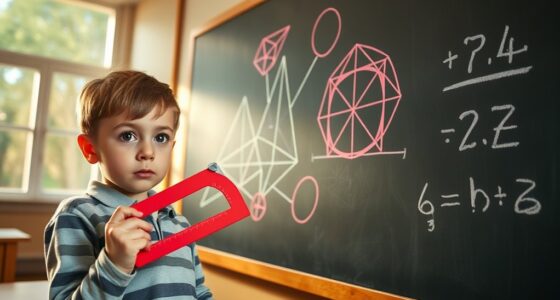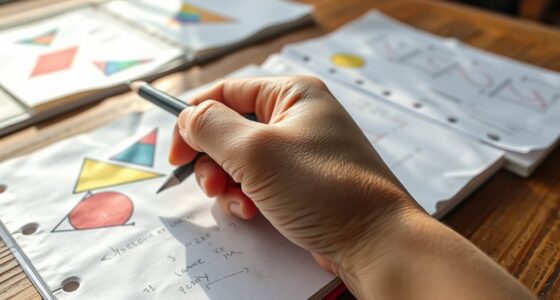
Teaching proofs is essential for helping you develop strong reasoning skills and a deeper understanding of geometry. Proofs encourage visual reasoning, pattern recognition, and logical deduction, making concepts clearer and more intuitive. Although they can seem challenging or abstract at first, incorporating proofs strengthens critical thinking and systematic problem-solving. Balancing proofs with visual or real-world approaches can boost engagement. Keep exploring, and you’ll discover why integrating proofs can transform your grasp of geometric ideas.
Key Takeaways
- Teaching proofs enhances students’ visual reasoning and understanding of geometric relationships, making concepts more intuitive.
- Incorporating proofs develops critical thinking and logical deduction skills essential for mathematical proficiency.
- Balancing proof instruction with visual and practical methods can improve engagement and accessibility in geometry education.
- Emphasizing proofs fosters systematic thinking and metacognitive skills, benefitting overall cognitive development.
- A flexible approach that combines proofs and alternative methods prepares students for diverse mathematical challenges.
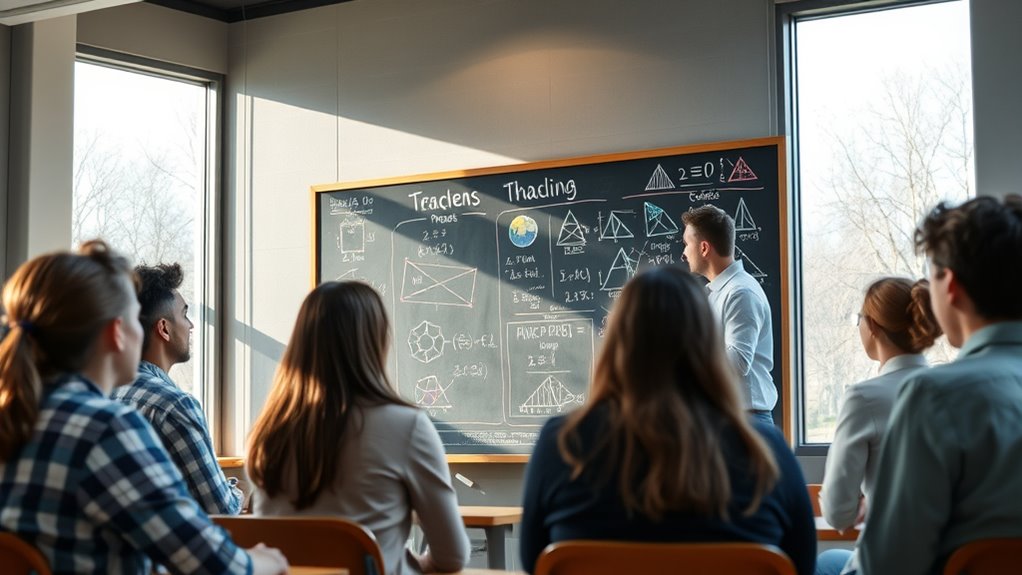
Many educators are questioning whether teaching formal proofs should remain a core part of geometry education. It’s a valid concern, especially when considering how students develop their understanding of spatial relationships and logical thinking. One compelling reason to include proofs is that they foster visual reasoning, which is fundamental in geometry. When you work through proofs, you learn to see patterns, interpret diagrams, and connect visual cues to abstract concepts. This process sharpens your ability to analyze geometric relationships, making the subject more intuitive and accessible. Visual reasoning isn’t just about recognizing shapes; it’s about understanding how different parts of a figure relate to each other, which strengthens your overall comprehension of geometric principles.
Fostering visual reasoning through proofs deepens geometric understanding and enhances pattern recognition and diagram interpretation skills.
In addition, focusing on proofs influences cognitive development in meaningful ways. As you engage with logical sequences and justify each step, you’re exercising your reasoning muscles. This kind of mental workout improves critical thinking skills and can translate to other areas of learning and problem-solving. Formal proofs require you to organize your thoughts systematically, which enhances your capacity for logical deduction. Over time, this can help you become a more analytical thinker, capable of approaching complex problems with clarity and confidence. The process of constructing and understanding proofs encourages patience and persistence, qualities that are valuable beyond mathematics. Moreover, integrating proofs into lessons can also help develop metacognitive skills by prompting students to reflect on their reasoning processes and identify areas for improvement.
However, some argue that the traditional emphasis on formal proofs might be too abstract or intimidating for many students. They suggest that alternative approaches—such as visual explorations, hands-on activities, or real-world applications—can also develop reasoning skills effectively. While these methods may boost engagement and immediate understanding, they might not always cultivate the same depth of logical reasoning and cognitive development as formal proofs do. The challenge lies in balancing the two: ensuring that learners develop strong visual reasoning skills and robust cognitive abilities while also feeling motivated and confident in their learning journey.
Ultimately, the decision about whether to prioritize proofs in geometry education hinges on your goals as a learner or educator. If you aim to deepen your understanding of geometric relationships and enhance your reasoning skills, engaging with formal proofs can be invaluable. They challenge you to see beyond the visual and into the logical structure underpinning geometry. But if your focus is on practical applications or fostering a love for the subject, alternative methods might serve you better. Still, recognizing the role of proofs in strengthening visual reasoning and cognitive development can help you appreciate their importance in cultivating a well-rounded mathematical mind.
Frequently Asked Questions
How Do Proofs Impact Students’ Overall Mathematical Understanding?
Proofs enhance your overall mathematical understanding by strengthening your visual reasoning and critical thinking skills. When you engage with proofs, you learn to analyze logical connections and visualize concepts more clearly. This process encourages you to question assumptions and develop a deeper grasp of geometric principles. As a result, your ability to solve complex problems improves, making math more meaningful and accessible. Proofs truly refine your analytical mindset and comprehension.
What Are Alternative Methods to Teach Geometric Concepts Without Proofs?
You can teach geometric concepts effectively through visualization strategies and hands-on activities. Use models, diagrams, and dynamic software to help students see relationships and properties directly. Incorporate manipulatives like geometric solids and drawing tools to make abstract ideas tangible. These methods foster understanding without relying on formal proofs, engaging students actively and making geometry accessible, memorable, and enjoyable.
How Do Cultural Differences Influence the Teaching of Proofs?
Cultural perspectives considerably influence how you approach teaching proofs, as different teaching traditions shape students’ understanding of logic and reasoning. In some cultures, emphasis on memorization and rote learning may limit critical thinking, while others prioritize exploration and debate. Recognizing these differences helps you adapt your methods, making proofs more accessible and relevant, ultimately fostering a deeper appreciation of geometry’s foundational concepts across diverse educational contexts.
Can Technology Replace Traditional Proof-Based Geometry Instruction?
Technology can’t fully replace traditional proof-based geometry instruction because it enhances visual learning and supports conceptual reasoning but doesn’t develop critical thinking skills on its own. You benefit from interactive tools that make proofs more accessible, yet engaging with proofs manually helps deepen understanding. Combining technology with traditional methods provides a balanced approach, ensuring you develop both visual intuition and the reasoning skills necessary for true mathematical comprehension.
What Are the Long-Term Benefits of Learning Geometric Proofs?
They say, “a picture is worth a thousand words,” and learning geometric proofs enhances your visual reasoning and conceptual comprehension. Long-term, you’ll develop sharper problem-solving skills, better logical thinking, and a deeper understanding of mathematical relationships. These skills aren’t just for math—they help you analyze real-world situations more effectively. By mastering proofs, you build a strong foundation that benefits all areas of critical thinking and lifelong learning.
Conclusion
Ultimately, deciding whether to teach proofs is like choosing the right map for a journey. You want your students to navigate geometry confidently, understanding not just the ‘what’ but the ‘why.’ Incorporating proofs can be a guiding star, illuminating reasoning and fostering critical thinking. But if it’s too complex, it’s like trying to read a map without landmarks. Striking the right balance guarantees your students explore geometry with curiosity and clarity.