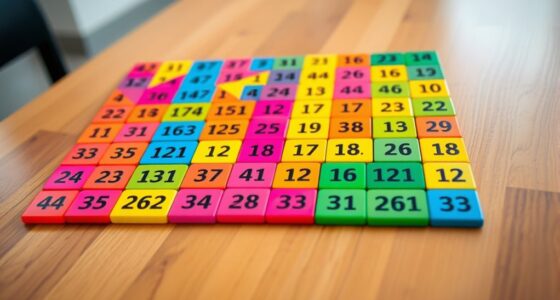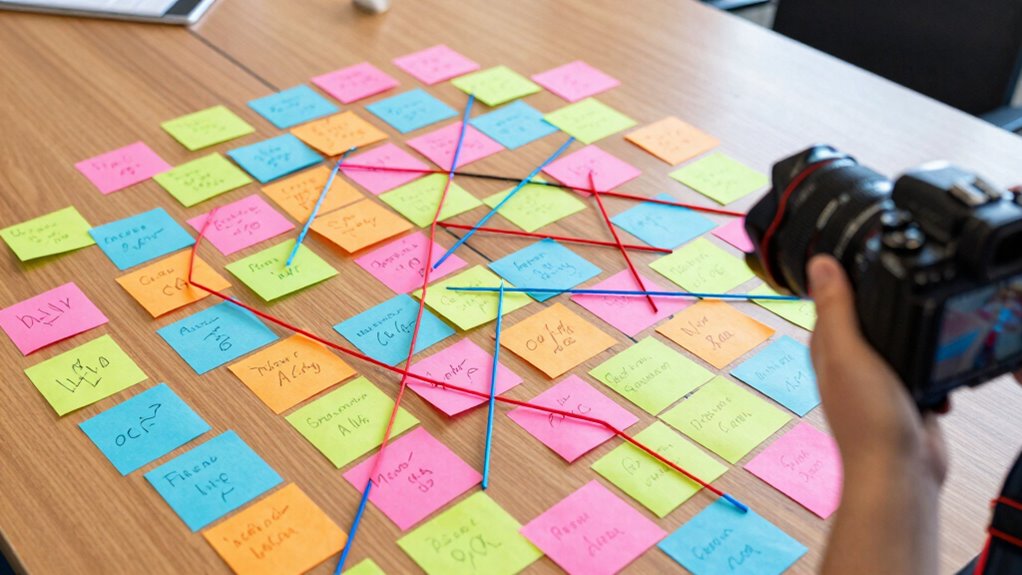

You’ll find graph coloring valuable because it helps you model conflicts and allocate resources efficiently. It assigns different colors to tasks or resources to avoid overlaps, making complex scheduling easier to manage. Its visual approach clarifies relationships and constraints, even in intricate systems. Despite advances in technology, its simplicity and effectiveness keep it relevant. If you want to understand how it continues to shape real-world solutions, keep exploring its applications further.

Prime made for students and young adults
- Fast, free delivery for dorm and study essentials
- Prime Video and Amazon Music included
- Member-only deals
Key Takeaways
- Graph coloring effectively models complex conflicts and constraints in scheduling and resource allocation problems.
- It provides visual and analytical clarity, simplifying the management of interdependent tasks.
- The approach remains relevant despite computational complexity, especially through heuristics and approximations.
- It is essential in wireless communication for interference-free frequency assignment.
- Its flexibility allows adaptation across various industries with diverse constraints and priorities.

Have you ever wondered how to efficiently assign resources or timeslots without conflicts? That’s where graph coloring proves its worth, especially in real scheduling problems. When you’re trying to manage limited resources, such as rooms, equipment, or personnel, you need a method to avoid clashes. Graph coloring offers a mathematical approach that simplifies this process: it assigns colors (or labels) to each node—representing tasks, timeslots, or resources—so that no two connected nodes share the same color. This technique directly addresses resource allocation challenges, making it easier to allocate resources effectively without overlaps that could cause delays or conflicts.
Graph coloring helps assign resources and timeslots efficiently, preventing conflicts and overlaps in scheduling and resource management.
Frequency assignment in wireless networks is another area where graph coloring remains highly relevant. You need to assign frequencies to transmitters so that neighboring stations don’t interfere with each other. Here, each transmitter is modeled as a node in a graph, and edges connect stations that could potentially interfere. The goal is to assign frequencies—colors—to each node such that no two adjacent nodes share the same frequency. This is a classic graph coloring problem, and it helps ensure reliable communication by minimizing interference. Despite advances in technology, the fundamental challenge of assigning distinct frequencies to neighboring transmitters keeps graph coloring at the forefront.
The reason graph coloring continues to show up in these real-world problems is that it provides a clear, visual way to model conflicts and constraints. It transforms complex scheduling issues into a manageable graph structure, allowing you to leverage well-studied algorithms to find ideal or near-ideal solutions. Whether it’s scheduling exams, assigning shifts, or planning transportation routes, the core idea remains the same: prevent conflicts by ensuring that connected nodes don’t share the same attribute—in this case, timeslots, resources, or frequencies. Additionally, the computational complexity of graph coloring influences the choice of algorithms, especially for larger or more constrained problems.
Moreover, the flexibility of graph coloring makes it adaptable across various domains. You can tweak the rules or constraints to suit specific needs, such as incorporating priorities or additional restrictions. It’s also computationally feasible for many real-world problems, especially with heuristic and approximation algorithms that help you find quick solutions when exact methods are too slow. Understanding the computational complexity of graph coloring helps in selecting appropriate algorithms for different problem sizes and constraints. Because scheduling problems often involve complex constraints and a high degree of interdependence, the intuitive nature of graph coloring helps you visualize and manage these relationships effectively. That’s why, despite the rise of advanced algorithms and machine learning, graph coloring remains a fundamental and practical tool in tackling scheduling challenges across industries.
graph coloring scheduling software
As an affiliate, we earn on qualifying purchases.
As an affiliate, we earn on qualifying purchases.
Frequently Asked Questions
How Does Graph Coloring Compare to Other Scheduling Algorithms?
You’ll find graph coloring compares favorably to other scheduling algorithms because it often uses heuristic approaches, making solutions quicker and more adaptable to complex problems. While the algorithm complexity can be high for large instances, its flexibility allows you to efficiently handle resource conflicts and constraints. Overall, graph coloring provides a practical balance between computational effort and effective scheduling, especially when exact methods become too resource-intensive.
What Industries Frequently Use Graph Coloring for Scheduling?
Imagine a busy airport managing flights like a giant puzzle. You’ll find industries like manufacturing, telecommunications, and transportation relying on graph coloring for scheduling. It helps with resource allocation and constraint management, ensuring no two flights or tasks clash. This allegory shows how graph coloring simplifies complex scheduling challenges, making sure resources are used efficiently and conflicts are minimized across these industries.
Are There Limitations to Applying Graph Coloring in Large-Scale Problems?
You might face scalability challenges when applying graph coloring to large-scale problems because the complexity increases exponentially with the size of the graph. Exact methods often become impractical, so you’ll need to rely on heuristic approaches to find good enough solutions efficiently. These heuristics help manage the computational load, but they may not always produce the best schedule, which is a key limitation in very large or complex problems.
How Has Graph Coloring Evolved With Modern Computing Power?
Imagine your scheduling puzzle as a vast, intricate tapestry, now illuminated by modern computers that act like a skilled weaver. They’ve enhanced graph coloring by applying heuristic techniques, making complex patterns manageable. While computational complexity remains a challenge, these advances enable you to tackle larger problems faster, finding near-optimal solutions. Your tools now adapt dynamically, weaving efficiency into even the most tangled scheduling threads.
Can Graph Coloring Adapt to Dynamic or Real-Time Scheduling Needs?
Yes, graph coloring can adapt to real-time scheduling needs by incorporating real-time adaptation techniques. You can update the coloring dynamically as new constraints or conflicts arise, allowing the system to respond swiftly to changing conditions. By integrating algorithms designed for dynamic constraints, you guarantee your scheduling stays efficient and flexible, making graph coloring a valuable tool even in complex, real-time environments.
resource allocation planning tools
As an affiliate, we earn on qualifying purchases.
As an affiliate, we earn on qualifying purchases.
Conclusion
You might think that advances in technology would render graph coloring obsolete, yet it still shines in real scheduling problems. While algorithms and software evolve, the fundamental challenge of avoiding conflicts remains the same. Just like a puzzle that never loses its charm, graph coloring persists as an essential tool—bridging simple theory and complex reality. It’s a reminder that sometimes, the most elegant solutions are rooted in timeless concepts.
frequency assignment tools for wireless networks
As an affiliate, we earn on qualifying purchases.
As an affiliate, we earn on qualifying purchases.
As an affiliate, we earn on qualifying purchases.
Fall Picks
fall essentials
As an affiliate, we earn on qualifying purchases.