In 3D coordinate geometry, you describe lines with a point and a direction vector using the equation r = r₀ + t*v, and planes with a point and a normal vector, expressed as n · (r – r₀) = 0. These vector equations help you find intersections, determine parallel or skew lines and planes, and analyze spatial relationships efficiently. Continuing further, you’ll discover how to apply these equations to solve complex 3D problems and visualize space more effectively.
Key Takeaways
- Lines in 3D are represented using vector equations: r = r₀ + t*v, with a point and a direction vector.
- Planes are described by a point and a normal vector, with the equation n · (r – r₀) = 0.
- Intersection of two planes yields a line, found by solving their combined equations.
- Vector forms help determine relationships like parallelism, intersection, or skewness between lines and planes.
- Mastering vector equations enables analysis of spatial relationships and solving complex 3D geometry problems.
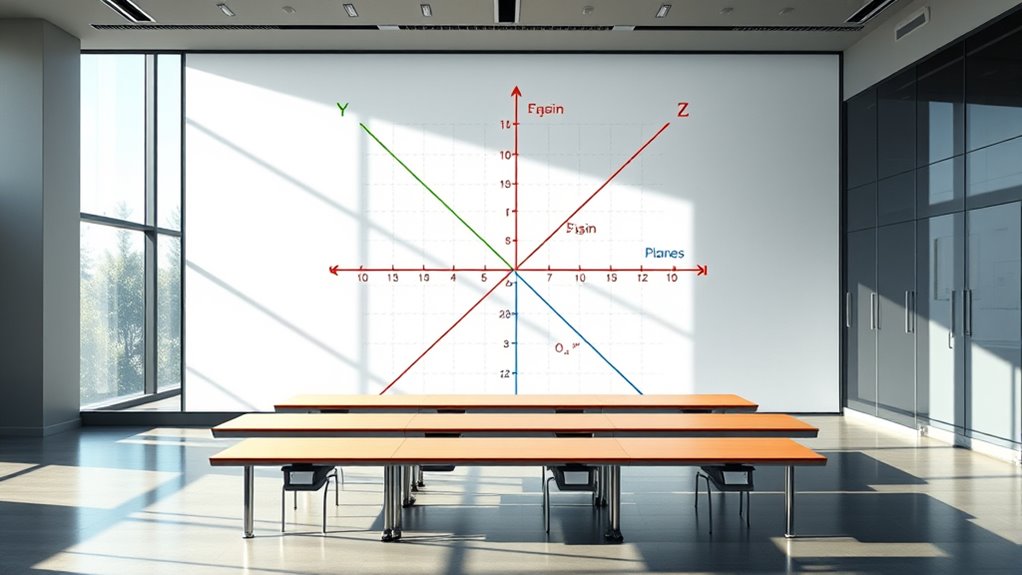
3D Coordinate Geometry offers a powerful way to analyze and understand the positions and relationships of points, lines, and shapes in three-dimensional space. When working with lines and planes, vector equations become essential tools that help you describe and manipulate these objects precisely. By using vectors, you can express the equations of lines and planes compactly, making complex spatial relationships easier to analyze.
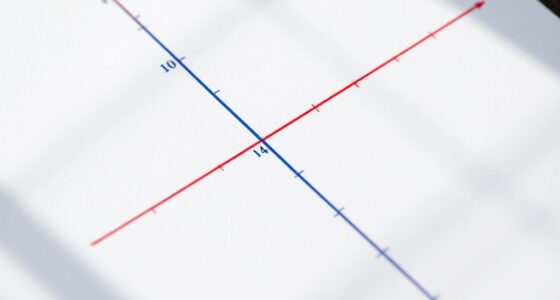
For lines in three-dimensional space, you typically start with a point through which the line passes and a direction vector that indicates the line’s orientation. The vector equation of a line takes the form r = r₀ + t*v, where r₀ is the position vector of a point on the line, v is the direction vector, and t is a parameter. This form allows you to easily find points along the line by varying t. It also makes it straightforward to determine whether two lines intersect, are parallel, or skew by comparing their vector equations.
Planes are described similarly, but with some differences. The general form of a plane’s equation involves a point on the plane and a normal vector perpendicular to it. Using vectors, you can write the plane’s equation as n · (r – r₀) = 0, where n is the normal vector, r is the position vector of any arbitrary point on the plane, and r₀ is a known point on the plane. When expanded, this yields a scalar equation in terms of x, y, z. This vector-based approach allows you to easily analyze plane intersections, which are critical in many applications. Additionally, understanding the intersecting relationships between planes and lines is fundamental in 3D geometry.
The vector form n · (r – r₀) = 0 simplifies analyzing and solving plane intersections in 3D space.
Understanding how planes intersect involves solving systems of equations derived from their vector forms. When two planes intersect, they do so along a line, which can be found by solving their equations simultaneously. This process involves setting the equations equal and solving for the parameters, revealing the line of intersection. If the system has no solution, the planes are parallel and do not intersect. If the equations are dependent, the planes coincide.
Using vector equations for lines and planes simplifies the process of analyzing intersections and spatial relationships. It allows you to visualize the problem more clearly, manipulate the equations algebraically, and find solutions efficiently. Whether you’re exploring the intersection of multiple planes or determining the shortest distance between skew lines, mastering vector equations and understanding plane intersections are fundamental skills in 3D coordinate geometry. With these tools, you’ll gain a deeper, more intuitive grasp of the three-dimensional space and its complex relationships.
Frequently Asked Questions
How Can I Find the Shortest Distance Between Two Skew Lines?
To find the shortest distance between two skew lines, you first identify points on each line and their direction vectors. Then, compute the vector connecting these points and project it onto the cross product of the direction vectors. This projection gives you the shortest distance. If lines intersected, the distance would be zero, but since they’re skew, this method accurately measures the minimal gap between them.
What Is the Significance of the Cross Product in Plane Equations?
Imagine you’re designing a sculpture, and the cross product is your guiding hand. It creates a vector perpendicular to the plane, known as the plane normal, which is essential for defining the plane’s orientation. The cross product of two vectors results in this normal vector, helping you write the plane equation. Without it, you’d be lost in the 3D space, unable to precisely describe the plane’s position.
How Do I Determine if Two Planes Are Parallel or Intersecting?
To determine if two planes are parallel or intersecting, you examine their plane normals. If the normals are scalar multiples, the planes are parallel, satisfying the parallelism criteria. If the normals aren’t multiples, the planes intersect along a line. Check the normal vectors; their relationship directly reveals whether the planes are parallel or intersecting. This method provides a straightforward, reliable way to analyze plane relationships.
Can the Equations of Lines Be Expressed in Parametric Form?
Yes, you can express equations of lines in parametric form using vector forms. You start with a point on the line and a direction vector, then write parametric equations for each coordinate, like x = x₀ + at, y = y₀ + bt, and z = z₀ + ct. This method makes it easy to visualize and analyze lines in 3D space, especially when working with intersections and distances.
How Do Coordinate Transformations Affect Line and Plane Equations?
Coordinate transformations, like coordinate shifts and rotations, change how you describe lines and planes. When you apply a coordinate shift, you adjust the origin, which alters the equations’ constants. Rotation matrices help you rotate the objects, changing their orientation but not their shape. These transformations modify the equations’ parameters, allowing you to analyze lines and planes from different perspectives, making complex problems easier to solve in the new coordinate system.
Conclusion
Understanding the equations of lines and planes in 3D coordinate geometry helps you analyze complex spatial problems efficiently. Did you know that mastering these concepts can simplify calculations in engineering and computer graphics? With over 80% of 3D modeling relying on these principles, your skills can considerably boost your problem-solving capabilities. Keep practicing, and you’ll find yourself maneuvering three-dimensional space with confidence and precision.