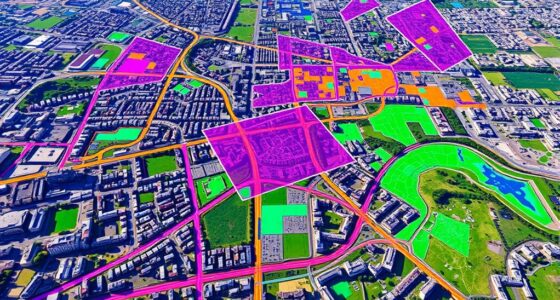
The Traveling Salesman Problem (TSP) can be better understood through a geometric lens, where you visualize cities as points on a plane. By analyzing spatial arrangements, convex hulls, and minimal spanning trees, you can develop heuristics that find efficient routes quickly. These geometric insights help in reducing the total travel distance and guide you toward near-optimal solutions. Exploring these concepts further will reveal how geometry improves TSP strategies and solutions.
Key Takeaways
- Geometric visualization of TSP involves representing cities as points in a plane, facilitating spatial analysis of routes.
- Constructing minimal spanning trees and convex hulls helps identify efficient connections and boundary constraints.
- Geometric properties like angles and distances guide heuristic algorithms to find near-optimal solutions efficiently.
- Spatial distribution analysis enables the design of heuristics that minimize travel by exploiting geometric arrangements.
- Geometric insights enhance heuristic performance, leading to faster, high-quality solutions for the TSP.

The Traveling Salesman Problem (TSP) is a classic challenge in computer science and operations research that asks: how can a salesperson visit a set of cities exactly once and return to the starting point while traveling the shortest possible distance? At its core, TSP involves finding the most efficient route through a collection of points, which is a complex task because the number of possible routes grows factorially with the number of cities. This combinatorial explosion makes exact solutions computationally infeasible for large instances. That’s where heuristic algorithms come into play. These methods don’t guarantee the absolute shortest route but can produce good, near-best solutions within a reasonable timeframe. They are especially valuable when dealing with real-world problems where time and computational resources are limited.
From a geometric perspective, TSP can be visualized as an optimization problem over a set of points on a plane, with each point representing a city. Geometric optimization techniques help in understanding how to connect these points efficiently. For example, one common approach involves constructing a minimal spanning tree, which connects all points with the least total edge length, serving as a foundation for building a shorter route. Another technique is the use of convex hulls, which provides boundary constraints that can guide heuristic algorithms toward more promising routes. By leveraging geometric properties—such as angles, distances, and spatial arrangements—you can improve the performance of heuristic algorithms, making the search for an ideal or near-best route more efficient. Additionally, understanding the spatial distribution of cities can help in designing more targeted heuristics that exploit specific geometric patterns.
In practice, heuristic algorithms like the nearest neighbor, greedy methods, or local search heuristics are designed to capitalize on these geometric insights. They typically start with a simple route and iteratively refine it by swapping or reordering city visits to reduce total travel distance. These adjustments are guided by geometric optimization principles, which help identify promising routes based on the spatial layout of the cities. The goal is to minimize unnecessary travel by exploiting the geometric structure of the problem, often leading to solutions that are surprisingly close to the best. While these heuristics don’t always find the absolute best route, their ability to quickly generate high-quality solutions makes them invaluable, especially in real-world scenarios where perfect optimization is less critical than timely results.
Frequently Asked Questions
How Does the Traveling Salesman Problem Relate to Modern Logistics?
You leverage the Traveling Salesman Problem to improve vehicle optimization and streamline your supply chain. By finding the shortest route to visit multiple delivery points, you reduce fuel costs, save time, and increase efficiency. This problem’s principles help you design ideal routes, minimizing travel distance and ensuring timely deliveries. Modern logistics firms use algorithms based on TSP to stay competitive and meet customer expectations in an increasingly complex supply chain network.
Are There Real-World Applications Beyond Routing and Scheduling?
Yes, you can apply the Traveling Salesman Problem beyond routing and scheduling. For example, you might use it in warehouse optimization to determine the most efficient path for picking items, saving time and resources. Additionally, drone delivery services leverage TSP algorithms to plan routes that minimize flight time and energy use. These applications help improve operational efficiency, reduce costs, and enhance customer satisfaction across various industries.
What Are the Latest Algorithms Used to Approximate Solutions?
You can use heuristic algorithms like nearest neighbor, genetic algorithms, or simulated annealing to approximate solutions for the TSP. These approximation techniques help you find near-optimal routes efficiently, especially as problem size grows. Recent advancements focus on hybrid methods combining multiple heuristics or leveraging machine learning to improve accuracy and speed. These algorithms are continually evolving, offering better solutions for complex, real-world applications beyond traditional routing challenges.
How Does Computational Complexity Impact Practical Problem-Solving?
You realize that computational complexity greatly impacts practical problem-solving because it determines how efficiently you can find solutions. Heuristic methods help you tackle complex problems within reasonable time, especially when dealing with NP-hard complexity classes. These approaches trade perfect accuracy for speed, allowing you to generate good solutions quickly. Without understanding complexity, you might spend too long or fail to find solutions, making real-world applications difficult or impossible to implement effectively.
Can Quantum Computing Offer Breakthroughs for the TSP?
Quantum computing could revolutionize solving the TSP by utilizing quantum algorithms that exploit superposition and entanglement optimization. You might see faster solutions as these algorithms process multiple routes simultaneously, unlike classical methods. While still in development, this approach promises breakthroughs in tackling complex instances of the TSP, potentially reducing computational time considerably and opening new possibilities for practical, large-scale route optimization.
Conclusion
Imagine solving the Traveling Salesman Problem isn’t just a task; it’s like revealing the secrets of the universe itself. With this geometric perspective, you wield the power to unravel complexities that have stumped mathematicians for centuries. By mastering these elegant visual insights, you elevate your understanding to a level where even the most intimidating routes become mere child’s play. You’re not just tackling a problem—you’re rewriting the very fabric of optimization itself.