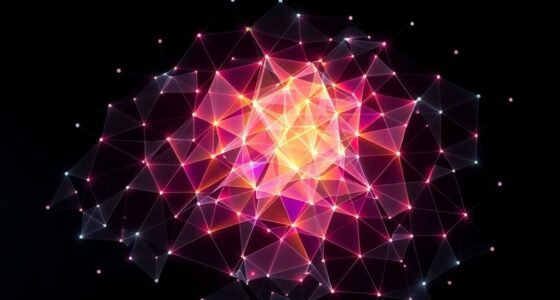

Triangulation helps you rebuild real-world surfaces by connecting scattered data points into a network of triangles, creating a continuous surface. It makes use of algorithms like Delaunay triangulation to avoid skinny triangles and accurately reflect natural features. Interpolation fills gaps between points, smoothing out errors and noise. This process is essential for detailed modeling in areas like mapping, medical imaging, and 3D design. If you keep exploring, you’ll discover how this technique enhances surface accuracy even further.
Key Takeaways
- Triangulation connects scattered data points into a network that models the surface structure accurately.
- It uses algorithms like Delaunay triangulation to optimize triangle shapes and improve surface fidelity.
- Triangles facilitate interpolation, filling gaps between data points to generate smooth, continuous surfaces.
- It efficiently handles irregular data distributions, enabling detailed surface reconstruction of complex shapes.
- Triangulation enhances the accuracy and realism of models in applications like mapping, 3D modeling, and imaging.
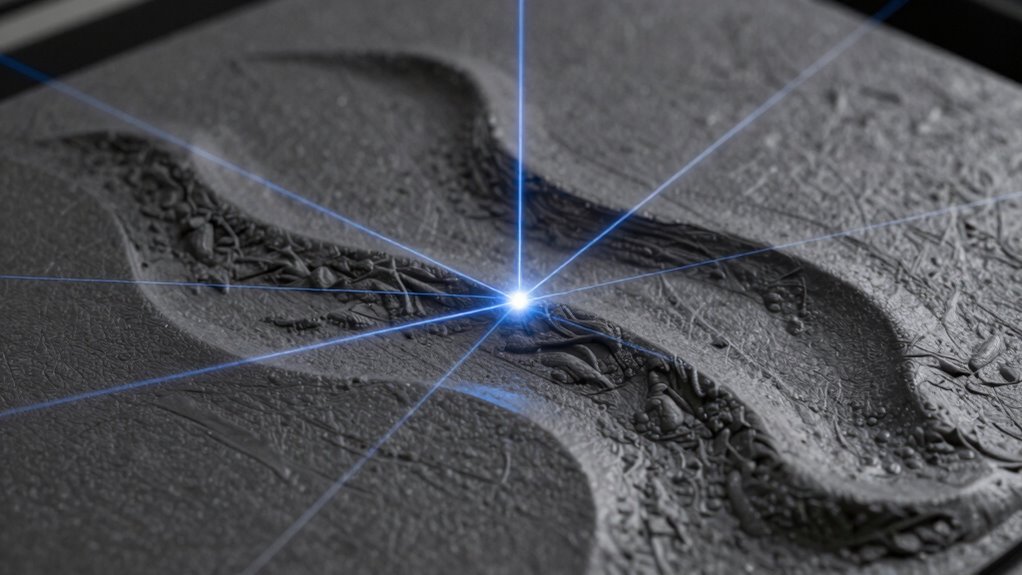
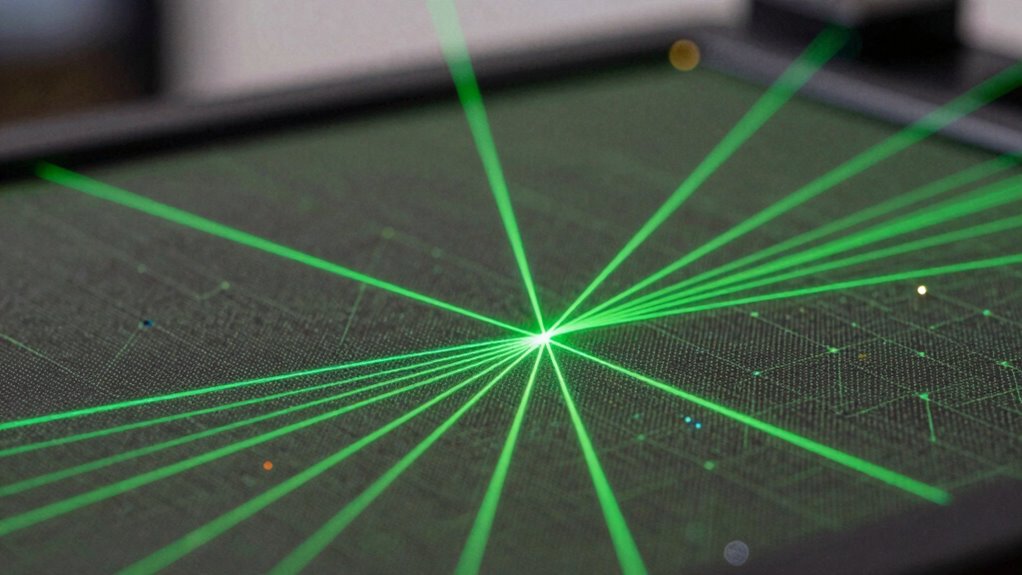
Have you ever wondered how computers can accurately recreate complex surfaces from scattered data points? The answer lies in the clever use of triangulation, a method that transforms irregularly spaced data into a coherent, smooth surface. When collecting data from real-world objects or environments, sensor accuracy plays a vital role. Precise sensors gather detailed measurements, but these data points are often scattered and irregularly spaced. To turn this scattered data into a meaningful surface, computers employ data interpolation techniques, which estimate unknown values between known data points, filling in gaps and creating a continuous surface.
Triangulation is a key step in this process. It involves connecting data points with triangles in such a way that the entire set forms a network covering the surface. By creating these triangles, the computer establishes a framework that respects the natural variations in the data. The Delaunay triangulation algorithm is a popular choice because it maximizes the minimum angles of the triangles, avoiding skinny or distorted shapes that could compromise the surface quality. This process guarantees that the resulting mesh accurately reflects the underlying data and preserves important features of the original surface. Additionally, the robustness of triangulation algorithms ensures consistent performance across diverse datasets.
Once the triangulation is complete, the computer uses it to perform data interpolation. Each triangle acts as a small, simple surface segment where values can be smoothly estimated across the entire mesh. This allows the computer to generate a detailed and realistic surface model from sparse and scattered data points. The quality of this reconstruction heavily depends on sensor accuracy—more precise measurements lead to a more faithful surface. Any errors or noise in the data can be smoothed out during the triangulation and interpolation processes, especially when combined with filtering techniques. Additionally, the efficiency of triangulation algorithms makes it feasible for real-time applications, further expanding its usefulness.
Moreover, triangulation provides a flexible and computationally efficient way to handle complex surfaces. It adapts well to irregular data distributions, making it suitable for applications like topographic mapping, 3D modeling, or medical imaging. The computational efficiency of triangulation algorithms enables real-time processing, which is crucial for many practical applications and enhances the overall robustness of surface reconstruction. By breaking down complex shapes into manageable triangles, the computer simplifies calculations and enhances the overall fidelity of the reconstructed surface. This approach allows for real-time processing and high-resolution detail, essential for many modern technological applications.
In essence, triangulation bridges the gap between raw, scattered data points and accurate, smooth surface models. It leverages sensor accuracy to produce reliable data, and through data interpolation, it constructs continuous surfaces that mirror the complexity of the real world. Recognizing the importance of triangulation algorithms helps us appreciate how these techniques enable precise surface reconstructions in various fields. This synergy of techniques enables computers to recreate detailed, realistic surfaces that support a wide range of scientific, engineering, and artistic endeavors.
3D surface reconstruction software
As an affiliate, we earn on qualifying purchases.
As an affiliate, we earn on qualifying purchases.
Frequently Asked Questions
How Accurate Is Triangulation Compared to Other Surface Reconstruction Methods?
Triangulation is highly accurate, especially with high data density and precise surface measurements, making it superior to some other methods for detailed surface reconstruction. Its surface precision depends on the quality and density of data points collected, allowing you to capture intricate details effectively. While alternative methods can excel in specific scenarios, triangulation offers a reliable balance of accuracy and efficiency, especially when working with dense, high-quality data sets.
What Are Common Challenges in Implementing Triangulation Algorithms?
You might face challenges with triangulation algorithms, especially with sensor calibration issues and data noise. If sensors aren’t properly calibrated, the reconstructed surface can be inaccurate. Data noise from measurement errors complicates the process, making it harder to generate precise models. To overcome these challenges, you need to guarantee proper calibration and implement filtering techniques to minimize noise, leading to more reliable and accurate surface reconstructions.
How Does Triangulation Handle Complex or Irregular Surfaces?
Triangulation manages complex or irregular surfaces by breaking them into smaller, manageable triangles, which adapt to surface irregularities. You’ll find it effective with irregular geometries because the method dynamically adjusts triangle shapes and sizes to match surface contours. This flexibility allows for accurate surface reconstruction, capturing surface irregularities precisely. As a result, triangulation provides a detailed and faithful digital representation, even when dealing with challenging, uneven, or intricate real-world surfaces.
Can Triangulation Be Used for Real-Time Surface Reconstruction?
Yes, triangulation can be used for real-time surface reconstruction. You’ll need to guarantee proper sensor calibration to accurately measure distances, and be mindful of data noise, which can affect the quality of the reconstructed surface. Advanced algorithms process incoming data quickly, allowing you to create real-time models. Although challenges like noise exist, optimizing calibration and filtering techniques enables effective real-time reconstructions using triangulation.
What Are the Limitations of Triangulation in 3D Modeling?
You might find triangulation limited in complex models, like capturing intricate textures on a sculpture. It can struggle with surface smoothing, leading to rough edges, and may produce inaccuracies in texture mapping across uneven surfaces. These limitations can cause artifacts or distortions, especially when dealing with highly detailed or organic shapes. To improve results, you often need additional processing or alternative methods, like subdivision or mesh refinement, for smoother and more accurate 3D models.
As an affiliate, we earn on qualifying purchases.
Conclusion
So, next time you see a 3D model or a digital map, remember how triangulation works behind the scenes, bridging the gap between raw data and realistic surfaces. It’s like giving a computer the ability to see and understand the world in three dimensions. Doesn’t it make you wonder how much more accurate and detailed our digital environments could become? With triangulation, the possibilities for recreating our world are virtually endless.
As an affiliate, we earn on qualifying purchases.
As an affiliate, we earn on qualifying purchases.