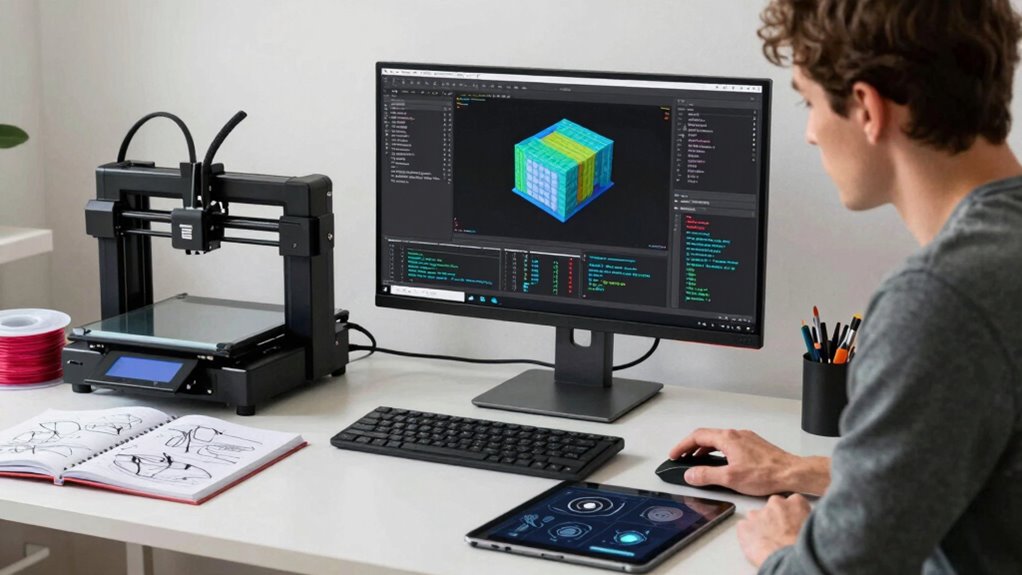

As a computational designer, you spend your day developing and refining algorithms to improve the creative process, manipulating parametric models for quick iteration, and exploring complex shapes through parameter adjustments. You collaborate with clients, architects, and engineers to turn ideas into adaptable digital models, running tests, simulations, and performance analyses to guarantee practicality and sustainability. If you keep exploring, you’ll discover how these skills come together to shape innovative, optimized designs.
Key Takeaways
- Develop, refine, and optimize algorithms to enhance creative and technical aspects of design projects.
- Manipulate parametric models to explore various design possibilities and iterate quickly.
- Collaborate with clients, architects, and engineers to translate ideas into digital, adaptable systems.
- Test and analyze models for feasibility, performance, and sustainability, making necessary adjustments.
- Continuously learn new tools, techniques, and emerging digital methods to stay innovative.
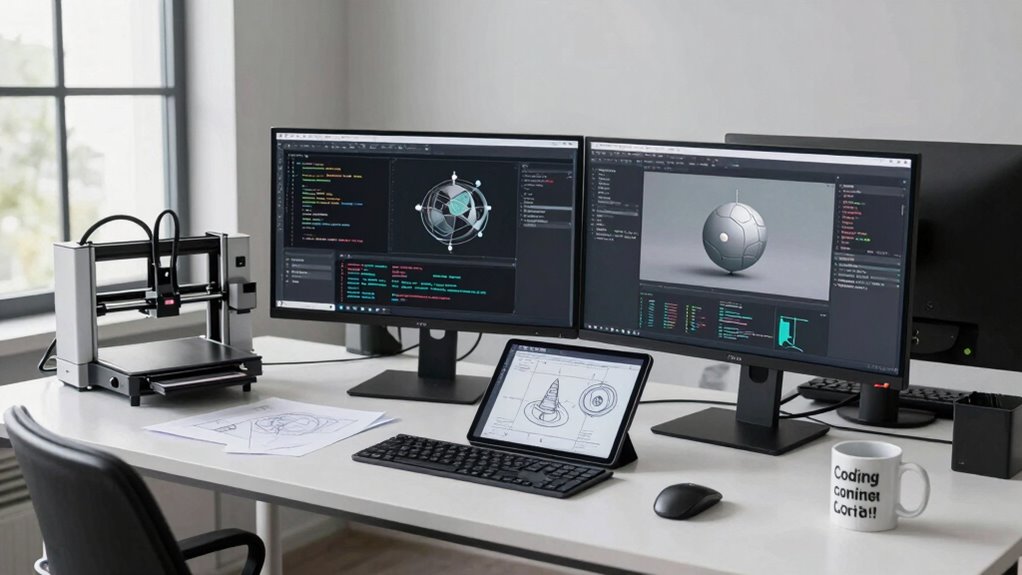
A computational designer’s job centers on leveraging digital tools and algorithms to develop innovative and efficient design solutions. Your day often begins with setting up or refining algorithms that drive the creative process. You focus on algorithm optimization to guarantee that these algorithms run smoothly, efficiently, and produce accurate results. This involves fine-tuning code, eliminating redundancies, and improving performance so your models can handle complex calculations without slowing down. As you work, you’re constantly balancing creativity with technical precision, making sure your algorithms are adaptable yet reliable.
Parametric modeling plays an essential role in your daily tasks. Instead of designing static forms, you manipulate parameters that control the entire geometry. This approach allows for rapid iteration, as adjusting one parameter automatically updates the entire model. You spend a good part of your day experimenting with different parameter sets to explore various design possibilities. This process enables you to generate complex, organic shapes or highly optimized structures that would be difficult to create manually. You also use parametric modeling to embed performance criteria into your designs, such as structural efficiency or environmental responsiveness, making your work highly functional and innovative. Additionally, incorporating environmental responsiveness helps create designs that are more sustainable and adaptive to their surroundings.
Throughout the day, you often collaborate with architects, engineers, or clients who rely on your expertise to translate their visions into digital models. You interpret their requirements, then translate these into parametric systems that can be easily modified and refined. Your role involves not just creating these models but also explaining how they work, demonstrating how tweaking one element influences the overall design. This communication helps stakeholders understand the potential of algorithm-driven design and fosters iterative improvements.
Collaborating with clients and architects to translate visions into adaptable, algorithm-driven digital models.
You spend significant time testing and refining your models, guaranteeing they are both feasible and optimized. This may involve running simulations or performance analyses to evaluate structural stability or environmental impact. When issues arise, you tweak your algorithms or parameters to improve the outcomes. Your work often requires a deep understanding of material properties, fabrication methods, and environmental factors, all incorporated into your digital models. The goal is to create designs that are not only visually compelling but also practical and sustainable.
In essence, your day revolves around harnessing the power of algorithm optimization and parametric modeling to push the boundaries of conventional design. You continuously learn new scripting languages, software tools, and computational techniques to stay ahead. Your job is a blend of creativity, technical mastery, and problem-solving—an ongoing process of refining digital systems that bring innovative architectural and design visions to life. Staying current with emerging digital techniques is crucial for maintaining your edge in this evolving field.

Parametric Modeling with SOLIDWORKS 2025
SDC Publications Parametric Modeling with SOLIDWORKS 2025.
As an affiliate, we earn on qualifying purchases.
As an affiliate, we earn on qualifying purchases.
Frequently Asked Questions
What Software Tools Do Computational Designers Prefer?
You prefer software tools like Rhino with Grasshopper for parametric modeling, enabling you to create complex, adaptable designs. You also use Dynamo with Revit for algorithm optimization, streamlining workflows and automating tasks. These tools help you explore design possibilities quickly, test variations efficiently, and refine your concepts. Overall, your choice of software enhances your ability to innovate and solve architectural challenges through advanced computational techniques.
How Does Collaboration Work in Computational Design Projects?
In computational design projects, you immerse yourself in interdisciplinary teamwork and collaborative problem solving. You share ideas and data through digital platforms, enabling seamless communication across disciplines like architecture, engineering, and art. You actively contribute by coding, modeling, and refining concepts together. This collaborative approach boosts innovation, allowing everyone’s expertise to shape creative solutions efficiently. You find that working as a team enhances the design process and leads to more integrated, effective results.
What Industries Most Commonly Hire Computational Designers?
You’ll find computational designers most often hired in architecture, product design, and urban planning. They use generative algorithms and parametric modeling to create innovative, efficient solutions. In architecture, they shape complex structures; in product design, they develop customizable products; and in urban planning, they optimize layouts. These industries value your skills in leveraging computational tools to solve problems creatively and improve design processes.
How Do Computational Designers Stay Updated With New Technology?
You stay updated with new technology by actively engaging in online courses, webinars, and industry forums focused on algorithm optimization and generative modeling. You read research papers, follow influential designers on social media, and experiment with new tools. Attending conferences and participating in workshops also helps you learn about innovations. This continuous learning enables you to refine your skills, stay competitive, and incorporate the latest techniques into your projects.
What Educational Background Is Ideal for a Computational Designer?
An ideal educational background for a computational designer combines a degree in architecture, engineering, computer science, or math with a focus on design philosophy and creative problem solving. You should develop skills in programming, algorithms, and digital modeling. Emphasize understanding design principles while applying innovative tech solutions. This blend helps you craft efficient, aesthetic, and functional designs, making you adaptable to evolving technologies and project demands.

Genetic Algorithms in Search, Optimization and Machine Learning
As an affiliate, we earn on qualifying purchases.
As an affiliate, we earn on qualifying purchases.
Conclusion
As a computational designer, you spend your day blending creativity with technology, solving complex problems, and pushing boundaries. Did you know that over 70% of design firms now rely on computational tools to streamline workflows? Embracing this tech-savvy approach not only boosts productivity but also sparks innovation. So, whether you’re crafting unique structures or optimizing spaces, your work is shaping the future of design—making every day both challenging and incredibly rewarding.

VFX Made Easy with Houdini: A mesmerizing journey into procedural modeling, simulations, visual effects, and rendering
As an affiliate, we earn on qualifying purchases.
As an affiliate, we earn on qualifying purchases.

Modelling Techniques and Tools for Performance Analysis
As an affiliate, we earn on qualifying purchases.
As an affiliate, we earn on qualifying purchases.