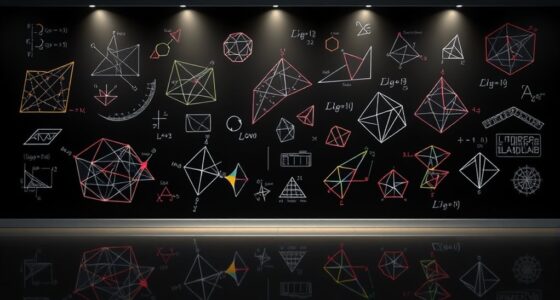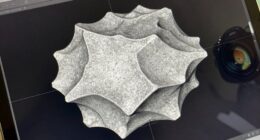

Non-Euclidean geometry breaks Euclid’s fifth postulate by showing that parallel lines can diverge or converge, creating curved spaces like hyperbolic planes. In this geometry, the rules change: triangles have angles summing to less than 180 degrees, and space behaves differently from flat Euclidean space. Understanding these concepts sheds light on how the universe might be shaped at large and small scales. If you keep exploring, you’ll discover how this redefines our view of space itself.
Key Takeaways
- Non-Euclidean geometry arises from rejecting Euclid’s fifth postulate, allowing for curved spaces like hyperbolic and elliptic geometries.
- Hyperbolic geometry features triangles with angle sums less than 180°, contradicting Euclidean assumptions.
- These geometries demonstrate that parallel lines can diverge or converge, breaking Euclid’s parallel postulate.
- The development of non-Euclidean geometry expanded understanding of space, impacting cosmology and the model of the universe.
- Mathematicians like Lobachevsky and Bolyai formalized these alternative geometries, challenging Euclid’s postulate and broadening geometric principles.
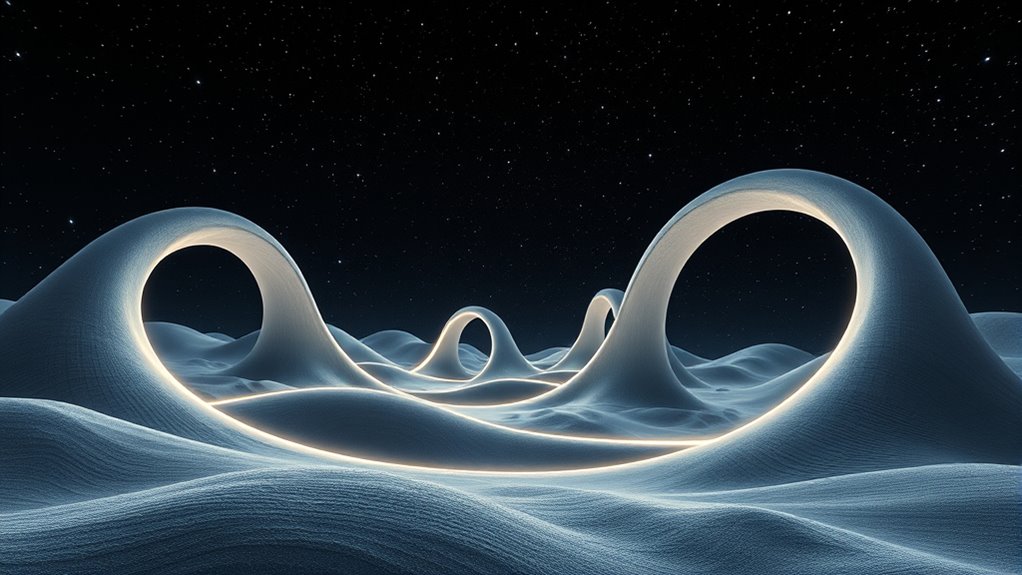
Understanding hyperbolic planes helps you see how space can curve negatively, allowing an infinite number of lines to pass through a point without intersecting a given line. This makes the notion of parallel lines radically different from what you’re familiar with in Euclidean space. When you draw geodesic triangles in these planes, you’ll notice that their shape defies the intuition built from flat geometry. Instead of the sum of the angles always adding up to 180 degrees, you’ll find that in hyperbolic geometry, the sum is always less than that. The larger the triangle, the more pronounced this difference becomes, emphasizing the unique nature of hyperbolic space. This property has profound implications, affecting how distances, angles, and areas are calculated, and it challenges the idea that Euclidean rules are universal. Additionally, the development of quasigeodesics in hyperbolic spaces helps mathematicians understand how paths can be optimized in curved environments.
As you explore hyperbolic planes and geodesic triangles, you’ll realize that non-Euclidean geometry isn’t just a mathematical curiosity—it’s a way of understanding the universe’s structure at both cosmological and quantum levels. By breaking Euclid’s fifth postulate, mathematicians like Lobachevsky and Bolyai opened up new worlds where space behaves differently, offering insights into the fabric of reality. So, the next time you think about geometry, remember that the universe isn’t bound by the rules you learned in school. Instead, it might just be a hyperbolic plane, full of surprises and new ways of understanding the space around you.
Frequently Asked Questions
How Did Non-Euclidean Geometry Impact Modern Physics?
Non-Euclidean geometry profoundly impacts modern physics by altering your understanding of space and gravity. It introduces theoretical implications that challenge traditional views, leading you to explore curved spaces and alternative models. This sparks philosophical debates about the nature of reality and the universe. You realize that these ideas underpin Einstein’s theory of general relativity, transforming your perspective on the universe’s structure and the fundamental laws governing it.
Are There Real-World Applications of Hyperbolic and Elliptic Geometries?
Did you know that hyperbolic and elliptic geometries are used in real-world applications? In architectural design, hyperbolic geometry helps create innovative structures with unique curves and surfaces. Meanwhile, elliptic geometry plays a role in virtual reality, enhancing spatial accuracy and immersion. These geometries transform how we build, explore, and experience spaces, proving their importance beyond theoretical math and into everyday technology and design.
Who Were the Key Mathematicians Behind Non-Euclidean Discoveries?
You should know that key mathematicians behind non-Euclidean discoveries include Carl Friedrich Gauss, who explored Euclidean foundations and questioned geometric axioms, and Nikolai Lobachevsky and János Bolyai, who independently developed hyperbolic geometry by challenging Euclid’s fifth postulate. Their work revolutionized understanding of geometry by breaking traditional assumptions, opening new mathematical and physical possibilities, especially in understanding curved spaces and Einstein’s theory of general relativity.
How Does Non-Euclidean Geometry Influence Computer Science?
They say, “think outside the box,” and non-Euclidean geometry pushes you to do just that in computer science. It influences algorithms and data structures by inspiring new ways to approach spatial problems, optimize network routing, and develop realistic simulations. You can leverage these concepts to create more efficient algorithms and innovative data structures that handle complex, curved spaces, ultimately expanding the boundaries of what your software can achieve.
Can Non-Euclidean Concepts Be Visualized Easily?
You can visualize non-Euclidean concepts, but it’s not always easy because of visualization challenges. Traditional models often fall short, so you need intuitive models, like hyperbolic or spherical representations, to grasp these ideas. Using computer graphics helps make these complex geometries more accessible, but you still might find it tricky to fully understand without exploring multiple perspectives. With patience, though, you’ll get closer to intuitive understanding.
Conclusion
So, next time you try to draw a perfect triangle on a curved surface, remember Euclid’s fifth postulate is just a suggestion, not a rule. Non-Euclidean geometry proves you can bend, twist, and redefine space itself—like trying to fit a square peg in a round universe. It’s as if geometry said, “Hey, who needs straight lines anyway?” Surprising, isn’t it? Just like your math teacher’s idea of “simple” being totally out of shape.