
Non-Euclidean geometry shows that space isn’t always flat like in everyday life. Instead, it can curve outward, like a saddle (hyperbolic), or inward, like a sphere (spherical). In these worlds, lines can behave differently—parallel lines may diverge or meet, and triangle angles can add up to less or more than 180 degrees. Exploring these shapes challenges your intuition and reveals how space can be more complex than it seems; keep going to discover more about this fascinating universe.
Key Takeaways
- Non-Euclidean geometry explores spaces where parallel lines can diverge or meet, defying classic Euclidean rules.
- Hyperbolic geometry features saddle-shaped spaces with triangles having less than 180° angles.
- Spherical geometry deals with curved surfaces like a globe, where lines of longitude meet at poles.
- These geometries challenge intuition and are used in understanding the universe, navigation, and complex networks.
- They reveal that space can be more flexible and varied than the flat, straight-line assumptions of traditional geometry.

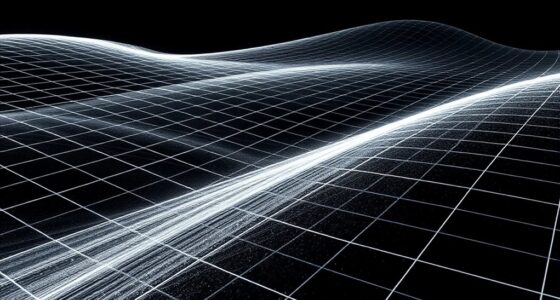
Have you ever wondered what shapes and spaces look like beyond the familiar rules of Euclidean geometry? It’s a fascinating journey into worlds where the usual rules—like parallel lines never meeting—don’t always apply. That’s where non-Euclidean geometry comes into play, opening up entirely new ways to understand space and form. Instead of flat planes, imagine hyperbolic planes, which curve outward like a saddle. Here, lines that start parallel can diverge forever, and the angles of a triangle can add up to less than 180 degrees. It’s a mind-bending concept, but it’s more than just theory; hyperbolic geometry has real-world applications, especially in understanding complex networks and the universe’s shape. Encryption solutions play a crucial role in protecting the data involved in these advanced scientific studies and technological applications.
Explore how hyperbolic geometry bends our understanding of space and real-world applications beyond flat planes.
On the flip side, there’s spherical geometry, which you experience whenever you look at the Earth. Think of the surface of a sphere—every line of longitude is a great circle, and these lines always meet at the poles. Unlike Euclidean planes, where parallel lines never intersect, in spherical geometry, all “straight” lines eventually cross. Triangles drawn on a sphere have angles that sum to more than 180 degrees, and this property explains phenomena like navigation and cartography. When you’re traveling across the globe, you’re essentially moving through a spherical space, which defies the flat-plane assumptions most people learn in school.
Both hyperbolic planes and spherical geometry challenge your intuition about space. They show that the rules we take for granted don’t hold everywhere. In hyperbolic spaces, the idea of infinite parallel lines is replaced by an abundance of lines that diverge rapidly, which is useful in understanding certain cosmological models and even some complex algorithms. Meanwhile, spherical geometry’s properties help in understanding planetary surfaces, astronomy, and navigation. These geometries aren’t just mathematical curiosities—they help explain the universe’s structure on large and small scales.
In fundamentally, non-Euclidean geometry invites you to see the universe from different perspectives. It pushes beyond the flat planes and straight lines you’re used to, revealing a universe of curved spaces and surprising relationships. Whether it’s the saddle-shaped hyperbolic plane or the round surface of a sphere, these geometries prove that the universe’s true shape can be stranger—and more fascinating—than Euclidean geometry ever suggested. Exploring them expands your understanding of space, showing that the rules depend on where and how you look.
Frequently Asked Questions
How Does Non-Euclidean Geometry Apply to Real-World Technology?
You might not realize it, but non-Euclidean geometry plays a role in real-world technology. It’s essential for hyperspace navigation, helping spacecraft plot routes through curved space. In virtual reality, it creates realistic environments that defy traditional geometry, enhancing immersion. By understanding non-Euclidean principles, you improve navigation systems and immersive experiences, making technology more intuitive and advanced than ever before.
Can Non-Euclidean Geometry Be Visualized Easily?
Imagine trying to draw a circle on a curved surface; that’s where visualization challenges arise. Non-Euclidean geometry isn’t easy to visualize because it defies our usual sense of space. You might find it hard to grasp these concepts without a strong conceptual understanding. While some models and computer graphics help, fully visualizing non-Euclidean geometry remains complex, requiring you to think beyond traditional shapes and flat spaces.
What Are the Main Differences Between Euclidean and Non-Euclidean Geometries?
You’ll notice that in Euclidean geometry, parallel lines never meet, and the sum of angles in a triangle is always 180 degrees. In non-Euclidean geometry, these rules change: parallel lines can intersect or diverge, and triangle angles may add up to less or more than 180 degrees. These differences fundamentally alter how shapes and spaces behave, offering a new way to understand the universe’s geometry.
How Does Non-Euclidean Geometry Impact Our Understanding of the Universe?
You might be surprised to learn that about 95% of the universe’s mass-energy remains mysterious. Non-Euclidean geometry changes how you understand space curvature and cosmic topology, revealing that the universe isn’t flat. This impacts theories about its shape and expansion, helping scientists explore whether space loops back on itself or stretches infinitely. Your understanding of the cosmos evolves as non-Euclidean principles challenge traditional views, offering a more accurate picture of our universe’s true structure.
Are There Practical Uses of Non-Euclidean Geometry in Everyday Life?
You might wonder if non-Euclidean geometry has practical uses in daily life. While its primary role lies in theoretical applications like GPS technology and understanding spacetime, it also has philosophical implications about the nature of reality. Though you may not encounter it directly, recognizing its influence helps you appreciate how complex geometrical concepts shape modern science and technology, bridging abstract theory with real-world applications.
Conclusion
Now that you’ve explored non-Euclidean geometry, you realize how it reshapes our understanding of space. Did you know that our universe might be non-Euclidean? In fact, recent studies suggest the universe could be curved like a saddle or a sphere. This means the geometry you learned in school isn’t the only way to see the world. Keep questioning and exploring—reality might be more mind-bending than you ever imagined!