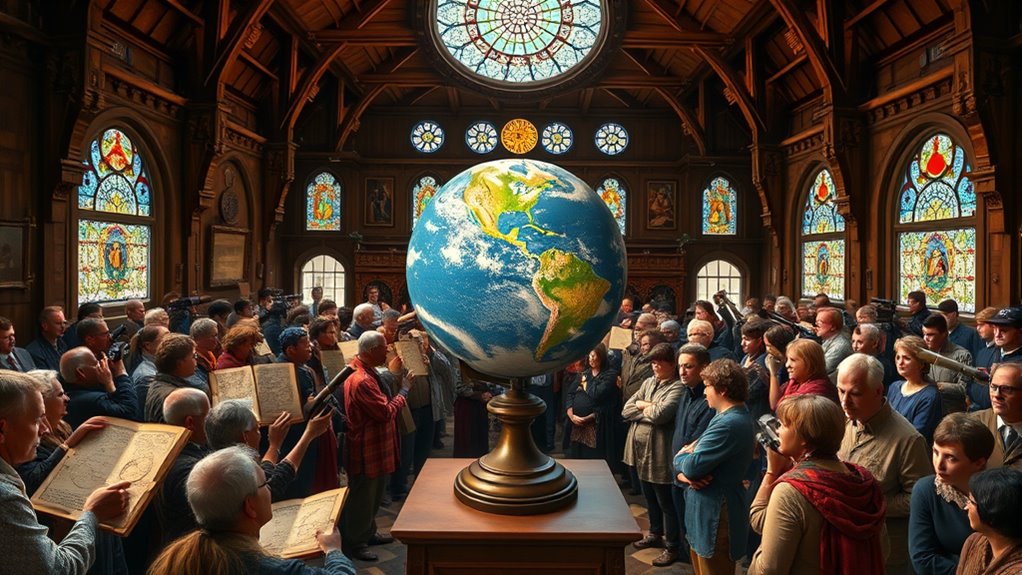

Throughout history, many cultures believed Earth was flat or supported by divine beings, reflecting their myths and spiritual views. Greek philosophers shifted toward reason, proving Earth’s round shape with observations like lunar eclipses, while other societies like Chinese and Indian cultures imagined Earth differently. As scientific discoveries advanced during the Renaissance, the spherical Earth became widely accepted. Exploring these beliefs reveals humanity’s enduring curiosity and evolving understanding—continue exploring to uncover more about how these ideas shaped our world today.
Key Takeaways
- Ancient civilizations imagined Earth as flat or supported by divine beings, reflecting cultural values and spiritual beliefs.
- Greek philosophers shifted from myth to reason, proposing a spherical Earth based on observations and mathematical ideas.
- Different cultures, like Chinese and Indian, held unique beliefs about Earth’s shape, blending myth and philosophical concepts.
- Scientific discoveries during the Renaissance confirmed Earth’s roundness, replacing myth-based explanations with empirical evidence.
- Modern beliefs about Earth’s form are shaped by a mix of cultural myths, philosophical ideas, and scientific understanding across societies.
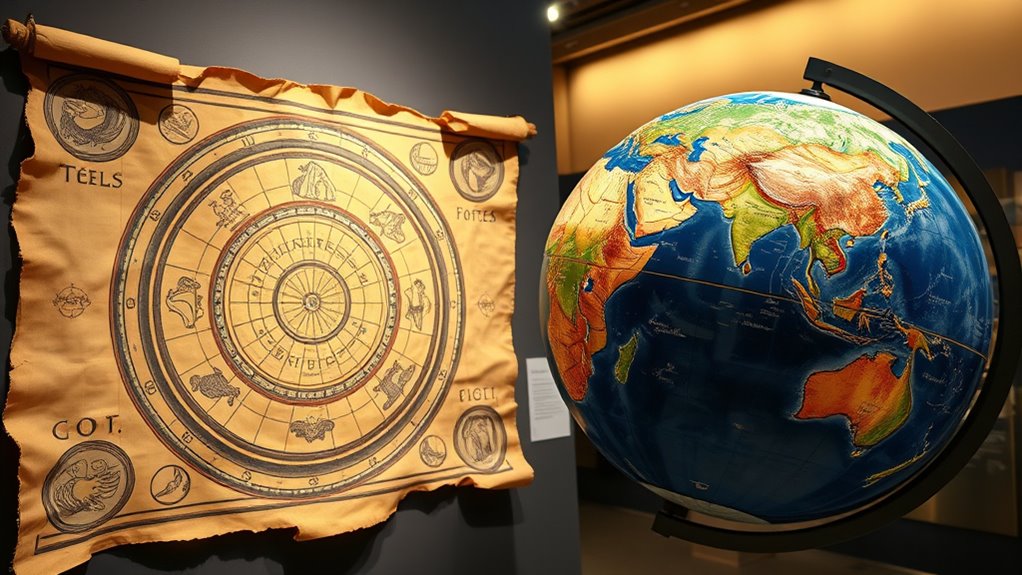
Throughout history, different cultures have held diverse beliefs about the shape of the Earth, shaping their worldviews and understanding of the universe. Many of these beliefs stem from mythical origins, where stories and legends served as explanations for the natural world. For instance, ancient civilizations often imagined the Earth as a flat disc or a vast, anchored plane supported by giant creatures or divine beings. These stories reflected their cultural values and spiritual beliefs, offering a way to make sense of the world around them. Such mythical origins provided a foundation for their worldview, shaping how they perceived their place in the cosmos.
Ancient cultures viewed Earth as a flat disc supported by divine beings.
Philosophical perspectives also played an essential role in shaping early ideas about Earth’s shape. Greek thinkers, for example, moved from myth to reason, with philosophers like Pythagoras and Parmenides proposing more abstract ideas about the universe. Pythagoras believed in a spherical cosmos, influenced by mathematical harmony, while Parmenides argued that the universe was unchanging and perfect, which later supported the idea of a spherical Earth. These philosophical perspectives moved beyond myth and introduced a more rational approach to understanding the world. Over time, thinkers like Aristotle provided more concrete evidence for a round Earth, such as observing the curved shadow during lunar eclipses and noticing ships disappearing hull-first over the horizon.
In many ancient cultures, the shift from mythical origins to philosophical perspectives was pivotal. It marked a change from stories rooted in tradition to ideas grounded in observation and reason. For example, in Chinese cosmology, the Earth was often depicted as a flat, square world supported by cosmic turtles or dragons, reflecting both myth and philosophical thought. Meanwhile, in Indian philosophy, the universe was seen as an interconnected whole, with debates about the Earth’s shape intertwined with spiritual concepts. These diverse views demonstrate how myth and philosophy merged, influencing how societies understood the Earth’s form.
As scientific inquiry advanced, especially during the Renaissance, the notion of a spherical Earth became widely accepted in Western thought. Yet, even today, cultural beliefs about Earth’s shape remain varied, influenced by historical mythologies, philosophical perspectives, and scientific discoveries. These beliefs reveal the human desire to understand our origins and our place in the universe, shaped by stories, reason, and evidence across different eras and societies.
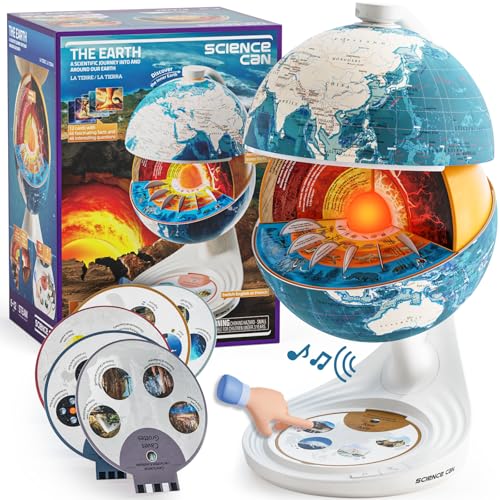
Science Can Globe for Kids, 8" Interactive Globe, STEM Toys for 5 Year Old
- Openable Globe with Layered Core: Reveals Earth's crust, mantle, core
- Realistic Geological Model: Explore Earth's layers in detail
- LED-lit Earth Core: Illuminates Earth's core for visual learning
As an affiliate, we earn on qualifying purchases.
As an affiliate, we earn on qualifying purchases.
Frequently Asked Questions
How Did Ancient Civilizations Determine Earth’s Shape Without Modern Technology?
You can see that ancient civilizations determined Earth’s shape through ancient navigation and mythical cosmology. They observed that ships disappeared hull-first over the horizon and used stars for navigation, noticing patterns that hinted at a curved surface. Mythical cosmology explained Earth’s shape through cultural stories, while practical navigation confirmed a spherical Earth. These methods helped them understand Earth’s roundness long before modern technology existed.
What Role Did Religious Beliefs Play in Shaping Views About Earth’s Form?
Religious beliefs act like a guiding star, illuminating views about Earth’s shape through doctrinal interpretations. You might see ancient scriptures as celestial maps, shaping the understanding that Earth is a divine creation, perfectly centered in the universe. Religious influence often intertwined faith and science, reinforcing the idea of a sacred, unchanging world. This spiritual perspective guided civilizations, anchoring their beliefs about Earth’s form in divine truth rather than scientific evidence.
Are There Any Cultures That Believed in a Flat Earth Today?
You’ll find that some cultures still believe in a flat earth today, largely influenced by modern conspiracy theories and cultural misconceptions. These beliefs persist despite scientific evidence proving otherwise. You might encounter communities or online groups that promote flat earth ideas, often rejecting mainstream science. It’s important to recognize how cultural misconceptions can shape perceptions, even in the face of overwhelming scientific consensus.
How Have Scientific Discoveries Challenged Traditional Cultural Beliefs?
Scientific discoveries have challenged your traditional cultural beliefs by providing evidence that supports cosmological theories of a spherical Earth. You see how observations from astronomy, satellites, and physics have overturned flat Earth ideas, prompting philosophical implications about humanity’s place in the universe. These advancements encourage you to question old notions, embracing a scientific perspective that aligns with modern understanding, shaping your worldview and fostering curiosity about the cosmos.
What Myths or Stories Explain Earth’s Shape in Different Cultures?
In many cultures, myths explain Earth’s shape through stories like the cosmic ocean and sky pillars. You might envision the Earth as a flat disk floating on a vast cosmic ocean, with sky pillars holding up the heavens. These stories reflect ancient peoples’ attempts to understand their world, blending imagination and observation. While modern science offers different explanations, these myths reveal how diverse cultures sought to explain the universe.

Metal Earth Military USS Arizona Ship 3D Metal Model Kit Fascinations
- Hobby Model Kit: Unassembled with easy instructions
- Detailed Etched Model: Highly detailed 3D display piece
- Steel to 3D Conversion: Pop out pieces, connect with tabs
As an affiliate, we earn on qualifying purchases.
As an affiliate, we earn on qualifying purchases.
Conclusion
Throughout history, you’ve seen how cultural beliefs about Earth’s shape have evolved from flat discs to spherical globes. These ideas, like shifting sands under your feet, reflect humanity’s curiosity and desire to understand the world. As your perspective broadens, you realize that these beliefs are part of a larger story—one that’s as intricate as a tapestry, woven with science, tradition, and imagination. Embrace this journey, for it shapes how you see the universe around you.

KISEER 8 Inch World Globe with Stand Rotating Earth Spinning Globe for Kids Geography Classroom Education or Decorations (Blue)
- High-Quality Material: Made of durable, high-quality plastic
- Optimal Size: 8-inch diameter for easy display and storage
- Educational Design: Detailed, colorful world map with clear labels
As an affiliate, we earn on qualifying purchases.
As an affiliate, we earn on qualifying purchases.
Science Can Globe for Kids, 8" Interactive Globe, STEM Toys for 5 Year Old
- Openable Globe with Layered Core: Reveals Earth's crust, mantle, core
- Realistic Geological Model: Explore Earth's layers in detail
- LED-lit Earth Core: Illuminates Earth's core for visual learning
As an affiliate, we earn on qualifying purchases.
As an affiliate, we earn on qualifying purchases.