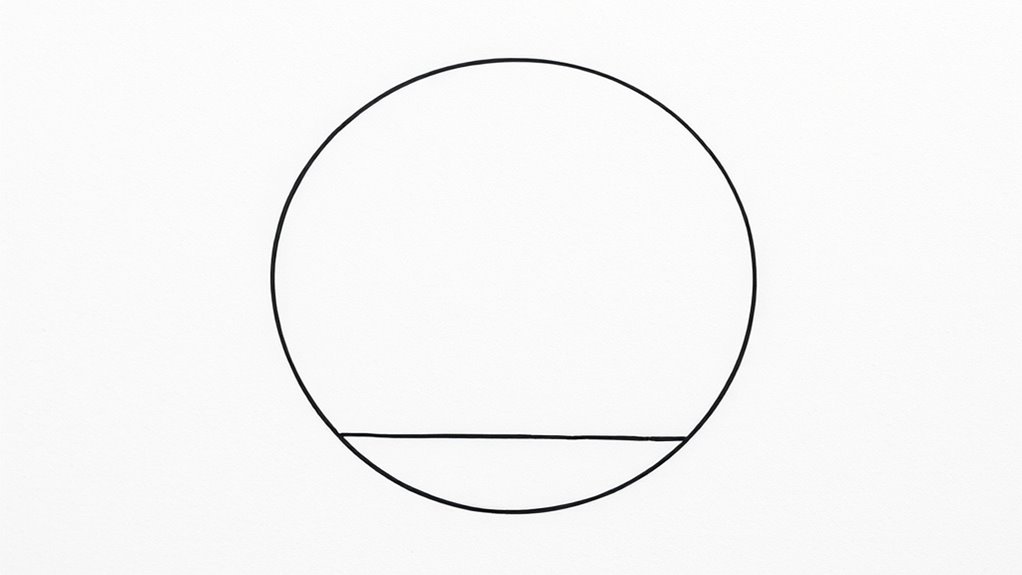
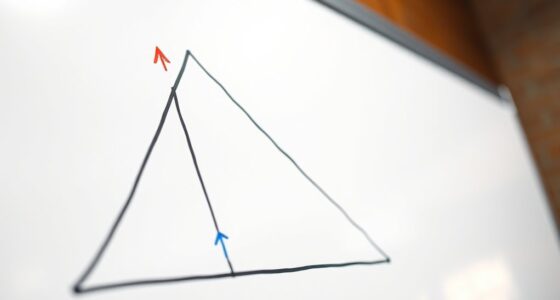
Thales’ theorem states that if you draw a triangle inscribed in a circle with its hypotenuse along the diameter, the opposite angle will always be 90°. This happens because the circle’s symmetry guarantees that any point on the semicircular arc creates a right angle at the vertex. The diameter acts as the longest chord, and the angle inscribed here is consistently a right angle, revealing a key property of circle geometry. Keep exploring to see how this principle applies in various geometric constructions.

Prime made for students and young adults
- Fast, free delivery for dorm and study essentials
- Prime Video and Amazon Music included
- Member-only deals
Key Takeaways
- An inscribed angle subtended by a diameter in a circle always measures 90°.
- Thales’ theorem states that any triangle inscribed with the hypotenuse as diameter is a right triangle.
- The diameter divides the circle into two semicircles, with the vertex of the right angle on the arc.
- The symmetry of the circle ensures the inscribed angle opposite the diameter is always a right angle.
- This property is fundamental in circle geometry, linking diameters and right-angled triangles.
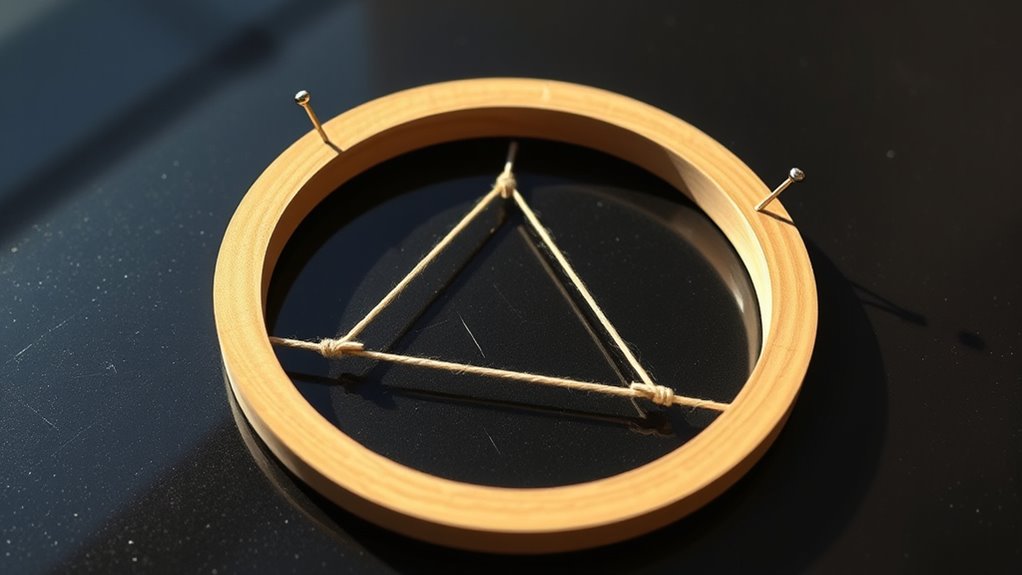
Have you ever wondered what happens to angles inscribed in a semicircle? If you’ve studied circles before, you might recall that certain angles exhibit unique properties when drawn inside a circle. One of the most fascinating is that any angle inscribed in a semicircle is always a right angle, measuring exactly 90 degrees. This fact is formalized in Thales’ theorem, which states that if a triangle is inscribed in a circle with its hypotenuse as the diameter, then the angle opposite the hypotenuse must be a right angle. This property isn’t just a curious fact; it’s a fundamental aspect of circle geometry that reveals the deep symmetry inherent in these figures.
When you draw a diameter across a circle, it essentially divides the circle into two equal halves, creating what’s known as a semicircle. Now, imagine inscribing a triangle inside this semicircle, with one side lying along the diameter. The key insight here is that the vertex of the triangle, which lies somewhere on the arc of the semicircle, will always form a 90-degree angle with the endpoints of the diameter. This isn’t coincidental—it’s a direct consequence of the circle’s symmetry. The circle’s symmetry ensures that any points on the arc are equidistant from the endpoints of the diameter, creating a consistent and predictable geometric relationship.
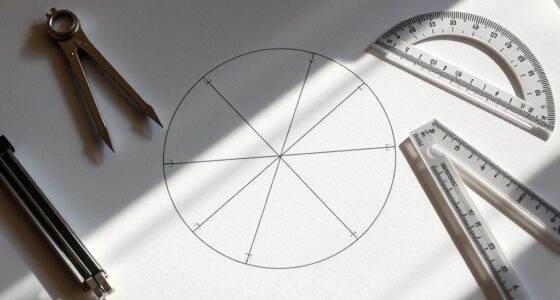
Chord properties play a significant role in understanding this theorem. The diameter acts as the longest chord in the circle, and any angle inscribed in the semicircle with this chord as its side must be a right angle. This is because the chord, in this case, is acting as a special kind of boundary—its endpoints are fixed, and the inscribed angle’s vertex can be anywhere on the arc. The circle’s symmetry guarantees that the angle formed is always 90 degrees, regardless of where the vertex is located on the semicircle, as long as it’s on the arc. This symmetry ensures that the inscribed angles subtended by the diameter are always equal, maintaining the right angle property.
Understanding this property helps you see how circle symmetry and chord properties interconnect beautifully in circle geometry. The symmetry ensures that all points on the semicircular arc are equally positioned relative to the endpoints of the diameter, which leads to the consistent right angle. This insight makes it easier to solve problems involving inscribed angles and provides a solid foundation for more advanced geometric concepts. Whether you’re analyzing the properties of triangles or exploring circle constructions, recognizing the relationship between inscribed angles and circle symmetry is essential. It’s a perfect example of how elegant and predictable circle geometry can be when you understand the underlying principles.
As an affiliate, we earn on qualifying purchases.
Frequently Asked Questions
Does Thales’ Theorem Apply to All Circles?
Yes, Thales’ theorem applies to all circles. You can rely on it because it’s based on fundamental circle properties, specifically that an inscribed angle subtending a diameter measures 90°. When you analyze arc measures, you’ll see that any angle inscribed in a semicircle always equals 90°, regardless of the circle’s size. This theorem is universal for all circles with a diameter, making it a key geometric principle.
Can an Inscribed Angle Be More Than 90°?
When it comes to inscribed angles, remember that “you can’t judge a book by its cover.” An inscribed angle in a circle can’t be more than 90°, as angle properties dictate. If it appears larger, it’s likely not inscribed or not in the same circle. So, you’ll find that inscribed angles are always 90° or less, keeping the circle’s balance intact.
What Are Real-World Applications of This Theorem?
You can apply Thales’ Theorem to real-world problems involving circle properties and angle measurement. For example, in construction, it helps guarantee right angles when designing bridges or buildings with circular components. In navigation, it aids in determining directions using the properties of angles inscribed in circles. Additionally, it’s useful in art and design, where precise right angles are needed within circular patterns or layouts.
How Is the Diameter Related to the Theorem?
Think of the diameter as the mighty bridge connecting two shores, representing the widest span of a semicircle. Its properties guarantee that any triangle inscribed with this bridge as one side will always have a right angle opposite the diameter. This relationship is key to understanding semicircle angles, as the diameter’s length and position directly influence the right angles formed, illustrating Thales’ theorem’s core principle.
Does the Theorem Hold in Three-Dimensional Geometry?
In spherical geometry, Thales’ theorem doesn’t hold in three-dimensional angles. You can’t directly extend the semicircle rule to three dimensions because spherical surfaces alter how angles behave. When dealing with three-dimensional geometry, angles involve curved surfaces and different principles. So, while the theorem applies nicely in two dimensions, you’ll find it doesn’t work the same way in three-dimensional space, especially on spherical surfaces.
As an affiliate, we earn on qualifying purchases.
Conclusion
Now you see how the semicircle’s secret unfolds—each angle a whisper of Thales’ theorem, dancing at 90°. Like a graceful arc, this rule guides your understanding, turning geometry into a melody you can follow. Remember, in the world of circles, the right angle is the heartbeat, pulsing at the edge of the arc. Embrace this truth, and let it shape your journey through the elegant rhythm of mathematics.
As an affiliate, we earn on qualifying purchases.
As an affiliate, we earn on qualifying purchases.
Fall Picks
fall essentials
As an affiliate, we earn on qualifying purchases.


![Terence Tao: Math 2.0 [Pdf]](https://geometr.info/wp-content/uploads/2026/10/terence-tao-math-2-0-pdf-featured-260x140.jpg)