
Non-Euclidean geometry explores spaces where the usual rules of flat geometry don’t hold, such as curved or infinite surfaces. You’ll see how hyperbolic space has saddle-shaped geometry with diverging lines and triangles with less than 180 degrees, while elliptic geometry is like the surface of a sphere, with lines that always meet. Understanding these concepts helps explain the universe’s shape and expansion. Keep exploring to discover how these ideas shape our view of space and reality.
Key Takeaways
- Non-Euclidean geometry challenges traditional flat-space rules, exploring curved spaces like hyperbolic and elliptic geometries.
- Hyperbolic space features diverging lines and triangle angles less than 180°, resembling saddle-shaped surfaces.
- Elliptic geometry is based on spherical surfaces where all lines eventually meet, with triangle angles exceeding 180°.
- Visualizing these geometries helps understand complex universe structures, including curved space and cosmic expansion.
- These concepts are fundamental in modern physics and cosmology, offering insights into the shape and behavior of the universe.
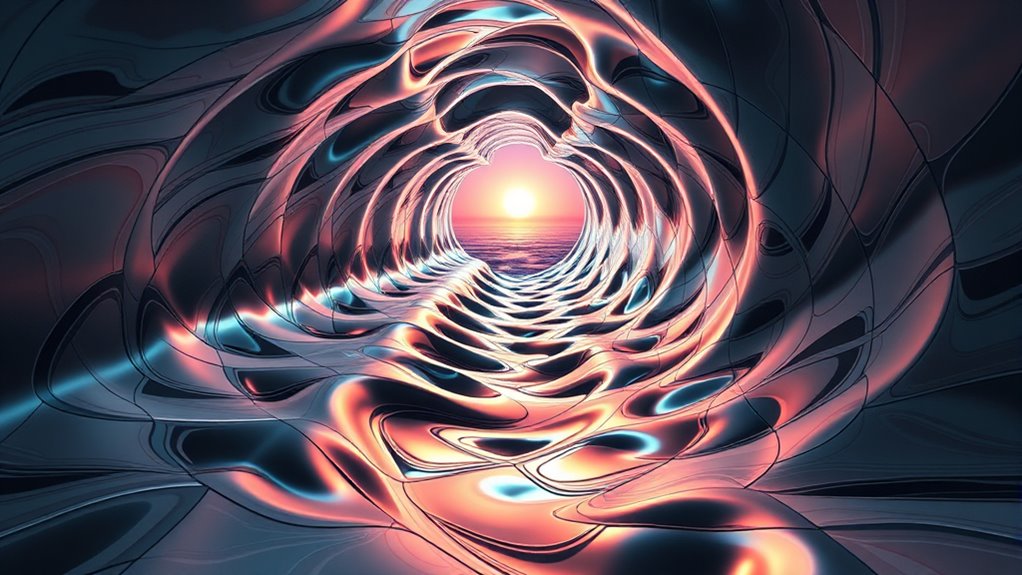
Imagine stepping outside and realizing that the rules of geometry you learned in school don’t always apply. That’s the thrill of exploring non-Euclidean geometry, where the familiar rules of flat space are challenged and expanded. In this world, the traditional notions of parallel lines, angles, and shapes take on new meanings. When you plunge into hyperbolic space, you find a universe where parallel lines diverge, creating a saddle-shaped geometry that feels counterintuitive but is mathematically consistent. Here, the sum of angles in a triangle is less than 180 degrees, and space itself stretches in ways that seem almost impossible. This contrasts sharply with the Euclidean geometry you’re used to, where the rules are straightforward and predictable. Hyperbolic space can be visualized as a kind of infinite, curved surface that expands exponentially, making it a fascinating subject for mathematicians and physicists alike. It’s like walking on a surface that keeps diverging outward, with lines that never meet no matter how far they extend. Understanding the universe’s curvature helps illuminate how non-Euclidean geometries influence cosmological theories.
On the other hand, elliptic geometry presents a different twist to the geometric landscape. Imagine the surface of a sphere, like Earth, where the shortest path between two points is a great circle. In elliptic geometry, there are no parallel lines because all lines eventually intersect. The angle sum of a triangle exceeds 180 degrees, and shapes behave in ways that defy our usual intuition. This geometry is often used to model the universe’s shape in cosmology, where space can be curved positively. When you explore elliptic geometry, you see how space can be finite yet unbounded, like the surface of a globe, where you can keep traveling in a straight line and eventually return to your starting point. It’s a mind-bending concept that shows how geometry isn’t just about paper and rulers but about understanding the fabric of the cosmos itself.
Both hyperbolic space and elliptic geometry reveal that the universe isn’t confined to the flat, Euclidean space your school textbooks often depict. Instead, the universe might be curved in complex ways, and understanding these shapes opens up new ways of thinking about space, gravity, and the universe’s structure. As you explore these non-Euclidean geometries, you start to see how mathematical principles extend beyond the classroom, shaping our understanding of reality itself. It’s a journey that challenges your assumptions about space and invites you to see the world in a whole new light, where the rules are different but equally logical.
Mr. Pen- Professional Geometry Set, 15 pcs, Drafting Tools with Protractor
Package includes 2 Compasses, 2 triangles, 1 6-inch ruler, 1 protractor, 2 pencils for compass, 2 fineliners, 1…
As an affiliate, we earn on qualifying purchases.
As an affiliate, we earn on qualifying purchases.
Frequently Asked Questions
How Does Non-Euclidean Geometry Apply to Real-World Architecture?
Non-Euclidean geometry influences real-world architecture by enabling you to create curved structures that defy traditional straight lines. You can incorporate innovative designs, such as domes and freeform shapes, that are both functional and visually striking. This approach allows you to push architectural boundaries, crafting buildings that stand out and better adapt to their environments by leveraging geometric principles beyond Euclidean constraints.
Are There Practical Uses of Non-Euclidean Geometry in Physics?
You use non-Euclidean geometry in physics to understand curved spacetime, which is essential in Einstein’s theory of general relativity. It helps explain phenomena like gravity and black holes. Hyperspace theory also relies on non-Euclidean concepts to explore faster-than-light travel ideas. These practical applications allow physicists to model the universe more accurately, deepening your understanding of how the cosmos behaves on large scales.
How Can I Visualize Non-Euclidean Shapes Easily?
To visualize non-Euclidean shapes easily, you can use computer graphics to create immersive models. Start with simple visualization techniques like drawing hyperbolic or spherical surfaces, then explore 3D software to manipulate these shapes dynamically. This approach makes abstract concepts tangible, helping you grasp their properties. By experimenting with digital tools, you turn complex, counterintuitive geometries into engaging visual experiences, making understanding more intuitive and enjoyable.
What Is the History Behind the Development of Non-Euclidean Geometry?
You should know that non-Euclidean geometry emerged as a response to the Euclidean challenge, where mathematicians questioned Euclid’s parallel postulate. In the 19th century, this sparked a geometric revolution, leading to the development of hyperbolic and elliptical geometries. These new ideas expanded our understanding of space, influencing modern physics and mathematics, and showing that alternative geometries are possible beyond the traditional Euclidean framework.
Do All Cultures Have Concepts Related to Non-Euclidean Ideas?
You might think all cultures see the world in straight lines, but many have explored non-Euclidean ideas like curved spaces and paradoxes. Cultural perceptions shape how people understand geometry’s philosophical implications, revealing diverse ways of thinking about reality. Some traditions embrace these concepts intuitively, while others only discover them through modern science. So, no, not every culture has explicit non-Euclidean concepts, but many have a rich history of questioning space’s true nature.

Pull String 3D Geometry Learning Book, 3D Geometry Learning Book with Braided Rope Design, Interactive Math Teaching Tool for Geometric Beginners, Teach Volume & Surface Area Formulas (15 Models)
Enhance Geometry Understanding: This pull string 3d geometry learning book helps to master the relationships between points, lines,…
As an affiliate, we earn on qualifying purchases.
As an affiliate, we earn on qualifying purchases.
Conclusion
As you step into non-Euclidean geometry, you’re opening a door to a universe that challenges your perceptions, like exploring a maze with no familiar walls. It may seem strange at first, but remember, every twist and turn reveals new insights about space and reality. Embrace the complexity, for just like a master navigator, you’ll discover that understanding these strange shapes can lead to a deeper appreciation of the cosmos—your journey has only just begun.

World Globe with Weighted Solid Wood Base – 8" HD Printing Illuminated Antique Desk Decor – Flicker-Free Eye-Care LED Light Up Vintage Globe – Sturdy Metal Meridian World Sphere for Adults & Kids
【Uncompromising High-Definition Clarity】This world globe features professional-grade high-definition printing, ensuring every coastline and city name is rendered with…
As an affiliate, we earn on qualifying purchases.
As an affiliate, we earn on qualifying purchases.

Nicpro 22 PCS Compass Geometry Tools with Case, Drafting Tools Geometry Set with Swing Arm Protractor, Rulers, Metal Compass, Square Set, Mechanical Pencil, Back to School Supplies for Students
Complete Compass Geometry Set – This all-in-one compass geometry set includes 3 types of compasses (study, graphic, bow),…
As an affiliate, we earn on qualifying purchases.
As an affiliate, we earn on qualifying purchases.