
To solve geometry problems efficiently, focus on visual analysis by examining diagrams carefully for angles, markings, and symmetrical features. Recognize properties like vertically opposite, corresponding, and alternate interior angles to establish relationships quickly. Use similarity criteria such as AA, SAS, or SSS to confirm figures are similar, then apply proportional sides to find unknown lengths. Mastering these techniques helps simplify complex figures and advance your problem-solving skills—keep exploring to uncover more helpful strategies.
Key Takeaways
- Carefully analyze diagrams for known angles, markings, and relationships like vertically opposite or corresponding angles.
- Use angle properties (e.g., equal or supplementary angles) to establish relationships and simplify problems.
- Identify similar figures with AA, SAS, or SSS criteria and set up proportions to find unknown lengths.
- Confirm similarity before applying proportional relationships to ensure correct problem-solving steps.
- Practice recognizing angle patterns and symmetry to develop intuition and solve problems efficiently.
Have you ever wondered how to approach challenging geometry problems? It’s a common question, especially when you’re faced with complex diagrams and unfamiliar concepts. To sharpen your problem-solving skills, it’s essential to understand some foundational principles, such as angle properties and similarity criteria. These tools can transform a formidable problem into a manageable puzzle. Recognizing emotional support strategies can also help you stay motivated and reduce frustration during your practice.
When tackling geometry questions, start by carefully examining the diagram. Look for known angle properties, such as vertically opposite angles, corresponding angles, and alternate interior angles. Recognizing these angles often helps you establish relationships between different parts of the figure. For example, if two angles are marked as equal or supplementary, you can use those clues to find unknown angles or to prove certain lines are parallel. Knowing angle properties allows you to make quick deductions, saving time and reducing guesswork.
Carefully examine diagrams for known angles—like vertically opposite or alternate interior angles—to identify relationships quickly.
Another powerful approach involves similarity criteria. When two figures in a problem are similar, their corresponding angles are equal, and their sides are proportional. This can be incredibly useful for solving problems involving missing lengths or angles. For instance, if you identify that two triangles are similar by criteria such as AA (angle-angle), SAS (side-angle-side), or SSS (side-side-side), you can set up proportions to find unknown side lengths. Recognizing similarity not only helps in calculating lengths but also in proving relationships between different parts of your figure.
It’s important to verify the criteria for similarity carefully. For example, in the AA criterion, you need to confirm that two angles of one triangle are equal to two angles of another, which implies the triangles are similar. Once established, you can confidently apply proportional relationships across corresponding sides. This step often simplifies what initially seems like a complex geometric figure, turning it into a straightforward algebraic problem.
Throughout your problem-solving process, keep in mind that understanding these concepts doesn’t happen instantly. Practice recognizing angle properties and similarity criteria in various diagrams. Over time, you’ll develop an intuitive sense of which approach to use and when. Keep your diagrams clear and accurate, label all known and unknown quantities, and always look for patterns or symmetrical features. Combining this careful observation with your knowledge of angle properties and similarity criteria creates a solid foundation for solving even the most challenging geometry problems efficiently and confidently.

Nicpro 17 PCS Compass Geometry Set for Students, Drafting Tools Math Protractor Compass with Rulers, Mechanical Pencil, Square Set, Box of Protractors Kit for Class Supplies, Back to School Supplies
Comprehensive 17PCS Geometry Kit for Students—This All-in-one geometry set includes a metal compass for smooth circles, 1 ruler…
As an affiliate, we earn on qualifying purchases.
As an affiliate, we earn on qualifying purchases.
Frequently Asked Questions
How Do I Identify the Best Approach for Complex Geometry Problems?
To identify the best approach for complex geometry problems, start with visual pattern recognition to spot relationships and similarities. Then, break the problem down strategically into smaller, manageable parts, focusing on key angles, shapes, or properties. This method helps you see connections more clearly and simplifies the solution process. By combining visual cues with systematic breakdowns, you’ll find it easier to choose the most effective approach.
What Tools Can Aid in Visualizing Geometric Constructions?
To visualize geometric constructions effectively, you can use tools like dynamic drawing and interactive software. Dynamic drawing allows you to manipulate figures easily, helping you understand relationships better. Interactive software, such as GeoGebra, enables you to create precise constructions and experiment with different configurations. These tools make complex problems more manageable by providing real-time feedback and enhancing your spatial understanding, making your problem-solving process more intuitive and engaging.
How Can I Improve My Geometric Proof Skills?
To improve your geometric proof skills, focus on developing strong geometric intuition by visualizing problems clearly and understanding key properties. Practice different proof strategies, such as direct proof, contradiction, and induction, to find the most effective approach. Break down complex problems into manageable parts, and always verify each step logically. Regular practice, reviewing solved proofs, and seeking feedback help refine your reasoning and build confidence in constructing solid geometric proofs.
What Are Common Mistakes to Avoid in Geometry Problem-Solving?
Like a cautious navigator avoiding hidden reefs, you should watch for misinterpretation errors and calculation oversights. These common mistakes can steer your solution off course, causing confusion or incorrect results. Double-check your assumptions, carefully verify calculations, and guarantee you’re applying theorems correctly. By staying vigilant and attentive to detail, you’ll strengthen your problem-solving skills, much like a seasoned sailor mastering the subtleties of the sea.
How Do I Manage Time Effectively During Geometry Exams?
To manage time effectively during geometry exams, you should implement time management strategies like allocating specific minutes to each problem and sticking to a pacing plan. Use exam pacing techniques such as skipping difficult questions temporarily and returning to them later. Keep an eye on the clock, stay focused, and avoid spending too much time on one problem. This approach helps guarantee you complete all questions confidently within the allotted time.
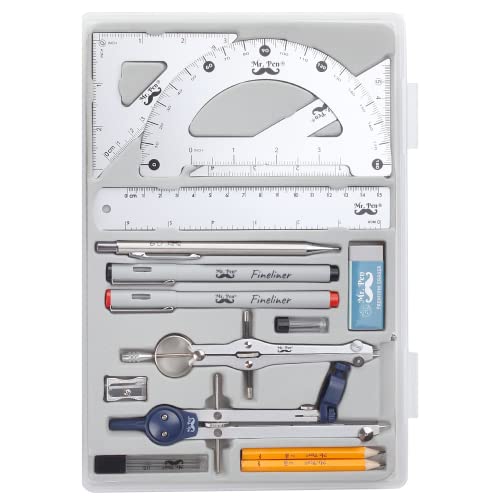
Mr. Pen- Professional Geometry Set, 15 pcs, Drafting Tools with Protractor, Compass, Metal Ruler, Triangles, Pens & Pencils, Complete Geometry & Drafting Kit for Architects, Engineers & Students
Package includes 2 Compasses, 2 triangles, 1 6-inch ruler, 1 protractor, 2 pencils for compass, 2 fineliners, 1…
As an affiliate, we earn on qualifying purchases.
As an affiliate, we earn on qualifying purchases.
Conclusion
Now that you’ve got these tips and techniques, solving geometry problems will feel like a breeze—no need to summon the Ghostbusters! Remember, stay curious, think outside the box, and don’t be afraid to try different approaches. With patience and practice, you’ll be a geometry whiz faster than you can say “Eureka!” So go ahead, tackle those tricky problems and prove that you’re the real MVP of math. The future of geometry is in your hands!
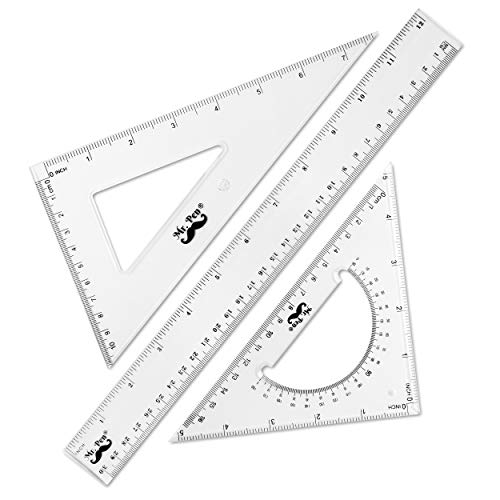
Mr. Pen Triangle Ruler, Protractor, Math Set – 3 Pack, Square Ruler, Protractor for Geometry
Package Includes: One 12-Inch Straight Ruler, One 45 Degree Set Square, And One 30/60 Set Square
As an affiliate, we earn on qualifying purchases.
As an affiliate, we earn on qualifying purchases.

Unjoo Math Geometry Kit Sets 10 Piece Student Supplies with Shatterproof Storage Box,Includes Rulers,Protractor,Compass,Eraser,Pencil Sharpener,Lead Refills,Pencil,for Drafting and Drawings(Black)
10 Piece Geometry Kit Set includes: 2 Metal Study Compasses, 2 Triangles (45° & 30°/60°), 6" Ruler, 4"…
As an affiliate, we earn on qualifying purchases.
As an affiliate, we earn on qualifying purchases.