

Different cultures taught geometry through unique methods, from ancient sand drawings and craftwork to formal textbooks. Egypt used sand to explore shapes and plan structures, while Greece developed systematic proof and art decorations. Indigenous peoples incorporated patterns into textiles and storytelling, and ancient China focused on practical applications like land survey and architecture. These approaches reflected their values and culture, shaping how geometry was passed down. If you’d like to discover more about these fascinating methods, keep exploring.

Prime made for students and young adults
- Fast, free delivery for dorm and study essentials
- Prime Video and Amazon Music included
- Member-only deals
Key Takeaways
- Ancient Egyptians used sand drawings and rudimentary tools for practical and cultural geometric explorations.
- Greeks formalized geometry through proofs, systematic methods, and artistic applications like pottery design.
- Indigenous cultures integrated geometric patterns into textiles and crafts, emphasizing storytelling and communal learning.
- Ancient Chinese taught geometry via diagrams, hands-on activities, and its role in architecture, astronomy, and philosophy.
- Cultural values shaped teaching methods, blending utility, artistic expression, and oral traditions across civilizations.
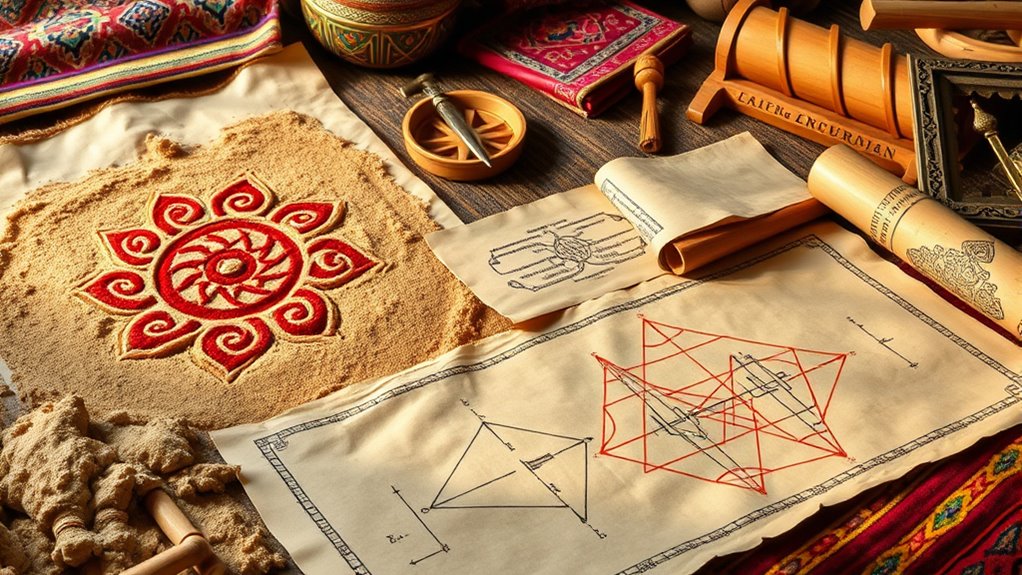
Have you ever wondered how different cultures approach teaching geometry? Throughout history, civilizations have used a variety of techniques, from simple drawings to complex texts, to pass on geometric knowledge. Ancient methods often relied on practical, hands-on activities that reflected their daily lives and cultural expressions. For example, in ancient Egypt, artisans and builders used sand drawings and rudimentary tools to understand basic geometric principles. They would draw lines and shapes in the sand to plan out constructions like pyramids and temples. These early practices weren’t just about creating; they served as a form of cultural expression, showcasing the Egyptians’ mastery of geometry through their art and architecture. Similarly, the Greeks formalized geometry as a mathematical discipline, but even their teachings were rooted in cultural expressions. They used geometric figures to decorate pottery, design intricate mosaics, and build monumental structures, embedding geometric concepts into their cultural artifacts. The Greeks also developed logical proofs and systematic approaches, which became foundational for Western geometry, but these methods still drew heavily on their cultural context of beauty, symmetry, and order.
In many indigenous societies, geometry was woven into their cultural expressions in unique ways. For example, Native American tribes incorporated geometric patterns into their textiles, beadwork, and pottery, each pattern carrying symbolic meanings and stories. Teaching geometry in these cultures often involved storytelling, dance, and craftwork, making the lessons deeply personal and culturally relevant. These methods emphasized communal participation and oral transmission, ensuring that geometric knowledge was preserved through generations. This approach contrasted with the more formalized, text-based methods seen in ancient Greece or China, highlighting how cultural values shape educational practices.
In ancient China, geometry was taught through practical applications like land surveying, architecture, and astronomy. The Chinese used diagrams, mathematical texts, and hands-on activities to teach geometric concepts, often integrating them into broader philosophical and cultural ideas. Their artistic expressions, such as intricate jade carvings and landscape paintings, also reflected geometric principles, reinforcing the importance of harmony and balance. These cultural expressions became part of their educational tradition, blending practical skills with aesthetic values. Overall, each culture’s approach to teaching geometry reveals how deeply intertwined mathematical knowledge is with cultural identity and expression. Whether through sand drawings, art, storytelling, or textbooks, every civilization found its unique way to pass on the beauty and utility of geometry, shaping not just their buildings but also their cultural legacy.
As an affiliate, we earn on qualifying purchases.
Frequently Asked Questions
How Did Ancient Cultures Discover Geometric Principles Independently?
You see, ancient cultures discovered geometric principles independently through everyday activities like land division, architecture, and crafting. These practical needs led them to recognize patterns, angles, and shapes naturally. Cultural influences shaped their approaches—Egyptians used sand drawings, Babylonians relied on clay tablets, and Greeks developed formal proofs. Their discoveries emerged from observing nature, solving problems, and adapting techniques, showing that geometry’s roots are deeply embedded in human experience across different societies.
Were There Any Cultural Taboos Related to Teaching Geometry?
You’ll find that some cultures had cultural restrictions around teaching geometry, especially when it involved sacred geometries. These sacred symbols were considered deeply spiritual, so sharing or teaching them outside specific rituals or contexts was often taboo. In many societies, geometry was intertwined with religious beliefs, and revealing certain teachings could be seen as disrespectful or dangerous. Respecting these cultural restrictions helped preserve the sacred nature of their geometric knowledge.
How Did Non-Literate Societies Pass on Geometric Knowledge?
You learn that non-literate societies passed on geometric knowledge mainly through oral transmission and symbolic representations. They used storytelling, demonstrations, and practical activities like weaving or building to teach concepts. Symbols, drawings, or gestures often conveyed geometric ideas, making it easier to remember and share knowledge without written texts. This hands-on approach guaranteed that essential geometric principles persisted across generations, even without a written language.
Did Religious Beliefs Influence the Teaching of Geometry?
Imagine sacred geometry as a divine blueprint etched into your mind, guiding teachings with religious symbolism. You see, religious beliefs deeply influenced how geometry was shared, transforming it into sacred knowledge. Temples and scriptures often embedded geometric patterns, blending faith with math. This sacred geometry became more than just shapes; it was a spiritual language, shaping how societies understood the universe and passed down their divine insights through generations.
How Did Technological Advancements Change Geometry Education Across Cultures?
Technological advancements revolutionized geometry education by enabling you to explore mathematical innovations more easily. Tools like the abacus, printing press, and later computers allowed for precise calculations and widespread sharing of geometric ideas. Cultural exchanges accelerated this progress, as ideas spread across regions, enriching teaching methods. You now benefit from diverse approaches that blend traditional knowledge with modern technology, making geometry more accessible and engaging across different cultures.
As an affiliate, we earn on qualifying purchases.
Conclusion
As you reflect on these diverse methods, you realize that geometry isn’t just about shapes or formulas—it’s a window into history, culture, and human ingenuity. Imagine what other secrets these ancient techniques might still hold, waiting quietly beneath the surface. Who knows what groundbreaking ideas could emerge if we explore more deeply into these traditions? The journey into geometry’s rich tapestry is far from over, and the next discovery could change everything you thought you knew.
geometric pattern craft supplies
As an affiliate, we earn on qualifying purchases.
As an affiliate, we earn on qualifying purchases.
land surveying tools for beginners
As an affiliate, we earn on qualifying purchases.
As an affiliate, we earn on qualifying purchases.
Columbus Day / Indigenous Peoples' Day Picks
long weekend sales
As an affiliate, we earn on qualifying purchases.





![Terence Tao: Math 2.0 [Pdf]](https://geometr.info/wp-content/uploads/2026/10/terence-tao-math-2-0-pdf-featured-260x140.jpg)
