Recent breakthroughs in non-Euclidean geometry, especially hyperbolic spaces, challenge your understanding of shape and distance. These advances show how curved spaces behave differently from flat ones, with parallel lines diverging and triangles having less than 180 degrees. Exploring the role of the metric tensor helps you see how space bends and warps. If you keep exploring, you’ll uncover even more fascinating insights into the universe’s true complexity.

Prime made for students and young adults
- Fast, free delivery for dorm and study essentials
- Prime Video and Amazon Music included
- Member-only deals
Key Takeaways
- Recent studies reveal advanced models of hyperbolic spaces, challenging traditional Euclidean assumptions.
- New metrics tensor formulations enable precise analysis of curvature and geodesics in non-Euclidean geometries.
- Breakthroughs in visualization techniques improve understanding of complex curved spaces and their properties.
- Research links hyperbolic geometry to practical applications in physics, such as spacetime modeling in general relativity.
- Innovative mathematical frameworks expand theoretical knowledge of non-Euclidean structures, influencing cosmology and geometric topology.
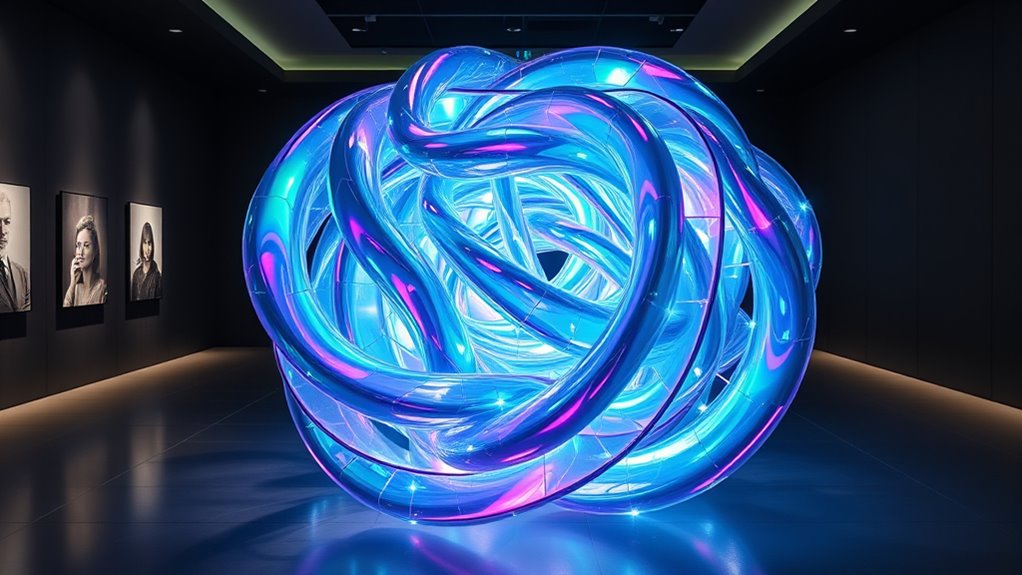
Recent breakthroughs in the study of non-Euclidean spaces are reshaping our understanding of geometry beyond traditional concepts. These advances, especially in hyperbolic geometry, challenge the familiar notions of flat space by exploring curved structures that defy Euclidean intuition. Instead of parallel lines remaining equidistant, as in classic geometry, hyperbolic spaces allow them to diverge, creating a universe of possibilities where the rules of shape and distance differ dramatically from what you might expect.
Hyperbolic geometry reveals how curved spaces defy Euclidean intuition, where parallel lines diverge and shapes transform.
In hyperbolic geometry, the metric tensor plays a vital role. It serves as the mathematical tool that defines how distances and angles are measured within these curved spaces. By adjusting the components of this tensor, researchers can model how space itself bends and warps, enabling them to analyze properties like curvature and geodesics with precision. This tensor becomes the foundation for understanding how a hyperbolic plane behaves, how triangles have angle sums less than 180 degrees, and how lines extend infinitely without ever intersecting, regardless of how far they are extended.
You might not realize it, but these concepts have real-world implications. For example, in the domain of physics, the metric tensor helps describe the fabric of spacetime in Einstein’s theory of general relativity. It tells you how gravity influences the shape of the universe, guiding the paths of planets, light, and even black holes. In mathematics, these insights open new pathways for understanding complex structures, such as tessellations and fractals, which often exhibit hyperbolic properties.
Furthermore, recent research dives into how the metric tensor can be manipulated to better understand non-Euclidean models, leading to potential breakthroughs in visualization and simulation. These studies reveal how space can be intrinsically non-flat, and how different models can be constructed to better grasp the geometry of the universe. You can think of it as a way to map the unknown territories of curved space, providing tools to navigate and comprehend worlds that challenge our Euclidean instincts. Additionally, the study of the metric tensor enhances our ability to develop more accurate visualization techniques, which are crucial for both scientific and educational purposes.
In essence, the ongoing exploration of hyperbolic geometry and the metric tensor helps you grasp the universe’s true complexity. It pushes beyond the limitations of flat geometry, offering a richer, more accurate picture of how space and distance work in non-Euclidean domains. These insights are not only expanding theoretical mathematics but also influencing physics, cosmology, and even computer graphics, where understanding curved spaces leads to more realistic simulations and models.
hyperbolic geometry visualization kit
As an affiliate, we earn on qualifying purchases.
As an affiliate, we earn on qualifying purchases.
Frequently Asked Questions
How Do Non-Euclidean Geometries Impact Modern Physics Theories?
You see, non-Euclidean geometries fundamentally change how you understand space and time. They explain phenomena like space-time distortion caused by massive objects and gravitational lensing, where light bends around stars and black holes. These geometries allow modern physics theories, such as General Relativity, to accurately describe gravity’s effects. By embracing these concepts, you gain a deeper insight into the universe’s structure, revealing how gravity shapes space and time itself.
What Are Practical Applications of Non-Euclidean Spaces in Technology?
You can see non-Euclidean spaces in technology through virtual reality, where they create more immersive environments by simulating curved spaces. Navigation algorithms also rely on these geometries to optimize routes in complex terrains or networks, making travel more efficient. By understanding non-Euclidean principles, you enhance user experiences and improve system performance, demonstrating how these advanced geometries have practical, real-world applications in modern tech.
How Does Curvature Influence the Properties of Space in Non-Euclidean Models?
You might wonder how curvature effects influence space properties in non-euclidean models. Curvature alters how distances and angles behave, impacting the geometry’s fundamental structure. Positive curvature, like in spherical spaces, causes lines to eventually converge, while negative curvature, found in hyperbolic spaces, makes lines diverge. These space property changes enable advanced applications in navigation, physics, and computer graphics, where understanding curvature effects helps model complex, realistic environments more accurately.
Are There Any Visual Tools to Better Understand Non-Euclidean Geometries?
Ever wonder if you could see the unseen? Visualization tools like interactive geometric models and computer simulations help you grasp non-Euclidean geometries. These tools act as windows, revealing curved spaces and warped angles that are hard to picture. By exploring these models, you turn abstract concepts into tangible visuals, making complex ideas more accessible. They’re your bridge to understanding the fascinating, curved universe beyond traditional Euclidean geometry.
What Challenges Exist in Teaching Non-Euclidean Concepts to Students?
When teaching non-Euclidean concepts, you face challenges like overcoming conceptual misconceptions students often have about space and geometry. You need effective instructional strategies, such as visual tools and interactive models, to clarify these complex ideas. Students might struggle to grasp curved spaces or alternative geometries, so your role is to simplify explanations and use hands-on activities, helping them develop accurate mental models and deepen their understanding of these advanced mathematical concepts.
non-Euclidean geometry educational model
As an affiliate, we earn on qualifying purchases.
As an affiliate, we earn on qualifying purchases.
Conclusion
You now see how groundbreaking these insights into non-Euclidean spaces truly are. This research isn’t just a step forward—it’s like opening the universe’s deepest secrets! As you explore deeper, you’ll realize that understanding these complex geometries could revolutionize everything from technology to our grasp of reality itself. Keep exploring, because this field is evolving faster than you can imagine, and the possibilities are infinite. The future of math and science hinges on these incredible discoveries!
spacetime modeling simulation software
As an affiliate, we earn on qualifying purchases.
As an affiliate, we earn on qualifying purchases.
mathematical tensor visualization tools
As an affiliate, we earn on qualifying purchases.
As an affiliate, we earn on qualifying purchases.
Fall Picks
fall essentials
As an affiliate, we earn on qualifying purchases.