

Symmetry breaking is how patterns in physics form from uniform states. When a system undergoes a phase transition—like cooling a liquid into a crystal or the early universe’s evolution—symmetry dissolves, and new, organized structures emerge. This process explains how simple laws lead to complex patterns, from atoms to galaxies. If you explore further, you’ll discover how symmetry breaking shapes the universe and creates the fascinating structures around you.
Key Takeaways
- Symmetry breaking occurs during phase transitions, leading to the emergence of organized patterns from initially uniform states.
- It explains how complex structures like crystals and fundamental particles form through spontaneous order.
- When symmetry dissolves, systems settle into lower-energy, less symmetric configurations, creating stable patterns.
- Symmetry breaking is essential to understanding the universe’s evolution, from early cosmology to condensed matter phenomena.
- Patterns in physics arise naturally as systems reorganize during symmetry breaking, balancing chaos and order.

Have you ever noticed how nature and the universe seem to follow repeating themes and structures? It’s as if there’s an underlying blueprint guiding everything from the tiniest particles to the vast cosmos. One fascinating aspect of this order is how patterns emerge through what physicists call symmetry breaking. At the heart of this process are phase transitions, where a system shifts from one state to another, often leading to the spontaneous formation of new, organized structures. These transitions aren’t just about changes in temperature or pressure—they’re about the fundamental ways in which order can arise out of chaos.
Think of a phase transition as a pivotal moment when a system’s symmetry dissolves, giving way to a new, less symmetric state. Before this shift, the system might look uniform and balanced, displaying a high degree of symmetry. But as conditions change—say, cooling a liquid into a solid—this symmetry breaks. The molecules settle into a crystal lattice, creating a regular pattern that wasn’t apparent before. This spontaneous order isn’t imposed from outside; instead, it emerges naturally as the system seeks its lowest energy configuration. It’s a perfect example of how complex patterns can arise without direct external design.
A phase transition is when symmetry dissolves, leading to spontaneous, ordered patterns like crystal structures from uniform states.
This process of symmetry breaking is fundamental across many areas of physics. In the early universe, for example, as it cooled after the Big Bang, symmetry breaking led to the formation of fundamental particles and forces. Similarly, in condensed matter physics, phase transitions result in phenomena like superconductivity and magnetism. Each of these instances showcases how spontaneous order emerges from the collective behavior of particles, driven by phase transitions. It’s as if the universe has an innate tendency to organize itself, creating intricate patterns from seemingly random initial conditions.
You can think of these patterns as nature’s way of balancing chaos and order. When conditions change, systems don’t just shift randomly—they reorganize into more stable, often more beautiful configurations. This ongoing dance of symmetry and its dissolution underpins much of what we observe in the physical world. It reveals that complexity and order aren’t separate; instead, they’re interconnected through the process of phase transitions. As you observe the universe, remember that these patterns are born from the spontaneous order that arises whenever fundamental symmetries are broken. They tell a story of how fundamental symmetries can give rise to the rich diversity we see today, shaping the universe in ways both subtle and profound.

Wooden Geoboard, Montessori STEM Toy with Pattern Blocks for Kids Ages 3+
- Complete Creative Play Set: Includes nails, pattern cards, and rubber bands
- Portable Educational Toy: Compact size for easy transport and use
- Enhances Learning Skills: Teaches shapes, fractions, and motor skills
As an affiliate, we earn on qualifying purchases.
Frequently Asked Questions
How Does Symmetry Breaking Relate to the Universe’s Evolution?
You might wonder how symmetry breaking relates to the universe’s evolution. During phase transitions in the early universe, symmetries break, leading to different forces and particles forming. These moments of symmetry breaking shape the universe’s structure, creating patterns like galaxies and cosmic filaments. Fundamentally, you can see symmetry breaking as the process that drives the universe’s complexity, transforming a uniform early cosmos into the diverse universe we observe today.
Can Symmetry Breaking Occur at the Quantum Level?
Did you know that symmetry breaking can occur at the quantum level? You see, quantum fluctuations, tiny energy changes in empty space, can trigger symmetry breaking. This process is essential in the Higgs mechanism, which gives particles mass. So, yes, symmetry breaking happens at the quantum scale, shaping the fundamental forces and particles you see in the universe. It’s a fascinating dance of tiny fluctuations creating cosmic patterns.
What Are Real-World Applications of Symmetry Breaking?
You might wonder about real-world applications of symmetry breaking. It plays a key role in phase transitions, where materials change states, like from liquid to solid. Symmetry breaking also causes structural distortions in crystals, influencing their properties. These phenomena are vital in creating superconductors, magnetic materials, and even in understanding the early universe’s evolution. Recognizing how symmetry breaking impacts these areas helps improve technology and deepen scientific understanding.
How Is Symmetry Breaking Detected Experimentally?
Imagine observing a crystal’s delicate pattern forming as it cools. You detect symmetry breaking by measuring phase shifts and tracking order parameters, which reveal changes in symmetry. Techniques like spectroscopy, diffraction, or microscopy help you see these shifts directly, highlighting the emergence of new patterns. These experiments show how the system’s symmetry breaks, allowing you to identify the transition points and understand the underlying physics.
Are There Theories Predicting New Types of Symmetry Breaking?
You might ask if theories predict new types of symmetry breaking beyond known phase transitions and the Higgs mechanism. Researchers explore extensions like supersymmetry, extra dimensions, and quantum phase transitions, which could reveal novel symmetry-breaking phenomena. These theories aim to unify forces or explain dark matter, offering exciting possibilities. Experimental detection is challenging, but advances in particle colliders and condensed matter systems could eventually uncover these new symmetry-disruption processes.
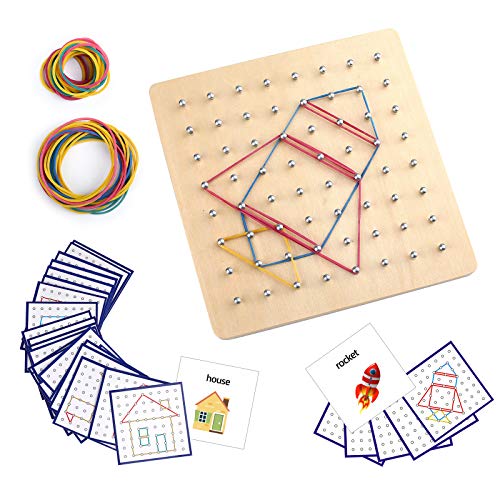
Thoth Montessori Wooden Geoboard Mathematical Manipulative Material Array Block Geo board with 36Pcs Pattern Cards and Rubber Bands Matrix 8x8 for Kids Graphical Educational Toys Early Development Toy
- Educational Shape and Fraction Learning: Teaches 2D shapes and fractions
- Durable Wooden Construction: Made of sturdy, safe wood
- High-Elasticity Rubber Bands: Rubber bands won’t break easily
As an affiliate, we earn on qualifying purchases.
Conclusion
As you explore the world of symmetry breaking, you realize how unexpectedly, these patterns mirror life’s own surprises. Just as a small change can create intricate designs in physics, your own moments of imbalance often lead to growth and new perspectives. It’s fascinating how coincidence plays a role—how nature’s subtle shifts birth complexity from simplicity. In the end, understanding these patterns reminds you that even chaos can carry the seed of beauty and order.
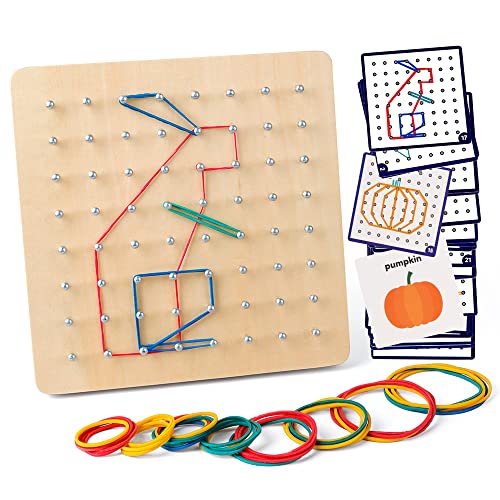
Coogam Wooden Geoboard Mathematical Manipulative Material Array Block Geo Board – Graphical Educational Toys with 30Pcs Pattern Cards and Latex Bands Shape STEM Puzzle Matrix 8x8 Brain Teaser for Kid
- Wooden Geoboard Dimensions: 7 x 7 x 0.9 inches
- Includes 64 Nails and 35 Pattern Cards: Pattern cards and nails included
- Educational STEM Toy: Teaches shapes, fractions, and motor skills
As an affiliate, we earn on qualifying purchases.

Premium Montessori Geometry Sticks Set 7lbs 23in– Wooden Construction Kit with Cork Workboard, Color-Coded Rods Metal Connectors, Hands-On 2D Shape Building Spatial Reasoning, STEM Homeschool Kids 3-6
- Complete 120+ Piece Kit: Includes rods, connectors, and cork board
- Real Architect Design: Build shapes on cork workboard
- Sensory Learning Experience: Connect rods to explore geometry
As an affiliate, we earn on qualifying purchases.