
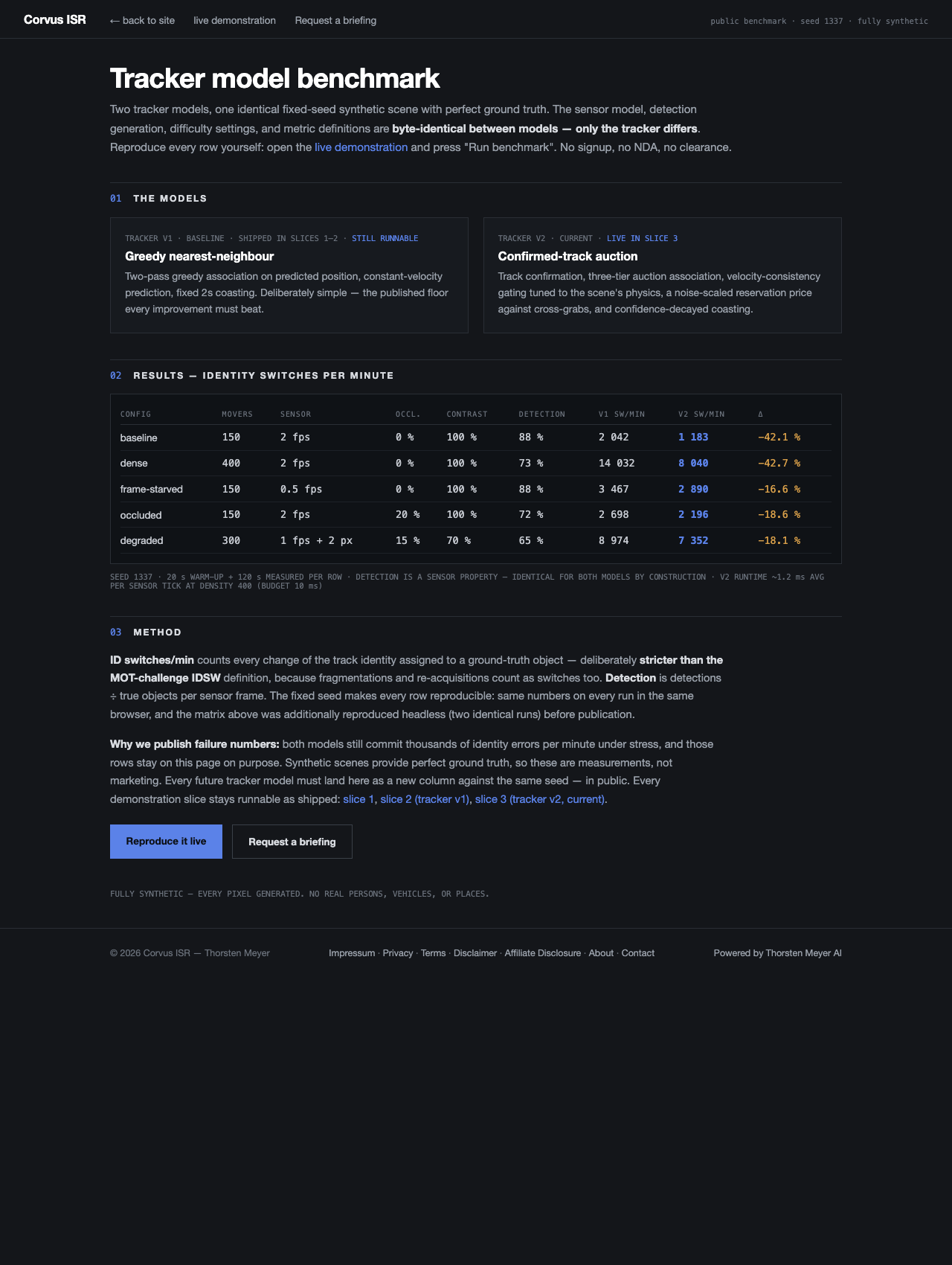
Corvus ISR, known for its wide-area motion imagery (WAMI) exploitation products, has released a public benchmark comparing two tracking models. This benchmark employs a fixed-seed synthetic scene with perfect ground truth, ensuring an exact and controlled environment for evaluation. By fixing the seed (seed 1337), the benchmark guarantees that every run is identical, allowing for precise comparisons across different tracker configurations.

Prime made for students and young adults
- Fast, free delivery for dorm and study essentials
- Prime Video and Amazon Music included
- Member-only deals
The benchmark pits the v1 “greedy nearest-neighbour” model—an intentionally simple baseline—against the newer v2 “confirmed-track auction” model. The v1 model utilizes a two-pass greedy association with constant velocity prediction and a fixed 2-second coasting period. In contrast, v2 incorporates a three-tier auction association, velocity-consistency gating, noise-scaled reservation prices, and confidence-decayed coasting, representing a significant evolution in tracking methodology.
Results show notable improvements with v2: in the baseline scenario with 150 movers at 2fps, ID switches per minute dropped from 2,042 to 1,183, a 42.1% reduction. Under dense conditions with 400 movers, ID switches decreased from 14,032 to 8,040, a 42.7% improvement. Even in degraded conditions with 1 fps plus jitter and 20% occlusion, the ID switch count still fell by approximately 18%, highlighting the robustness of the newer model.
Why publish failure numbers? Both models still generate thousands of identity errors per minute under stress, but these published failure metrics are essential for transparency. Synthetic scenes provide perfect ground truth, making these numbers valuable measurements rather than marketing claims. Every future tracker must produce comparable results against the same seed, fostering honest benchmarking. As the saying goes, “vendors who show only successes ask for faith; a published failure matrix asks for measurement.”
From an engineering perspective, v2 achieves an average processing time of around 1.2ms per sensor tick at 400 density, with the worst case around 5ms—well within real-time constraints. Anyone interested can reproduce these results by visiting the live demo and clicking “Run benchmark,” with no registration or NDA required.
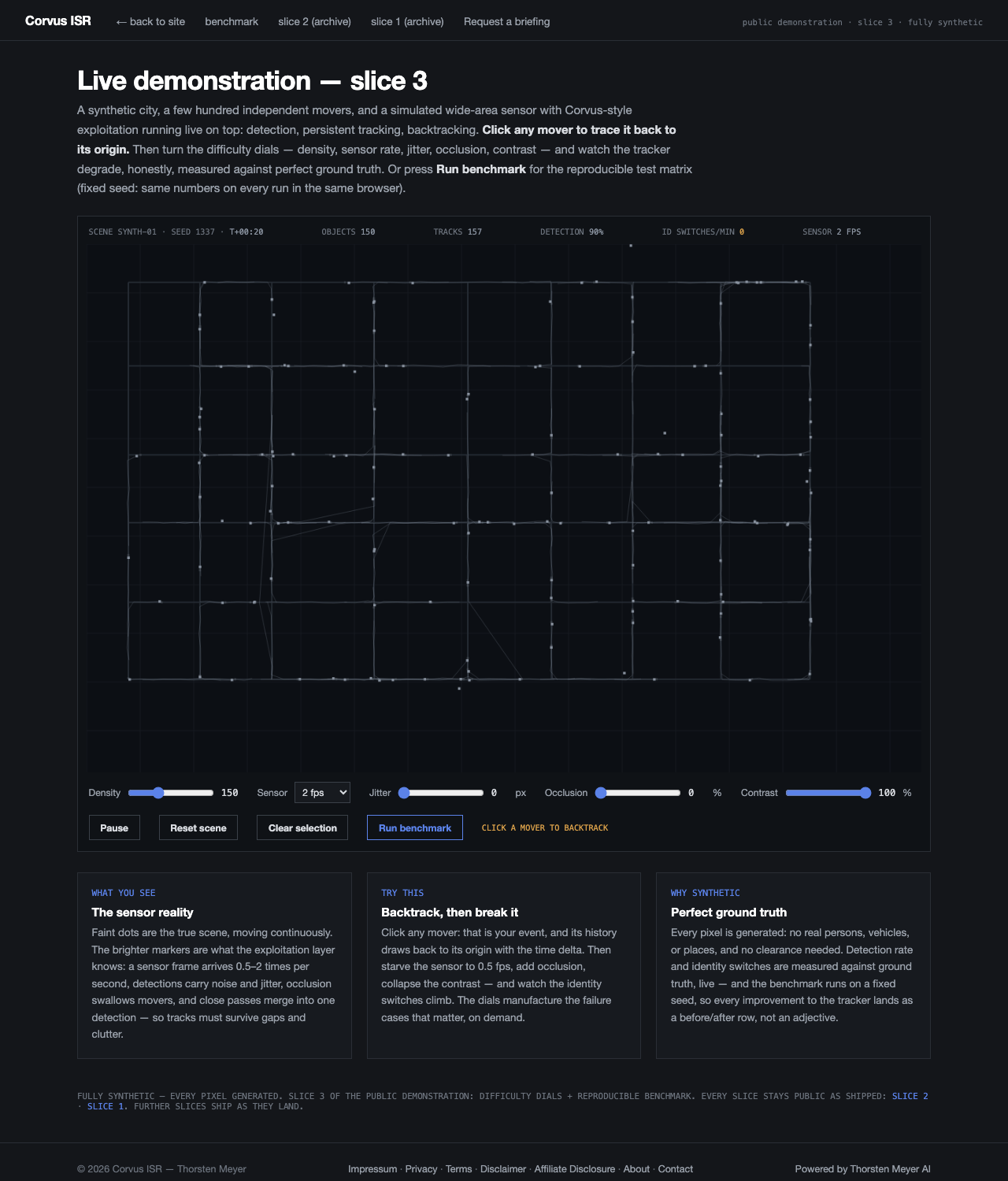
This fully synthetic setup ensures that no real persons, vehicles, or locations are involved; every pixel is artificially generated. The methodology emphasizes the importance of controlled environments and transparent data, especially when evaluating complex tracking systems. By publishing failure numbers alongside successes, Corvus ISR sets a standard for honest, science-based benchmarking in the field.
We invite readers to explore the benchmark themselves and see how their own tracker models measure up against this rigorous synthetic test. Feel free to view the public benchmark and reproduce it live to experience the process firsthand.
real-time object tracking software
As an affiliate, we earn on qualifying purchases.
As an affiliate, we earn on qualifying purchases.
synthetic benchmark testing tools
As an affiliate, we earn on qualifying purchases.
As an affiliate, we earn on qualifying purchases.
As an affiliate, we earn on qualifying purchases.
As an affiliate, we earn on qualifying purchases.
Halloween Picks
halloween
As an affiliate, we earn on qualifying purchases.