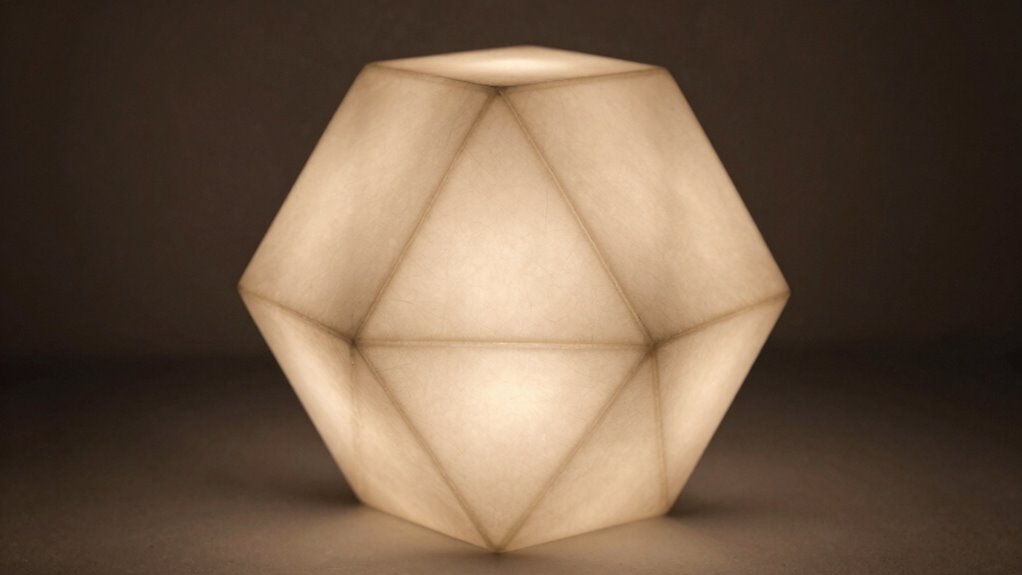

Euler’s Polyhedron Formula shows how vertices, edges, and faces are interconnected in 3D shapes, regardless of their complexity. It reveals the consistent pattern V – E + F = 2, which acts as a topological fingerprint. This helps you understand shape structure, connection, and classification. If you explore further, you’ll discover how this simple rule underpins the logic behind many complex geometries and topologies.
Key Takeaways
- Euler’s formula reveals consistent topological relationships between vertices, edges, and faces in 3D shapes.
- It helps analyze the connectivity and structural integrity of polyhedral shapes.
- The formula highlights invariants that remain unchanged under shape deformation, emphasizing topological properties.
- It extends beyond convex shapes, applying to complex and non-convex structures like toroids.
- Euler’s formula bridges geometric intuition and topological understanding of 3D object structure.
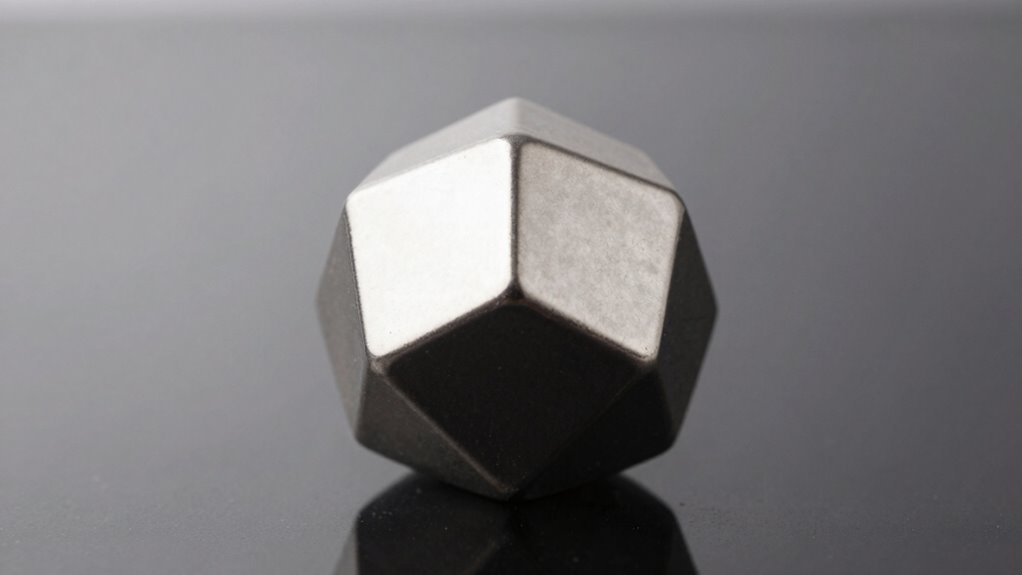
Euler’s Polyhedron Formula is a fundamental principle that helps us understand the relationship between the number of faces, vertices, and edges in many three-dimensional shapes. When you look at polyhedra, this formula—V – E + F = 2—acts as a guiding rule that reveals consistent patterns, regardless of how complex the shape appears. It’s more than just a mathematical curiosity; it’s a window into the underlying structure of 3D objects and their topological nature. By applying this formula, you gain insights into the geometric invariants that define these shapes, which remain unchanged even when the shape is deformed without tearing or gluing. These invariants serve as the shape’s topological fingerprints, helping you distinguish between different classes of polyhedra and understand their fundamental properties.
Understanding what Euler’s formula tells you about 3D shape logic goes beyond simple counting. It provides a framework for analyzing how shapes are connected and how their components relate to each other. For instance, if you know the number of faces and vertices, you can determine the number of edges, and vice versa. This interconnectedness hints at the logical rules that govern shape construction, giving you a deeper appreciation of the balance and harmony inherent in polyhedral structures. Topological insights emerge from this, showing that many seemingly complex shapes follow these simple yet powerful relationships. These insights are strengthened when you consider the topological invariants, which remain consistent under continuous deformations. Recognizing these invariants allows for a deeper understanding of the topological properties that define these shapes, emphasizing the importance of topological classification in shape analysis. These insights help you see beyond surface differences and understand the core logic that unites different forms under a common mathematical umbrella.
The beauty of Euler’s formula lies in its universality. It applies to convex polyhedra, but also extends, with some adjustments, to certain non-convex and even more complex shapes like toroids. This adaptability reveals the robustness of the topological principles underlying shape theory. When you explore these shapes, you realize that their fundamental properties—those that don’t depend on specific measurements—are governed by simple invariants. Recognizing these invariants allows you to classify shapes, predict their behavior, and even design new structures with desired properties. Ultimately, Euler’s Polyhedron Formula acts as a bridge between geometric intuition and topological understanding, deepening your grasp of the logic that shapes our three-dimensional world.

KiBcsLic 8 Pieces Transparent Geometric Solids Visual Demonstration Tool Transparent Geometry Models Foldable 3D Shapes Kit for Primary School Students
- Complete Geometric Shapes Set: Includes cube, cylinder, cone, pyramids
- Educational Classroom Tool: Ideal for elementary and middle school students
- Visual Learning Aid: Removable colorful inserts show surface area
As an affiliate, we earn on qualifying purchases.
As an affiliate, we earn on qualifying purchases.
Frequently Asked Questions
How Does Euler’s Formula Apply to Irregular Polyhedra?
Euler’s formula can be applied to irregular polyhedra, but with some adjustments for shape complexity. You need to account for additional faces, edges, or vertices that irregularities introduce. When analyzing these shapes, Euler’s formula helps verify if the structure is mathematically consistent or highlights unusual features. It’s a useful tool, but irregular polyhedra often require more detailed calculations to understand their geometric properties fully.
Can Euler’s Formula Be Extended to Non-Polyhedral 3D Shapes?
You can extend Euler’s formula to non-polyhedral shapes by considering their topological invariants, like genus or Euler characteristic. While the classic formula (V – E + F = 2) applies directly to convex polyhedra, topological approaches help analyze more complex, non-polyhedral 3D shapes. These invariants allow you to understand how shapes deform or connect without relying solely on faces, edges, and vertices.
What Are Common Errors When Applying Euler’s Formula?
You might mistakenly assume Euler’s assumptions always hold, but the formula has limitations. It applies mainly to convex polyhedra, so using it on non-convex or complex shapes can lead to errors. A common mistake is ignoring shape irregularities or topological complexities that break Euler’s assumptions. Remember, Euler’s formula works best within its constraints, so always check the shape’s properties before applying it to avoid incorrect conclusions.
How Does Topology Influence Euler’s Polyhedron Relationship?
Topology effects, especially shape connectivity, profoundly influence Euler’s polyhedron relationship. When the shape’s connectivity changes—like adding holes or handles—the basic formula adjusts, reflecting the shape’s complexity. You’ll notice that Euler’s formula still applies, but with modifications accounting for these topological features. By understanding how topology affects the structure, you can better analyze and predict the properties of complex polyhedra beyond simple convex shapes.
Are There Real-World Applications of Euler’s Formula in Design?
You can see Euler’s formula guiding real-world design, subtly shaping architectural innovation and 3D modeling. It helps you understand how the number of faces, edges, and vertices balance out, ensuring structures are both stable and efficient. Architects and designers use this principle to create complex shapes with integrity, optimizing materials and space. This elegant math underpins many innovative designs, making your creations more resilient and visually appealing.

Aenllosi Hard Case for DND Dice Set 70 Polyhedron DiceSmall
- Perfect Dice Storage: Custom cut holes prevent collision and noise
- High-Quality Material: Durable, dust-proof, scratch-proof EVA case
- Travel-Friendly Design: Lightweight, compact, fits in backpack or pocket
As an affiliate, we earn on qualifying purchases.
As an affiliate, we earn on qualifying purchases.
Conclusion
Think of Euler’s formula as a guiding star, illuminating the hidden harmony within every 3D shape. It’s like a secret code that reveals the balance between faces, edges, and vertices, much like a compass guiding a traveler through uncharted territory. When you see these shapes, remember they’re not just objects but stories woven together by underlying mathematical poetry. Embrace this understanding, and you’ll see the world’s geometry as a beautiful, interconnected dance.
4 Packs 100 Piece Puzzles for Kids Ages 4-6 6-8 8-10, USA World Map Kids Puzzles Ages 3-5 4-6 5-8, Solar System Mars Adventure 100 Piece Puzzle for Adults Seniors, Educational Jigsaw Puzzles 15"x10"
- Set Includes Four Themes: USA Map, World Map, Solar System, Mars Adventure
- 100 Pieces per Puzzle: Suitable for ages 4-10
- Perfect Puzzle Size: 10×15 inches / 26×38 cm
As an affiliate, we earn on qualifying purchases.
As an affiliate, we earn on qualifying purchases.
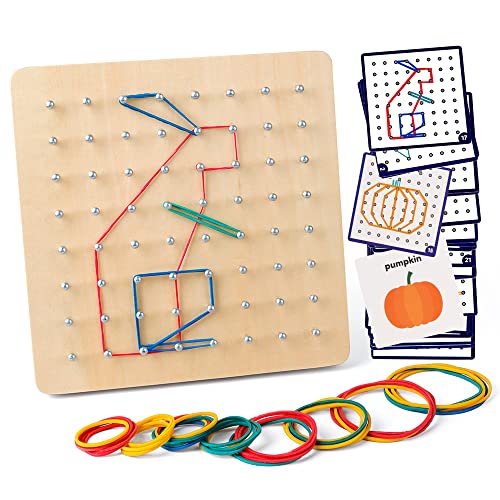
Coogam Wooden Geoboard Mathematical Manipulative Material Array Block Geo Board – Graphical Educational Toys with 30Pcs Pattern Cards and Latex Bands Shape STEM Puzzle Matrix 8×8 Brain Teaser for Kid
- Wooden Geoboard Dimensions: 7 x 7 x 0.9 inches
- Includes 64 Nails and 35 Pattern Cards: Pattern cards and nails included
- Educational STEM Toy: Teaches shapes, fractions, and motor skills
As an affiliate, we earn on qualifying purchases.
As an affiliate, we earn on qualifying purchases.