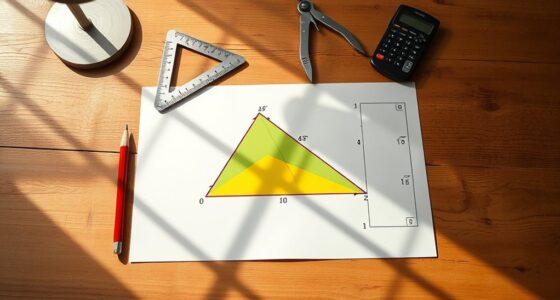
A theorem becomes worth remembering in geometry because it reveals key truths about shapes and figures that can be applied to solve real-world problems. It helps you understand how different properties are connected, guiding you in designing and constructing stable, beautiful structures. Timeless theorems like the Pythagorean theorem continue to influence technology and education today. Keep exploring, and you’ll discover how these important principles shape the world around you.
Key Takeaways
- It reveals fundamental truths that underpin broader geometric concepts and applications.
- Its simplicity and elegance make it easy to understand, remember, and apply.
- It has lasting practical relevance in real-world engineering, architecture, or design.
- It connects to historical and cultural milestones, enriching its significance.
- Its logical proof and universal applicability ensure it remains a foundational tool in learning.
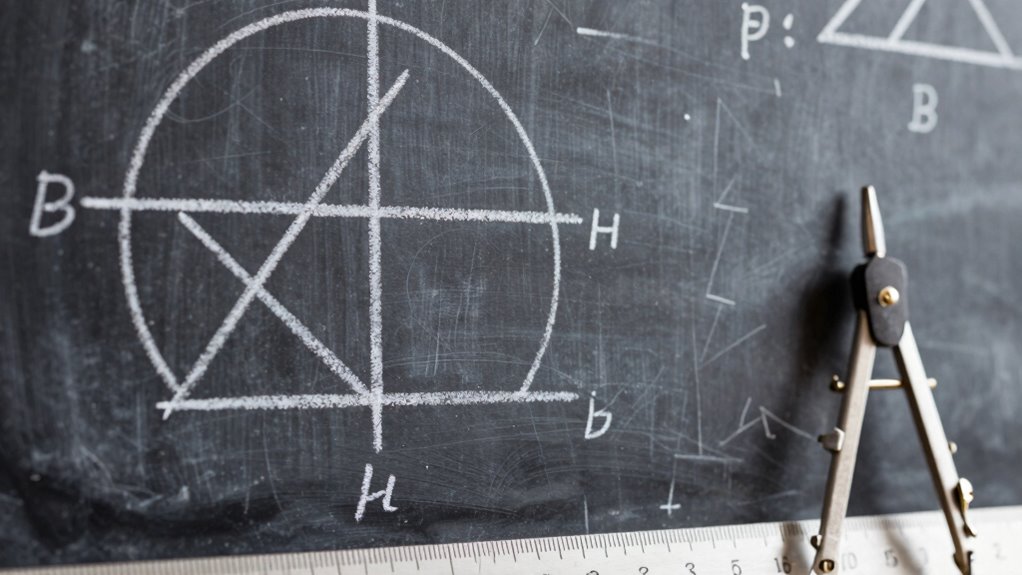
Have you ever wondered how mathematicians prove the relationships between different shapes and figures? It’s a fascinating process that underpins much of the structure and design we see around us. When a theorem in geometry is worth remembering, it’s often because it reveals fundamental truths that have practical applications and a rich historical background. These theorems serve as building blocks, allowing us to understand complex concepts by breaking them down into simpler, proven ideas.
Take, for example, the Pythagorean theorem. Its importance isn’t just in the mathematical sphere but also in real-world applications. Architects rely on it when designing buildings, ensuring walls are perpendicular or calculating the length of rafters. In historical development, this theorem marked a significant milestone, bridging the gap between ancient geometry and modern mathematics. Its simplicity and power have allowed it to stand the test of time, making it a cornerstone in both education and practical design. Because of its universal applicability, remembering the Pythagorean theorem isn’t just about solving a math problem—it’s about understanding a principle that shapes our physical environment.
Similarly, other theorems like the properties of similar triangles or the angles in a circle have enduring relevance. They help architects and engineers create structures that are both stable and aesthetically pleasing. These theorems also connect to the historical development of mathematics, showing how ancient civilizations like the Greeks and Babylonians contributed to our understanding of geometry. Recognizing this history deepens your appreciation for these theorems, transforming them from mere formulas into stories of human discovery and ingenuity. They remind you that geometry isn’t just theoretical; it’s a practical language that explains how the world is built. Additionally, understanding the practical applications of geometric theorems helps to appreciate how ancient insights continue to shape modern technology and design. Moreover, the logical foundation of geometric proofs forms the basis for deriving many other important mathematical results, emphasizing their significance.
A theorem’s worth remembering, therefore, hinges on its ability to unify theory with practice. When you see how an abstract idea can be applied to design, construction, or even art, it becomes more than just a lesson in geometry. It becomes a tool, a piece of a larger puzzle that helps you make sense of the world. The historical development of these ideas also adds a layer of richness, showing that the pursuit of understanding shapes and figures is a shared human endeavor across centuries. In this way, the evolution of geometric principles demonstrates the ongoing dialogue between mathematics and practical innovation.

Pythagorean Theorem Calculator
- User-friendly interface: Easy to use and navigate
- Ideal for homework: Perfect for educational purposes
- Simple design: Intuitive and straightforward
As an affiliate, we earn on qualifying purchases.
As an affiliate, we earn on qualifying purchases.
Frequently Asked Questions
How Do Mathematicians Choose Which Theorems to Prioritize Memorizing?
You prioritize memorizing theorems that are fundamental or frequently used, often aided by mnemonic devices to make recall easier. Teaching strategies also play a role; educators highlight theorems with broad applications or those that build on earlier concepts. By focusing on these, you guarantee your understanding is solid and your problem-solving skills improve. Mnemonic devices and effective teaching strategies help you retain essential theorems more efficiently.
Are There Historical Examples Where Forgotten Theorems Impacted Progress?
Yes, forgotten theorems have impacted progress. For example, historical breakthroughs often relied on discoveries that were later neglected, delaying advancements. When you overlook these forgotten discoveries, you risk missing vital insights that could lead to new solutions. Recognizing and revisiting such theorems can release valuable knowledge, helping you avoid repeating past mistakes and fostering innovative thinking. Remembering these forgotten gems keeps the progress of mathematics and science moving forward.
Can a Theorem’s Usefulness Change Over Time?
Yes, a theorem’s usefulness can change over time. Imagine a theorem once essential for ancient builders, now overshadowed by modern technology. Its historical relevance may fade, but its cultural significance endures, inspiring art and education. As new discoveries emerge, some theorems gain prominence, while others become historical footnotes. You see, a theorem’s value depends on current needs and perspectives, shaping how it influences math, science, and society over generations.
What Role Do Visual Proofs Play in Remembering Theorems?
Visual proofs enhance your visual memory and make theorems easier to recall. When you see a proof visualization, it creates a mental image that sticks with you, making complex ideas more intuitive. These visual representations help you understand the logic behind the theorem and strengthen your memory. By engaging your visual memory, visual proofs make theorems more memorable and accessible, ultimately deepening your understanding of geometry concepts.
How Does Understanding Proof Techniques Aid in Recalling Theorems?
Understanding proof techniques enhances your memorization strategies by making theorems more meaningful, which improves cognitive retention. When you grasp how a theorem is proven, you create mental connections that stick better, rather than just rote memorizing formulas. This active engagement helps you recall theorems more easily during tests or problem-solving. So, focusing on proof methods transforms passive memorization into a dynamic learning process that strengthens your overall understanding.

The Cartoon Guide to Geometry: A Humorous Mathematics Study Guide on Plane Geometry and Visual Proofs
As an affiliate, we earn on qualifying purchases.
As an affiliate, we earn on qualifying purchases.
Conclusion
Remember, a theorem becomes worth memorizing when it reveals a fundamental truth or simplifies complex problems. Did you know that Euclid’s Elements, which contains many classic theorems, has influenced mathematical thinking for over 2,000 years? That’s like having a timeless key to understanding shapes and space. So, keep exploring these theorems—they’re not just formulas, but powerful tools that unveil the beauty and logic of geometry. Your understanding of the world, and even history, depends on it.
As an affiliate, we earn on qualifying purchases.
As an affiliate, we earn on qualifying purchases.