
You instinctively find fractals familiar because they mimic patterns you see in nature, like tree branches, coastlines, or shells. Your brain recognizes these recurring motifs, even if the shapes look surreal. Fractals are built from simple rules, creating complex but natural-looking designs that feel connected to the world around you. This innate pattern recognition helps you feel comfortable with their strange appearances. Keep exploring, and you’ll discover why these unique patterns resonate so deeply.

Get school and study supplies delivered free — and shop member deals
- Fast, free delivery on millions of items
- Access to Prime Big Deal Days deals on October 6–7
- Prime Video, Amazon Music and more included
Key Takeaways
- Fractals mirror natural patterns like leaves and coastlines, creating a sense of familiarity despite their strange appearance.
- The brain instinctively recognizes recurring motifs and underlying structures common in natural growth processes.
- Simple mathematical rules generate fractals, making their complex forms feel rooted in natural, understandable principles.
- Symmetry and self-similarity in fractals evoke perceptions of order and stability, reinforcing their familiarity.
- Evolution has tuned human perception to identify and find comfort in repetitive, natural-like patterns.
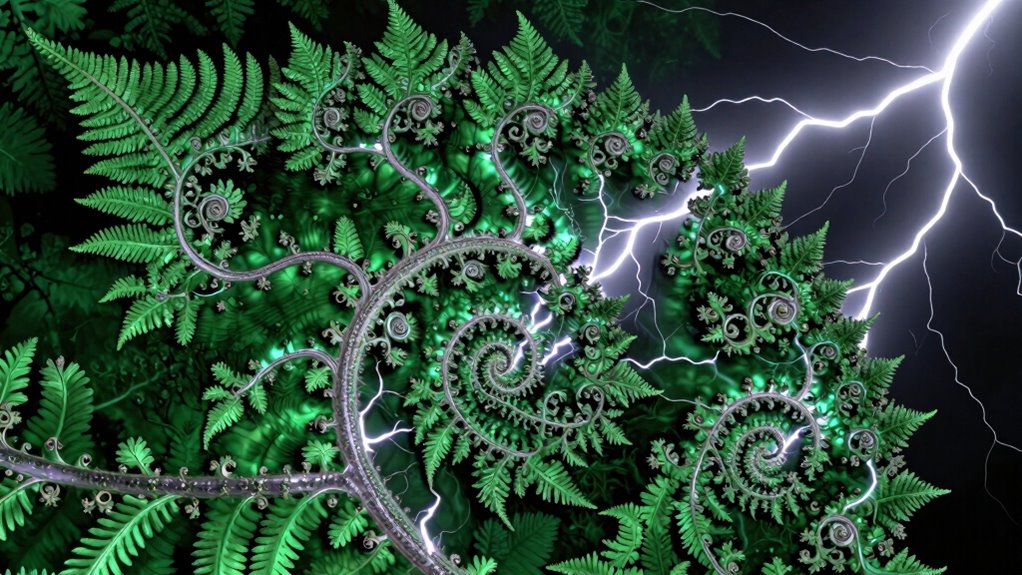
Even when fractals appear strange and otherworldly, they often feel surprisingly familiar to your eyes. That’s because fractals are, at their core, mathematical patterns that mirror structures you see all around you. These intricate designs, with their endless self-similarity, aren’t just abstract concepts—they echo the complexity of natural occurrences. Whether it’s the twisting branches of a tree, the veins on a leaf, or the jagged coastline of a country, fractals embody patterns that are embedded in nature’s very fabric. Your mind recognizes these recurring motifs because they’re rooted in the same principles that govern the world you experience daily.
When you look at a fractal, you might marvel at its apparent randomness or surreal shapes, but underneath, there’s a logic that your brain instinctively understands. The repeating patterns at different scales resemble the way natural forms grow and evolve. For example, the spiral shells of snails and the branching of lightning share fractal-like structures. These natural occurrences follow mathematical rules, making fractals a bridge between the abstract and the tangible. Your subconscious has evolved to find comfort in these patterns because they’re efficient, aesthetically pleasing, and often symmetrical—traits that signal stability and harmony in nature. This innate recognition of fractal patterns is part of what makes them so captivating, even when they seem unfamiliar or bizarre.
This familiarity isn’t just visual; it’s deeply rooted in how your brain processes information. Your eye is wired to recognize patterns quickly, and fractals fit into this pattern recognition system perfectly. When you see the recursive complexity of a fractal, your mind automatically associates it with similar patterns in nature, giving you a sense of connection and understanding despite the complexity. This is why even the most bizarre-looking fractals can evoke feelings of recognition—they tap into your innate ability to find order within chaos. Moreover, scientists continue to explore the mathematical rules behind fractals, revealing how simple formulas can generate such intricate designs, making their complexity even more fascinating.
Furthermore, fractals are often generated by simple mathematical rules, making their complexity all the more accessible to your mind. You don’t need to understand advanced calculus to appreciate their beauty; you just need to observe the repeating motifs. This simplicity in their creation contrasts sharply with the stunning complexity they exhibit, reinforcing the idea that nature’s complexity often arises from simple, elegant rules. So, whether it’s a fern’s fronds or a mountain’s ridges, the patterns you see in nature are fractal-like, reinforcing why these shapes feel so familiar—even when they look strange at first glance. Understanding fractals reveals how deeply interconnected natural patterns are with mathematical principles.
As an affiliate, we earn on qualifying purchases.
Frequently Asked Questions
How Do Fractals Relate to Natural Patterns in the Environment?
You notice that fractals relate to natural patterns through their mathematical complexity and visual symmetry. In nature, structures like coastlines, mountain ranges, and leaves exhibit fractal-like qualities, repeating similar patterns at different scales. This connection makes fractals feel familiar because your brain recognizes these self-similar patterns, which are deeply embedded in natural environments. Their intricate yet consistent design creates a sense of harmony and familiarity.
Can Fractals Be Used in Modern Technology Applications?
Yes, fractals are widely used in modern technology applications. You can see their influence in algorithmic beauty, where they help create visually stunning graphics and art. They also play a vital role in computational modeling, enabling you to simulate complex natural phenomena like coastlines, clouds, and biological structures. By harnessing fractals, you enhance the efficiency and realism of various systems, making them invaluable in fields like computer graphics, data compression, and environmental modeling.
Why Do Fractals Often Appear in Art and Architecture?
You notice fractals often appear in art and architecture because they embody mathematical beauty that resonates with your sense of harmony and order. Artists and architects use fractals for artistic inspiration, creating designs that feel both intricate and natural. Their repeating patterns evoke familiarity and aesthetic appeal, making structures and artworks more engaging. Fractals connect science and art, offering a visual language that captures complex beauty in simple, recursive forms.
Are There Psychological Reasons for Feeling Comforted by Fractals?
You might find yourself drawn to fractals because they offer a subtle sense of visual comfort, rooted in cognitive familiarity. Your brain naturally recognizes the repeating patterns, creating a soothing effect without you consciously realizing it. This subconscious connection makes fractals feel oddly reassuring, even when their intricate shapes seem strange. It’s like your mind appreciates the harmony and order in these complex designs, providing a calming, familiar experience amid chaos.
How Do Fractals Influence Our Understanding of Chaos and Order?
Fractals influence your understanding of chaos and order by showcasing mathematical complexity within visual symmetry. You see repetitive patterns that seem random but follow underlying rules, revealing how chaos can have structure. This interplay helps you grasp that apparent disorder often contains hidden order. As you observe fractals, you realize that complexity and simplicity coexist, deepening your appreciation for how natural and mathematical systems mirror each other through intricate patterns.
As an affiliate, we earn on qualifying purchases.
Conclusion
You might find yourself drawn to fractals because your brain recognizes their patterns, even if they look strange. Notably, studies show that around 70% of people report feeling a sense of comfort or familiarity when viewing fractals, thanks to their self-similarity. This connection explains why these complex shapes evoke such a visceral response—your mind instinctively finds order in chaos. So, next time you marvel at a fractal, remember, it’s your brain’s way of feeling at home in the universe’s intricate design.
As an affiliate, we earn on qualifying purchases.
As an affiliate, we earn on qualifying purchases.
Halloween Picks
halloween
As an affiliate, we earn on qualifying purchases.